
Summing and Difference Amplifiers
Introduction: This article focuses on summing and difference amplifiers and how to analyze them in a circuit.
The Essentials
When it comes to the summing amplifiers, the output voltage of the amplifier is a scaled, inverted sum of all input voltages. Figure 1. contains an example of a summing amplifier.

Figure 1: Summing Amplifier Circuit
When it comes to finding \( V_O \), the following equation will be helpful.
Now for a difference amplifier. The output of the amplifier is proportional to the difference between two input voltages. The textbook contains information on how the output voltage is proportional to the difference between a scaled replica of \( v_b \) and a scaled replica of \( v_a \). The scaling factor of each input can be made equal by setting the ratios of resistances equal to each other like so
\[ \frac{R_a}{R_b} = \frac{R_c}{R_d}\]
If this is satisfied, we get the following:
Figure 2. contains an image of a difference amplifier.

Figure 2: Difference Amplifier Circuit
Summing amplifiers are used in real life such as audio mixers and digital to analog converters. Difference amplifiers are used in noise cancellation and the control of motors and servos.
Example
Let's do a couple of quick examples of both summing and difference amplifiers. Figure 3. contains an example of a summing amplifier where we are curious to know about \( V_O \).

Figure 3: Summing Amplifier Example
We recognize this is a summing amplifier by the multiple voltage and resistor values all leading to the inverting input on the op amp. With this, we can use equation 1 to solve for \( v_o \).
\[ v_o = -(\frac{R_f}{R_a}v_a + \frac{R_f}{R_b}v_b+\frac{R_f}{R_c}v_c) = -(\frac{6000}{3500}\cdot15+\frac{6000}{2500}\cdot20+\frac{6000}{4200}\cdot12) = -90.86 \, \text{V}\]
Now let's do an example of a difference amplifier, which is found in Figure 4.
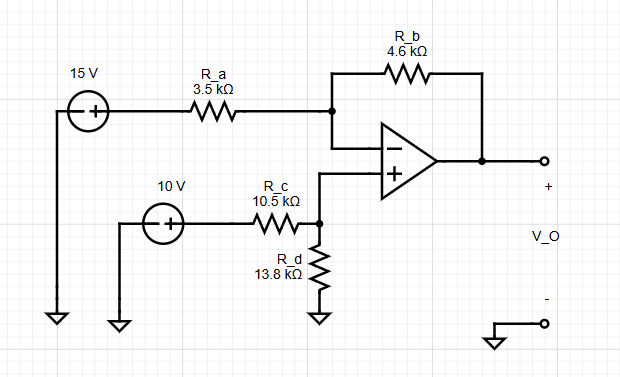
Figure 4: Difference Amplifier Example
We can recognize a difference amplifier from the two input voltages attached to both ends of the op amp with the resistors in these configurations. Let's use equation 2 to solve for \( v_o \).
\[ v_o = -\frac{R_b}{R_a}(v_b-v_a) = -6.57 \, \text{V} \]
Note: The only reason why we can use the equation above is because the ratios of resistors is satisfied. Essentially, so that this statement is true:
\[ \frac{R_a}{R_b} = \frac{R_c}{R_d} \]
If the ratios are not equal, then this assumption will not return correct values.
Practice
- Using Figure 5., solve for \( v_o \).

Figure 5: Circuit for practice problem #1.
- Using Figure 6., solve for \( v_o \)

Figure 6: Circuit for practice problem #2.
- Using Figure 7., solve for \( v_o \)

Figure 7: Circuit for practice problem #3.
- Using Figure 8., solve for \( v_o \)

Figure 8: Circuit for practice problem #4.
Solutions:
Problem 1 Solution.) \( v_o = -175 \, \text{V} \). Using equation 3, we get the following:
\[ v_o = -(\frac{9500}{8500}\cdot60 + \frac{9500}{7800}\cdot20+\frac{9500}{8200}\cdot72) = -175 \, \text{V}\]
Problem 2 Solution.) \( v_o = -172 \, \text{V} \). Using equation 3, we get the following:
\[ v_o = -(\frac{7400}{10200}\cdot30+\frac{7400}{9800}\cdot120+\frac{7400}{7500}\cdot60) = -172 \, \text{V}\]
Problem 3 Solution.) \( v_o = 16.9 \, \text{V} \). Let's first check the ratios of resistors to make sure we can use equation 4.
\[ \frac{7900}{5600} = \frac{15800}{11200} = \frac{79}{56}\]
Since the ratio of resistors are the same, so we can use equation 4.
\[ v_o = -\frac{7900}{5600}(12-24) = 16.9 \, \text{V}\]
Problem 4 Solution.) \( v_o = 16.92 \, \text{V} \). Again. let's check ratio of resistors.
\[ \frac{7400}{3500} = \frac{29600}{14000} = \frac{74}{35}\]
So now that we know this, we can use equation 4.
\[ v_o = -\frac{7400}{3500}(16-24) = 16.92 \, \text{V}\]