
Source Transformations
Introduction: This article focuses on the principle of transforming sources to provide another way to analyze circuits.
The Essentials
One method of circuit analysis that is helpful is to be able to adjust the source of a given circuit and still supply the same amount of power.
With the help of Ohm's law, we are able to transform a voltage source with a resistor in series to a current source with a resistor in parallel. Figure 1. shows the transformation in schematic form

Figure 1: Source Transformations
Example
Let's do an example of both kinds of transformations. Figure 2. is a schematic that we will do as our first example.

Figure 2: Voltage Transformation Example
This voltage source in series with a resistor can be written as a current source with a resistor in parallel. This can be done simply using Ohm's Law. Now what we do is we do NOT change the value of the resistor, just the value of the current source.
\[ i = \frac{V}{R} = \frac{12}{1000} = 12 \text{mA}\]
What this is saying is that the circuit that provides the same power is a current source of 12 mA with the resistor 1k \( \Omega \) in parallel with it, like in Figure 3.

Figure 3: Current Transformed From Voltage
Now we can do a little more complex problem found in Figure 4.
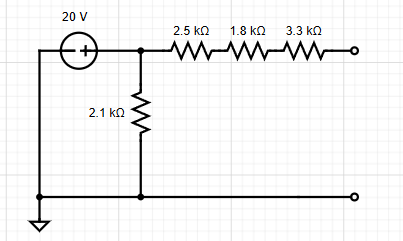
Figure 4: More Complex Transformation
Now this example can be confusing without some help or context. We're mainly curious about the resistor in parallel with the voltage source. What do we make of that?
Well, since that resistor is experiencing the same voltage potential as the resistors after, we can actually ignore this resistor since that resistor doesn't contribute to solving for a different source value. This principle also applies to current sources in series with resistors.
Put simply, we just have the three resistors in series with the 20 V power source. Using Ohm's Law, we calculate the current source to be 2.63 mA with the combined series resistance in parallel with it.

Figure 5: Complex Transformation Solution
Practice
Problem 1.) Using Figure 6., use source transformations to transform the source into a current source.
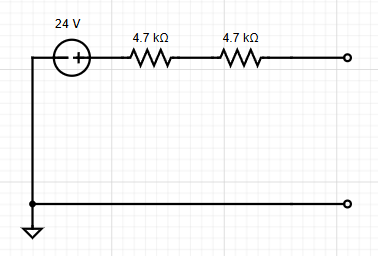
Figure 6: Problem 1 Schematic
Problem 2.) Using Figure 7., use source transformations to transform the source into a current source.

Figure 7: Problem 2 Schematic
Solutions:
Problem 1 Solution.) Current source is 2.55 mA in parallel with the sum of resistors, that being 9.4 k\( \Omega \). The current source can be solved with Ohm's Law
\[ i = \frac{24}{4700+4700} = 2.55 \, \text{mA}\]
Problem 2 Solution.) Voltage source is 7200 V in series with 3.6 k\( \Omega \). We can ignore the 2.5 k\( \Omega \) resistor since it is in series with the current source. Ohm's Law can help us to solve for the voltage source.
\[ V = i \cdot R = 2 \cdot 3600 = 7200 \, \text{V}\]