
Current
Introduction: This article focuses on the purpose of current and how it applies within circuit theory
The Essentials
Another electrical phenomena we are interested in is known as current. Current can be seen as the flow of charges through a given element. This occurs when a conducting wire is connected to a source of electromotive force, such as a battery.
Current, in technical terms, is described with this equation:
where
i = the current in amperes through an element
q = the charge in coulombs
t = the time in seconds
With this in mind, we can also find the charge transferred through algebraic methods and integrals.
With the way current is defined, it can either be constant-valued function or it can vary with different variables, one of which can be time. The latter example of current is common within the field of circuit analysis.
Example
Within the electrical world, we hear of terms such as DC and AC systems. These terms relate to two different natures of current. DC (direct current) flows only in one direction and can be constant or time varying. This can be represented by a current source set to 5 Amps. AC (alternating current) is a current that changes direction with respect to time. AC is used to power numerous circuits used within a home, such as an air conditioner, washing machine, and other similar appliances. Figure 1. depicts the two examples of current.
Since we have defined the current to be the movement of charge, current has an association with the direction of flow. Current is recognized as the flow of positive charge movement. Figure 2 shows an example of interpreting this current.
Practice
Problem 1.) Say that the total charge entering a terminal is given as \( Q = 2 t\ sin(4 \pi t \)). Calculate the current at \(t = 0.5 s\).
Problem 2.) Determine total charge entering a terminal between t = 1 s and t = 4 s if the current passing the terminal is described as I = (3\( t^{2} - t \)) A.
Problem 3.) Determine total charge entering a terminal between t = 2 s and t = 5 s if the current passing the terminal is described as I = -50sin(2\( \pi t \)) A.
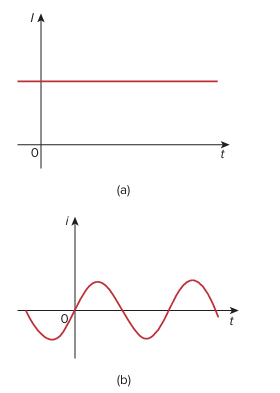
Figure 1: (a) Direct Current (DC) and (b) Alternating Current (AC)

Figure 2: Conventional current flow
Solutions:
Problem 1 Solution.) \(I = 8 \pi \) or 25.13 A. We take equation given 1 for current and we take its derivative with respect to time to solve for an equation for current. That current equation is
\[ I = \frac{dQ}{dt} = 2sin(4\pi t) + 8\pi cos(4\pi t) \]
We are interested in the current at a specific time, that being 0.5 s. Substitute t with 0.5 and solve for current. You should get \(8 \pi \) or 25.13 A as your answer.
Problem 2 Solution.) \(Q = 55.5 C \). Use equation 2 to evaluate the charge through the terminal. The expression for the Q is as follows:
\[ Q = \int_{1}^{4} (3{t}^{2} - {t})\,dt = t^{3} - \frac{t^{2}}{2} + C \]
Next, evaluate the integral with the bounds given
\[ (4^{3} - \frac{4^{2}}{2}) - (1^{3} - \frac{1^{3}}{2}) = 55.5\]
Problem 3 Solution.) Q = 0 C. This is done in the same method as previously:
\[ Q = \int_{2}^{5} -50 sin(2 \pi t), dt = \frac{50}{2\pi}cos(2\pi t) + C \]
Now evaluate the integral from t = 2 to t = 5 and you should get 0 C.
You may be curious as to why the total charge through the terminal is 0 C. This is the nature of a circuit with AC configuration. There are equal part positive and negative charges throughout the system, so in this scenario the total charge over time with the current described, the total charge is 0 C.