
The Second Law of Thermodynamics and Heat Engines
The Essentials
The First Law of Thermodynamics explains the relationship between energy and mass transfer into and out of a system. It is a very useful tool for analyzing a system, but fails to describe the natural tendency of a system to tend toward one state over another. An obvious principle of thermodynamics that is experienced in everyday life is that heat will naturally move from a hot system to a cold system. This principle is the basis of the Second Law of Thermodynamics.
Thermal Reservoirs and the Kevin-Planck Statement
Commonly, the surroundings of systems are large enough that they are able to receive heat transfer without a noticeable effect in the overall temperature of the system. This are known as thermal reservoirs. Thermal reservoirs can be either hot or cold, such as the heat provided by a large amount of fuel combusting or a cold lake or stream. Naturally heat will flow from a hot thermal reservoir to a cold reservoir. The heat transfer can be extracted as work, but the Kevin-Planck statement says that a heat engine acting in this capacity cannot be 100 percent efficient. Some of the heat passing into the heat engine must be rejected to the cold thermal reservoir.
Heat engines, Refrigerators and Heat Pumps
Generally, there are three types of devices that can work between a hot and cold reservoir. A heat engine will produce work as heat flows from hot to cold, and a refrigerator and heat pump will use work to move heat from cold to hot. The following diagram shows a) a heat engine, b) a refrigeration system and c) a heat pump.
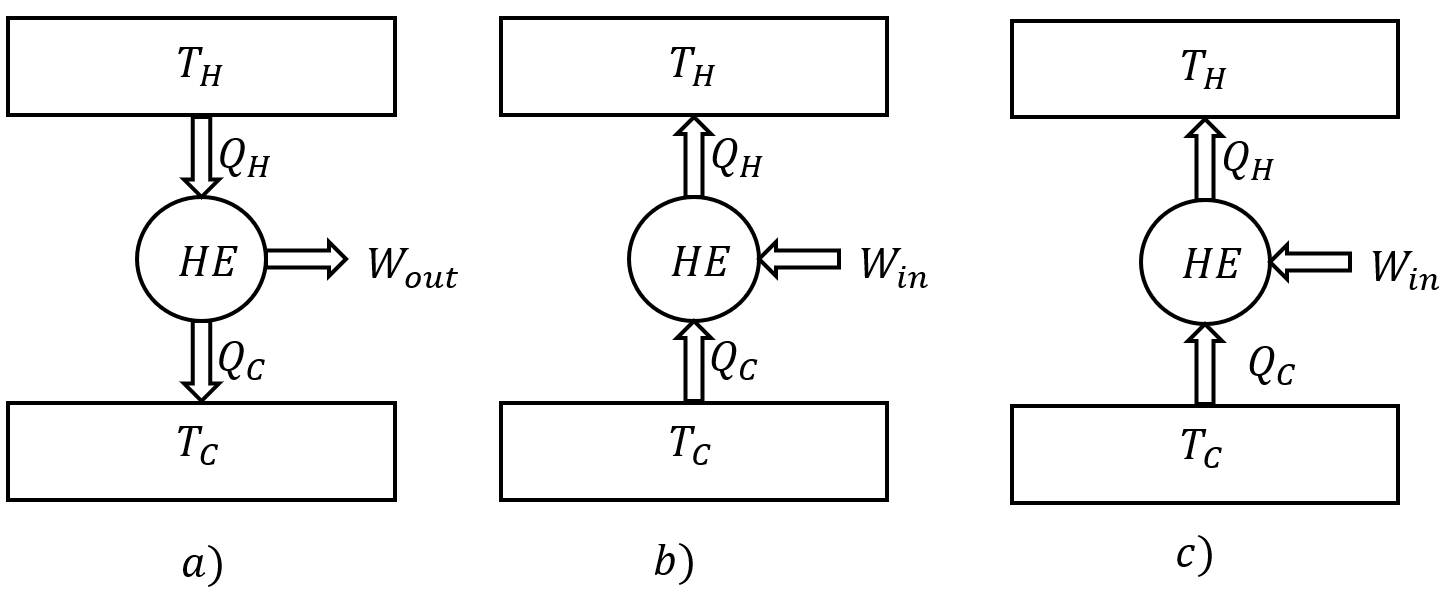
Heat Engines
Heat engines are a common way to generate work using a heat source, such as combusting a fuel. The main objective of a heat engine is to generate work. The work generated by a heat engine can be represented by the following equation Because of the Kevin-Planck statement, no heat engine can convert all of the heat transferred into work. The percentage of the heat that is extracted as work can be represented as the thermal efficiency of the heat engine.
Refrigerators and Heat Pumps
Refrigerators and heat pumps are very similar to each other. Both systems use a work input to move heat from a cold area to a hot area. The main difference between the two is that refrigerators have the objective of making a cold area colder, while heat pumps have the objective of making a hot area hotter by taking heat from a cold area. Refrigerators commonly use refrigerant liquids such as R-134a. The equation for the work required by a refrigerator is given below. Efficiencies are not used as a metric of performance for refrigerators or heat pumps because they commonly are able to exceed an "efficiency" of 100 percent. Instead, a new metric is defined, which is known and the Coefficient of Performance (COP). The COP is defined as the ratio between the desired output and the required input. It functions essentially in the same way as an efficiency. The desired output for a refrigerator is cooling a cold space, so the COP can be derived by the following formula. The desired output for a heat pump is to heat an area, so the COP can be derived using the following formula.
Carnot Cycles
A heat engine/refrigerator/heat pump with the maximum possible efficiency allowed by the second law is known as a Carnot Cycle. The Carnot Cycle consists of 4 fully reversible processes, meaning that nothing is lost over the course of the cycle. The Carnot efficiency of a cycle operating between two thermal reservoirs can be found with the following equations. Because the Carnot Cycle is the maximum possible efficiency allowed by the Second Law, no real heat engine operating between the same thermal reservoirs can have an efficiency that is higher than the Carnot efficiency.
Example
1: An inventor claims to have developed a heat engine that draws heat from a thermal reservoir of steam at 250 deg C and 100 kPa and exhausts heat into a basin of saturated liquid water at atmospheric pressure. The inventor claims that the engine produces 300 kJ of heat with an efficiency of 40 percent. Is his claim valid?
To solve this problem, start by finding the Carnot efficiency of a heat engine operating between the temperatures of the thermal reservoirs. This can be done using the following equation. Note that the temperatures used in this equation must be in units of Kelvin. The temperature of the hot reservoir is given, but the lower reservoir must be found. Using the saturated liquid tables, find the saturated temperature of water at atmospheric pressure. Convert both temperatures to Kelvin. Put the temperatures into the Carnot efficiency equation and solve. Because the reported efficiency of the heat engine is higher than the maximum efficiency allowed by the Second Law, the heat engine is not valid.
Practice
1: What is the COP of a heat pump that can output 3000 kJ per hour per kW of work?
Solutions:
1: COP=0.833