
Phase Diagram and Interpolation
The Essentials
Phases and P-/T- Diagrams
In thermodynamics, the most common materials analyzed are ideal gasses (air) and phase change fluids (water and R-134a). A phase change is when a fluid goes from a liquid to a gas. During the process of a phase change, any energy added to the fluid will not result in a temperature change; instead, the energy is used to break the atomic bonds and change the phase of the fluid. For phase change liquids, there are 5 common phases that are analyzed. These are compressed liquid, saturated liquid, saturated mixture, saturated vapor, and superheated vapor.
A compressed liquid is a liquid that is well below the vaporization (boiling) point. Once a liquid reaches the vaporization point but has not yet become a vapor, it is known as a saturated vapor. During the time in which the fluid is being changed from liquid to vapor, it is a saturated mixture. After all the fluid is a vapor but it is still at the vaporization point, it is a saturated vapor. Note that the temperature and pressure for all saturated phases is the same between the liquid, mixture, and vapor. Any vapor that is not at the vaporization point is known as a superheated vapor.
A common way to visualize the process of a phase change is a P- or T- diagram. These diagrams graph the specific volume (inverse of density) of a fluid versus its pressure and time respectively. An example of a T- diagram is shown below.
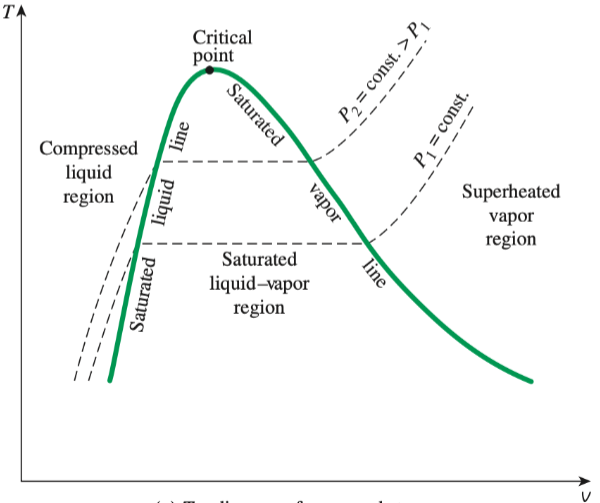
This graph has been formed by graphing lines of constant temperature experiments on the same graph. Note that in the region between the saturated liquid line and the saturated vapor line, known as the vapor dome, there is no increase in temperature as the fluid expands. The same principle holds true for the P- diagram, which has no change in pressure under its vapor dome. For both T- and P - diagrams, any point to the left of the vapor dome is a compressed liquid and any point to the right of the vapor dome is a superheated vapor.
Quality and Interpolation
Recall that the state postulate says that for a state to be fully defined, two independent intensive properties are needed. In the saturated region of a phase change fluid, temperature and pressure are dependent on one another and do not change throughout the phase change. Thus, it is necessary to define another independent property that can be used to define the state. This property is called the quality ().
The quality of a fluid is the ratio of the mass of the vapor to the total mass of the system. The quality of a saturated liquid with no vapor present is 0, and the quality of a saturated vapor with no liquid present is 1. The quality of a saturated mixture can be found using the following formula, where can be replaced with either specific volume , specific internal energy , specific enthalpy or specific entropy . Subscripts and represent the saturated liquid and vapor values, respectively. The quality is undefined for values outside of the vapor dome. For superheated vapors, tabulated data is provided for properties. For condensed liquids, the following approximation can be used to find unknown properties, with the exception of specific enthalpy. The values used in these equations are found in tabulated data. However, occasionally the data needed falls between the points available from the tables. When this happens, it is necessary to interpolate between points to find the values needed. Interpolation assumes that the line between data points is linear, and thus used a form of the slope-intercept equation for a linear line to find a value that lies between two points. To interpolate, first determine the values between which a known value falls. Then find the values of the desired variable that correspond to the upper and lower bounds of the known variable. Use the following equation to solve. This equation can be solved for the unknown value to give the following equation:
Example
1: Complete the table for all unknown properties using Tables A-4 and A-5.
| T | P | u | Phase | |
|---|---|---|---|---|
| - | 400 | 1450 | - | - |
| 220 | - | - | Sat. Vapor | - |
| 190 | 2500 | - | - | - |
| - | 4000 | 3040 | - | - |
For the top row, the pressure and specific internal energy are given. Go to Table A-5, which is organized by pressure, and find the 400 kPa line. Reference the specific internal energy values and . Because the given value for specific internal energy of 1450 kJ/kg is between and , the solution is a saturated mixture. Thus, the temperature is the saturated temperature, which is C. To find the quality, use the known values of specific internal energy in the quality equation
For the second line, it is given that the temperature is 220 deg C and that the phase is a saturated vapor. Using Table A-4, find the given temperature. Because the fluid is saturated, the pressure will be the saturated pressure, which is 2319.6 kPa. Given that the fluid is a saturated vapor, the specific internal energy can be found on the same row of Table A-4 to be kJ/kg. The quality of a saturated vapor is 1.
For the third line, it is given that the temperature is 190 deg C and the pressure is 25000 kPa. The first step is to determine if the fluid is saturated or not. To do so, go to either Table A-4 or A-5 and reference the temperature or pressure respectively. Using Table A-4, a temperature of 190 deg C correlates to a saturated pressure of 1255.2 kPa. Since the pressure of the system is greater than the saturation pressure, the fluid is a compressed liquid. The quality of a compressed liquid is undefined, so nothing is entered into that cell of the table. The specific internal energy can be approximated as the saturated liquid specific internal energy at the given temperature. For the final line of the table, a pressure of 4000 kPa is given and a specific internal energy of 3040 kJ/kg is given. Using Table A-5, check if the specific internal energy of the system falls in between the saturated values. For 4000 kPa, and . Because the given specific internal energy is greater than 2601.7, the fluid is a superheated vapor. The quality for a superheated vapor is undefined, so nothing is entered into the table. To find the temperature, use Table A-6. Find the section labeled as 4000 kPa and then locate the bounds in which the given specific internal energy is found. For this case, this is between and , which correlates to and . Interpolate between these values to find With all the answers found, this is the final table
| T | P | u | Phase | |
|---|---|---|---|---|
| 143.6 | 400 | 1450 | Sat. Mix | 0.434 |
| 220 | 2319.6 | 2601.3 | Sat. Vapor | 1 |
| 190 | 2500 | 806.00 | Comp. Liquid | N/A |
| 466.2 | 4000 | 3040 | Supr. Vapor | N/A |
Practice
1: A well insulated tank with a volume of holds saturated water vapor at 100 deg C. The water is stirred until the pressure is 200 kPa. Find the final temperature and the work needed to reach this temperature.
2: The temperature of a saturated mixture of R-134a is found to be 4 deg C, with a specific volume of .05 m/kg. What is the pressure, specific internal energy, specific enthalpy and specific entropy?
Solutions:
1: deg C, kJ
2: kPa, kJ/kg, kJ/kg, kJ/kg K