Vectors and Forces

Introduction

Vectors form the foundation for analyzing physical systems. A vector is a quantity defined by magnitude and direction. Forces are most accurately described using vector notation, so understanding vector combinations is essential.

Notation

Angle-Magnitude: A → = 3 k N \overrightarrow{A}\ = \ 3\ kN @ θ = 25 ∘ \theta = 25{^\circ} above x axis

Cartesian Coordinates: A → \overrightarrow{A}\ = 3 i ̂ \widehat{i} + 4 j ̂ \widehat{j} - 5 k ̂ \widehat{k}

Bracket Coordinates: A → \overrightarrow{A}\ =〈3, 4, -5〉

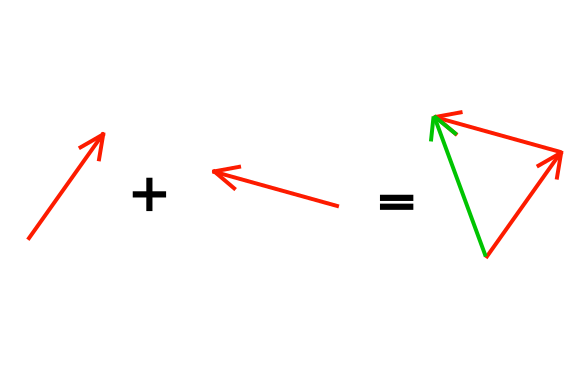
Vector Addition

image

A → + B → = ( A x + B x ) i ̂ + ( A y + B y ) j ̂ + ( A z + B z ) k ̂ \overrightarrow{A} + \overrightarrow{B} = (A_{x} + B_{x})\widehat{i} + (A_{y} + B_{y})\ \widehat{j} + (A_{z} + {B_{z})\widehat{k}}_{}

Dot Product

A → • B → = A B c o s θ = A x B x + A y B y + A z B z \overrightarrow{A} \bullet \overrightarrow{B} = ABcos\theta = A_{x}B_{x} + A_{y}B_{y} + A_{z}B_{z}

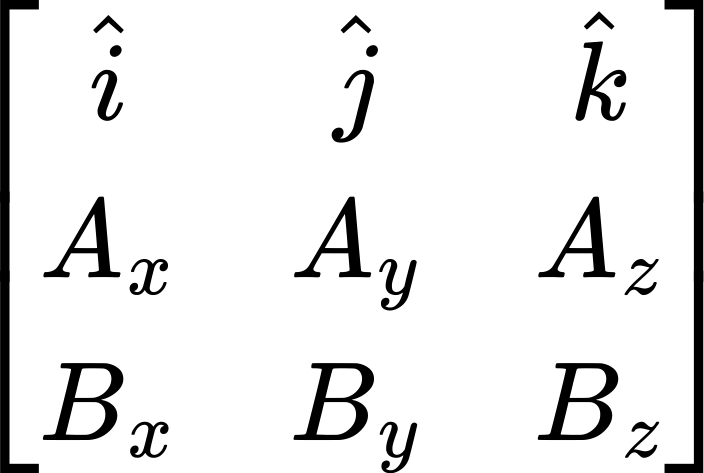
Cross Product

image

A → × B → = det \overrightarrow{A} \times \overrightarrow{B} = \det (matrix above) = ( A y B z − A z B y ) i ̂ − ( A x B z − A z B x ) j ̂ + ( A x B y − A y B x ) k ̂ {(A}_{y}B_{z} - A_{z}B_{y})\widehat{i} - (A_{x}B_{z} - A_{z}B_{x})\widehat{j} + (A_{x}B_{y} - A_{y}B_{x})\widehat{k}

Component & Resultant Forces

Given θ \theta is from the +x-axis, F x = F c o s θ F_{x} = \ Fcos\theta and F y = F s i n θ F_{y} = Fsin\theta . Given right triangle where a and b are legs and c is the hypotenuse, F x F_{x} is a c F \frac{a}{c}F and F y F_{y} is b c F \frac{b}{c}F . The resultant force is | F | = F x 2 + F y 2 |F| =\sqrt{F_x^2 + F_y^2}

Position Vector

The vector that points from one point to another (typically the origin to a point):

r → A B = ( x B − x A ) i ̂ + ( y B − y A ) j ̂ + ( z B − z A ) k ̂ {\overrightarrow{r}}_{AB}\ = {(x}_{B} - x_{A})\ \widehat{i} + (y_{B} - y_{A})\widehat{j} + (z_{B} - z_{A})\widehat{k}

Unit Vector

Gives direction only and is the position or force vectors divided by their respective magnitudes:

u → A B = r A B , x | r A B | i ̂ + r A B , y | r A B | j ̂ + r A B , z | r A B | k ̂ = F x | F | i ̂ + F y | F | j ̂ + F z | F | k ̂ {\overrightarrow{u}}_{AB}\ = \ \frac{r_{AB,\ x}}{|r_{AB}|}\widehat{i} + \frac{r_{AB,\ y}}{|r_{AB}|}\widehat{j} + \frac{r_{AB,\ z}}{|r_{AB}|}\widehat{k}\ = \ \frac{F_{x}}{|F|}\widehat{i} + \frac{F_{y}}{|F|}\widehat{j} + \frac{F_{z}}{|F|}\widehat{k}

Force Vector

Combines magnitude of force and direction to give components F x F_{x} , F y F_{y} , and F z F_{z} : F → = F ( u A B ) \overrightarrow{F} = F(u_{AB})

Coordinate Direction Angles

The angle between the resultant vector and the +x, +y, and +z axes, respectively:

α x = cos ⁡ − 1 ( F x | F | \alpha_{x} = \cos^{- 1}(\frac{F_{x}}{|F|} ) β y = cos ⁡ − 1 ( F y | F | \beta_{y} = \cos^{- 1}(\frac{F_{y}}{|F|} ) γ z = cos ⁡ − 1 ( F z | F | \gamma_{z} = \cos^{- 1}(\frac{F_{z}}{|F|} )

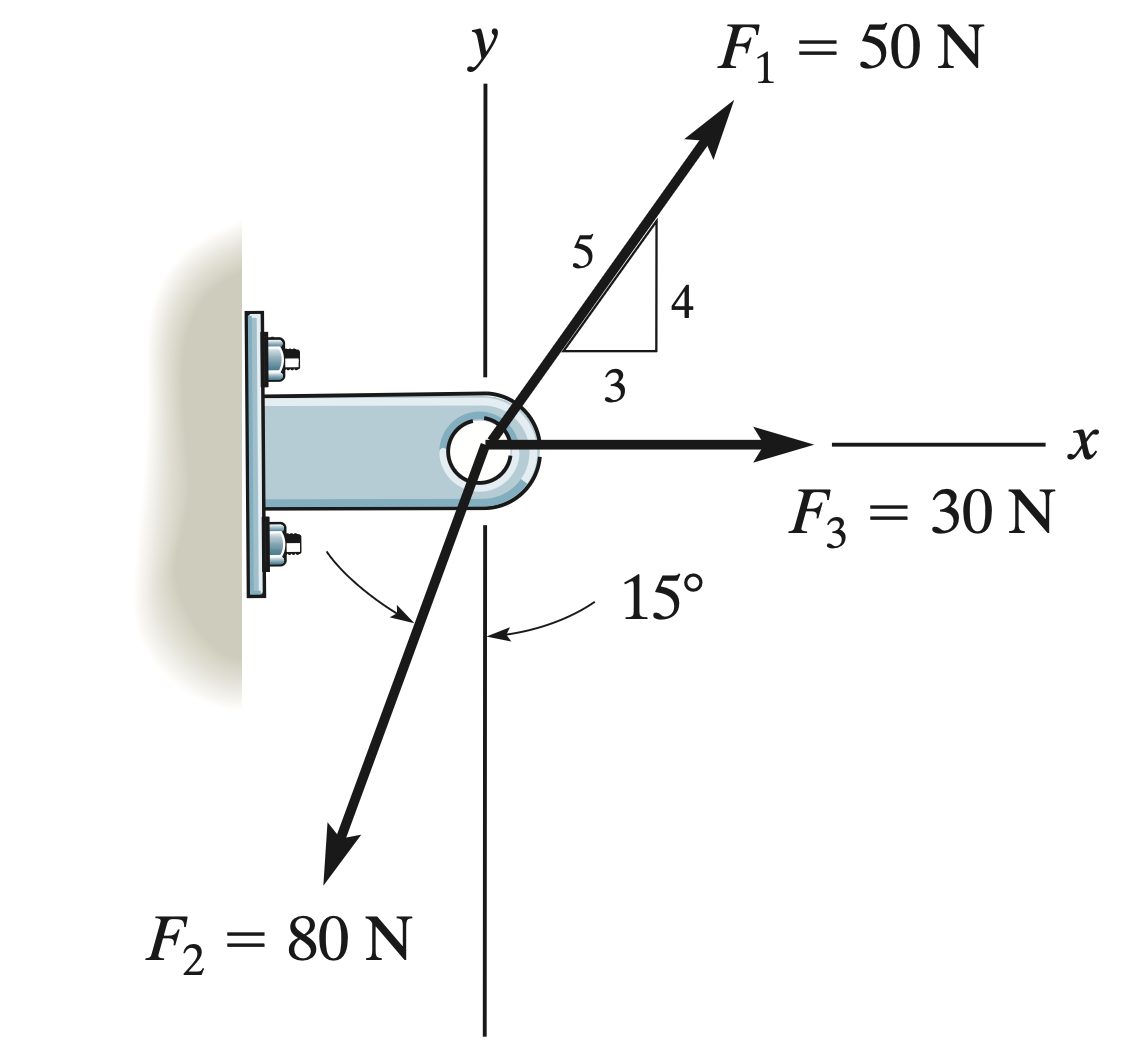
Example 1:
Find the Vector and Magnitude of the Resultant Force

image

1) Add x-components:

F x = F 1 , x + F 2 , x + F 3 , x = 3 5 ( 50 N ) − ( 80 N ) s i n 15 ∘ + 30 N F_{x} = F_{1,x} + F_{2,x} + F_{3,x} = \ \frac{3}{5}(50\ N) - (80\ N)sin15{^\circ} + 30\ N

F x = 39.29 N F_{x} = 39.29\ N

2) Add y-components:

F y = F_{y} = F 1 , y + F 2 , y + F 3 , y = 4 5 ( 50 N ) − ( 80 N ) c o s 15 ∘ + 0 N F_{1,y} + F_{2,y} + F_{3,y} = \ \frac{4}{5}(50\ N) - (80\ N)cos15{^\circ} + 0\ N

F y = − 37.27 N F_{y} = - 37.27\ N

Vector of Resultant Force: F → = 39.29 i ̂ − 37.27 j ̂ \overrightarrow{F} = 39.29\widehat{i} - 37.27\widehat{j}

Magnitude of Resultant Force: F = ( 39.29 ) 2 + ( − 37.27 ) 2 = 54.15 N F\ = \sqrt{(39.29)^2 + (-37.27)^2} = \ 54.15\ N

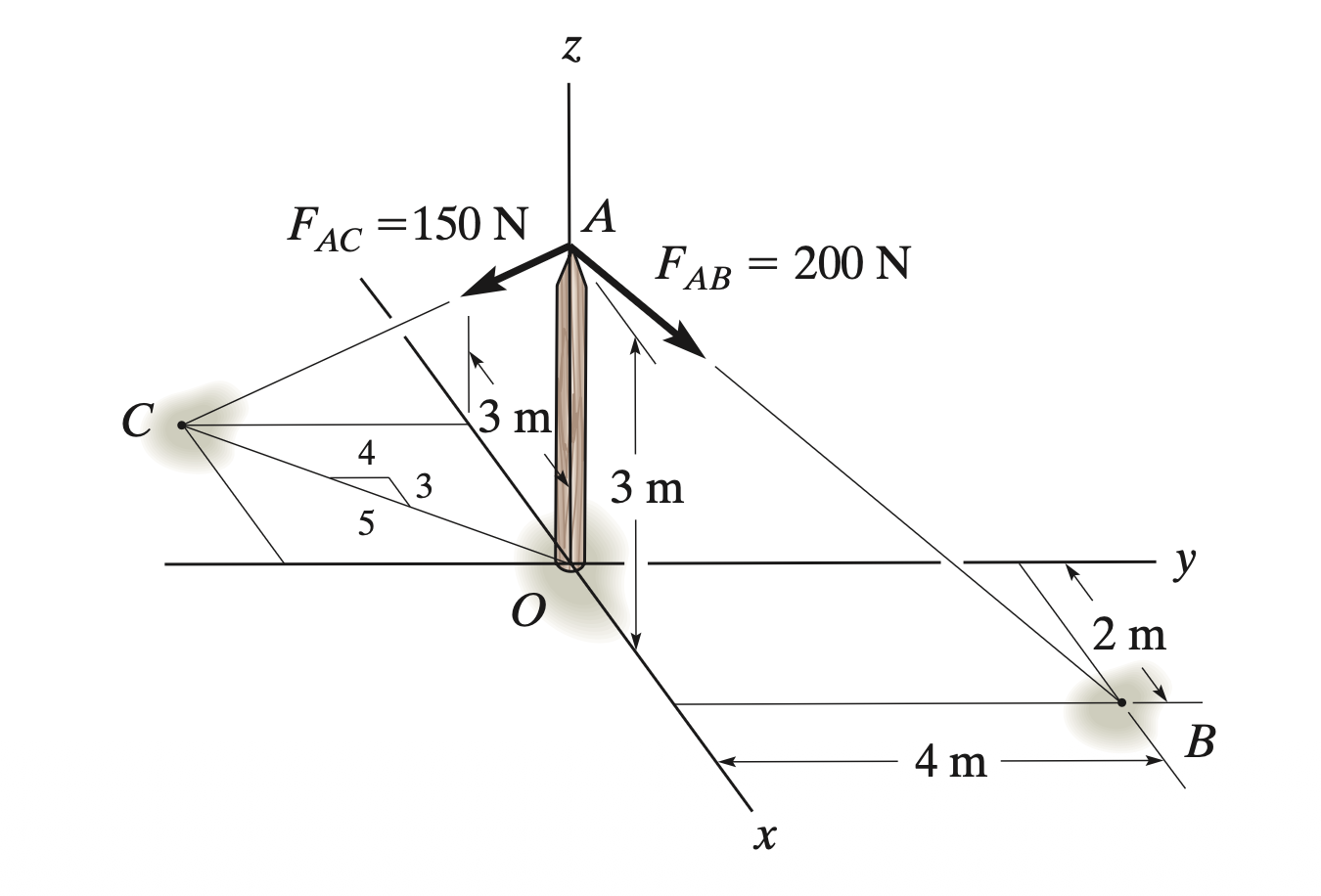
Example 2:
Find the Coordinate Direction Angles of the Resultant Force

image

1) Position Vectors:

From A to B: r → A B = 2 i ̂ + 4 j ̂ − 3 k ̂ {\overrightarrow{r}}_{AB} = 2\widehat{i} + 4\widehat{j} - 3\widehat{k}

From A to C: r → A C = − 3 i ̂ − 4 j ̂ − 3 k ̂ {\overrightarrow{r}}_{AC} = - 3\widehat{i} - 4\widehat{j} - 3\widehat{k}

2) Magnitudes of Position Vectors:

| r A B | = 2 2 + 4 2 + ( − 3 ) 2 = 5.385 m |r_{AB}|\ = \sqrt{2^2 + 4^2 + (-3)^2} = 5.385\ m

| r A C | = ( − 3 ) 2 + ( − 4 ) 2 + ( − 3 ) 2 = 5.831 m |r_{AC}|\ = \sqrt{(-3)^2 + (-4)^2 + (-3)^2} = 5.831\ m

3) Unit Vectors:

u → A B = 2 5.385 i ̂ + 4 5.385 j ̂ − 3 5.385 k ̂ = 0.371 i ̂ + 0.743 j ̂ − 0.557 k ̂ {\overrightarrow{u}}_{AB} = \frac{2}{5.385}\widehat{i} + \frac{4}{5.385}\widehat{j} - \frac{3}{5.385}\widehat{k} = 0.371\widehat{i} + 0.743\widehat{j} - 0.557\widehat{k}

u → A C = − 3 5.831 i ̂ − 4 5.831 j ̂ − 3 5.831 k ̂ = − 0.514 i ̂ − 0.686 j ̂ − 0.514 k ̂ {\overrightarrow{u}}_{AC} = - \frac{3}{5.831}\widehat{i} - \frac{4}{5.831}\widehat{j} - \frac{3}{5.831}\widehat{k} = - 0.514\widehat{i} - 0.686\widehat{j} - 0.514\widehat{k}

4) Force Vectors:

F → A B = ( 200 N ) ( u A B ) = 74.2 i ̂ + 148.6 j ̂ − 111.4 k ̂ {\overrightarrow{F}}_{AB} = (200\ N)(u_{AB}) = 74.2\widehat{i} + 148.6\widehat{j} - 111.4\widehat{k}

F → A C = ( 150 N ) ( u A C ) = − 77.1 i ̂ − 102.9 j ̂ − 77.1 k ̂ {\overrightarrow{F}}_{AC} = (150\ N)(u_{AC}) = - 77.1\widehat{i} - 102.9\widehat{j} - 77.1\widehat{k}

5) Sum x, y, and z Components to Find Resultant Force:

F x = − 2.9 N ; F y = 45.7 N ; F z = − 188.5 N ; | F | = ( − 2.9 ) 2 + 45.7 2 + ( − 188.5 ) 2 = 194 N F_{x} = - 2.9\ N;\ \ F_{y} = 45.7\ N;\ \ F_{z} = - 188.5\ N;\ \ |F|\ = \sqrt{(-2.9)^2 + 45.7^2 + (-188.5)^2} = 194\ N

6) Coordinate Direction Angles:

α = cos ⁡ − 1 ( − 2.9 194 ) = 90.9 ∘ \alpha = \cos^{- 1}(\frac{- 2.9}{194}) = 90.9{^\circ}
β = cos ⁡ − 1 ( 45.7 194 ) = 76.4 ∘ \beta = \cos^{- 1}(\frac{45.7}{194}) = 76.4{^\circ}
γ = cos ⁡ − 1 ( − 188.5 194 ) = 166 ∘ \gamma = \cos^{- 1}(\frac{- 188.5}{194}) = 166{^\circ}