
Moments and Couples
Introduction
When a force acts on a rigid body in a direction that does not pass through its axis or point of rotation, it tends to cause the body to rotate. This rotational effect is known as a moment. Moments and force couple systems are essential for analyzing how forces produce rotation and how their combined effects influence the equilibrium of a structure.
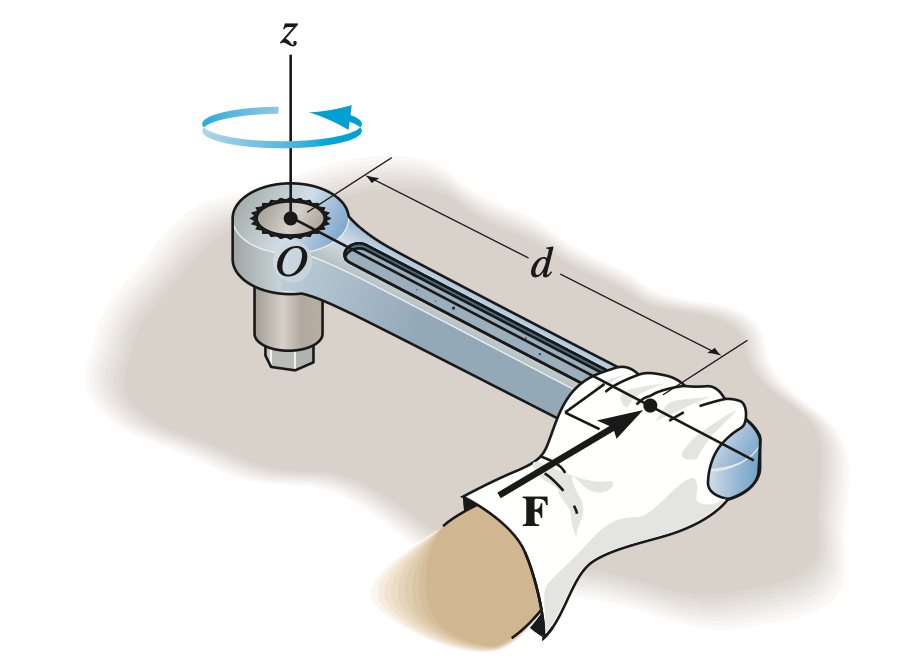
2D Moments
For planar problems, moments are calculated using perpendicular distances (moment arms). Moments are similar to torque in physics, as both have units of force times distance. Angled forces must be resolved into components before solving.
3D Moments (Vector Method)
Moments in 3D are computed using the cross product: , where is the position vector from point to force and is the force vector. In determinant form:

Moment About an Axis
To find the moment about a specific axis, take the dot product of the axis unit vector and :
In determinant form: 
Force Couple Systems
Occasionally, forces will cancel each other out but still result in a moment about a central point. The type of system is known as a force couple system. This entails a set of two equal but opposite forces set at equal distances from a given point. Force couple systems are represented as a moment about the given point with a magnitude twice what one of the forces would result in.
, where is one of the coupled forces and is the distance between the couple
Resultant Force & Moment
A system of forces can be reduced to and , replacing a system with a single resultant force and a couple moment at a point.
Example 1:
Find the Resultant Moment about Point A
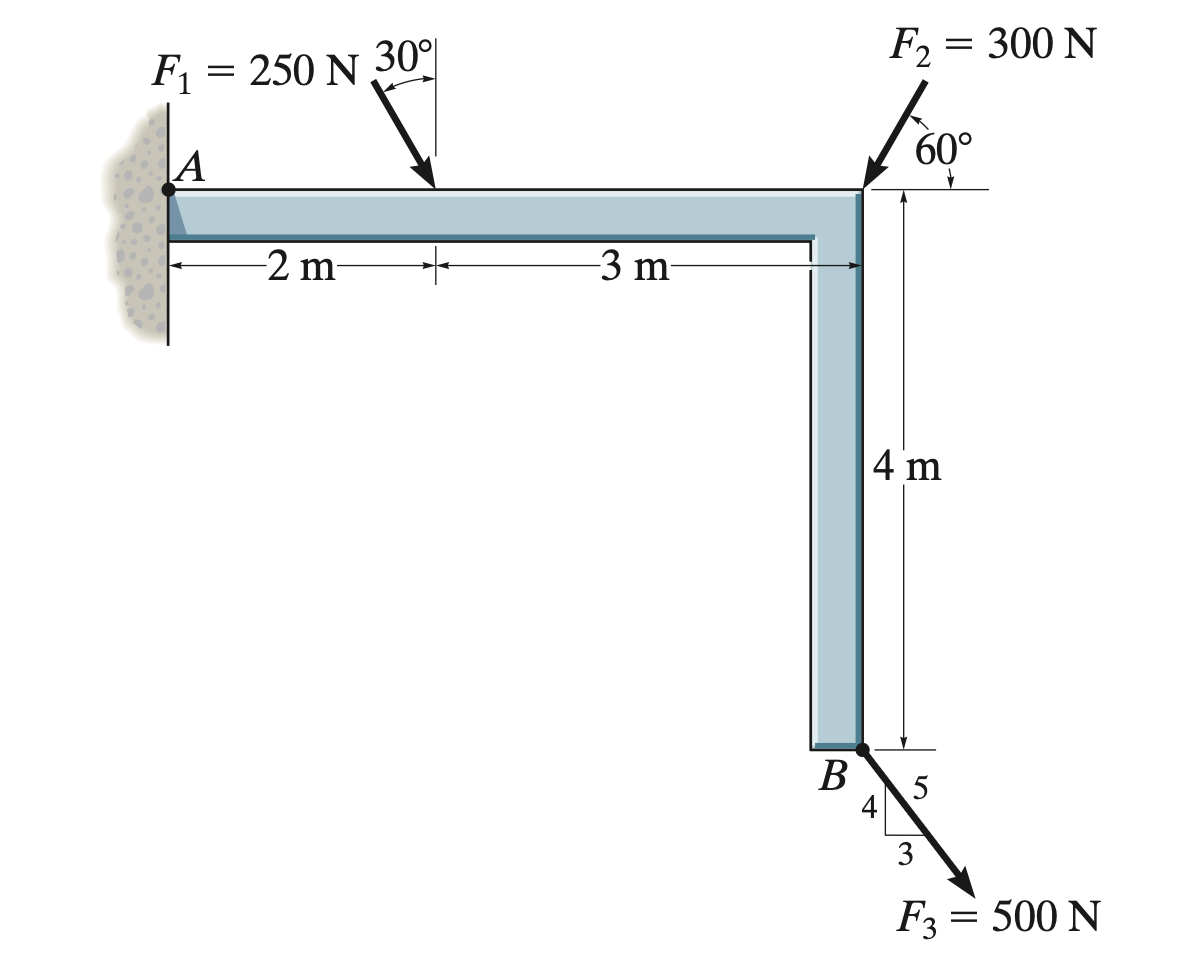
1) Resolve forces into x and y component magnitudes:
|
|
|
|
|
|
x |
|
|
|
|
y |
|
|
|
2) Multiply each force by the perpendicular distance of that force to point A. and have no moment arms, so they are excluded from the equation.
Assuming CW to be positive,
Substituting and solving:
Example 2:
Find the Moment of Force about Axis AC
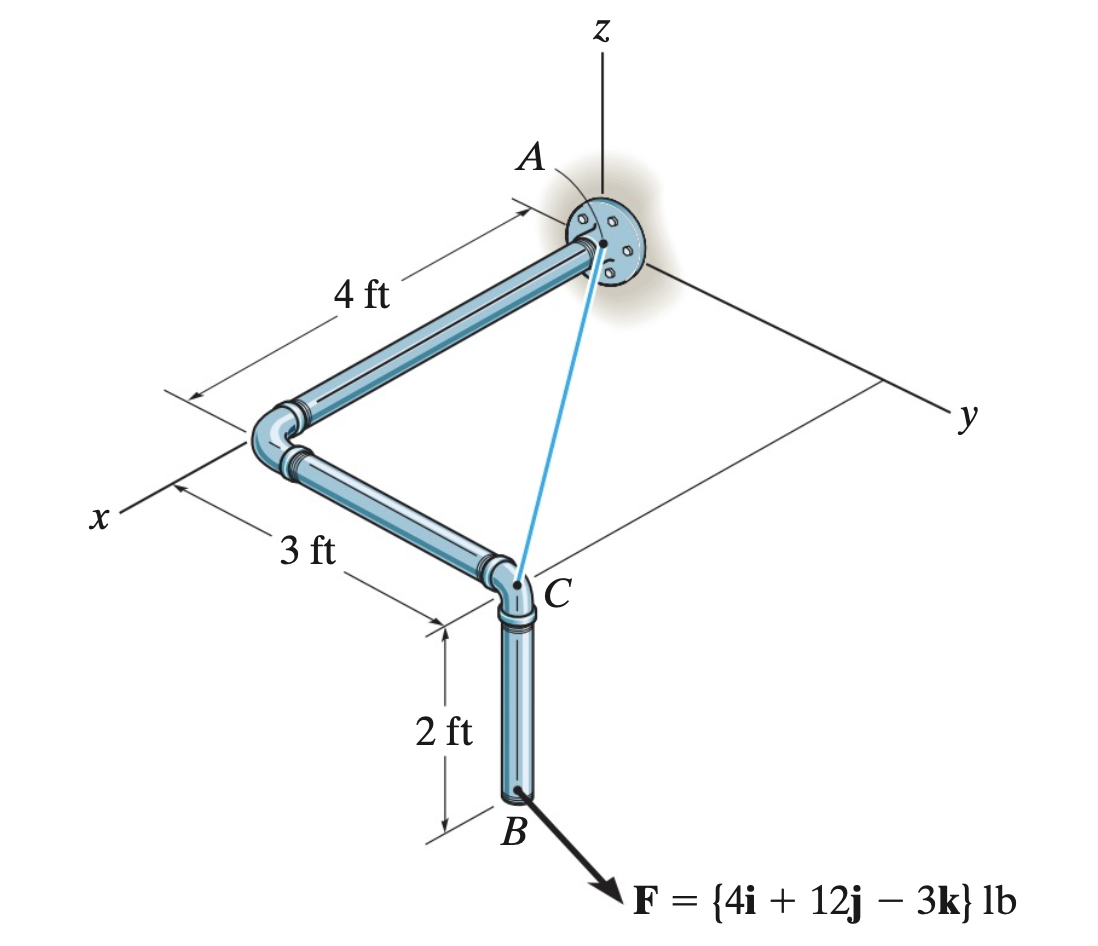
1) Find position vector for axis AC and from to the axis:
2) Solve for AC axis unit vector:
3) Solve

To express as cartesian vector, multiply by the axis unit vector: