Moment and Product of Inertia

Introduction

The moment of inertia describes how an area or mass is distributed relative to an axis and measures resistance to bending or rotational motion. The product of inertia describes how area is distributed simultaneously relative to two perpendicular axes. These properties are essential in structural analysis, beam design, and rotational dynamics.

Area Moment of Inertia
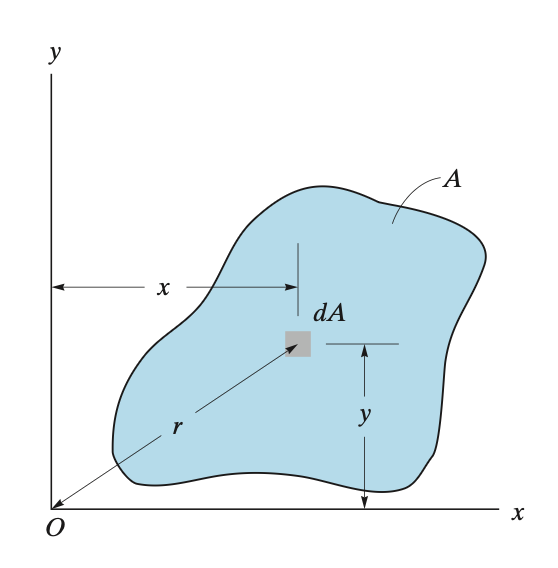
image

The area moment of inertia measures resistance to bending about an axis.

I x = ∫ y 2 d A I_{x} = \int_{}^{}y^{2}dA I y = ∫ x 2 d A I_{y} = \int_{}^{}x^{2}dA

Parallel-Axis Theorem

Used to find the moment of inertia about any axis that is parallel to the axis passing through the centroid. The area moment of inertia about any axis is equal to its moment of inertia about the centroid plus the product of the area and the square of the perpendicular distance between the axes:

I x = I x , c e n t r o i d + A d y 2 I_{x} = I_{x,\ centroid} + A{d_{y}}^{2} I y = I y , c e n t r o i d + A d x 2 I_{y} = I_{y,\ centroid} + A{d_{x}}^{2}

Product of Inertia

The product of inertia measures how area is distributed relative to two axes simultaneously. The product of inertia is positive in quadrants I & III, and negative in quadrants II & IV.

If an area is symmetric about the x-axis or y-axis, I x y = 0 I_{xy} = 0 .

I x y = ∫ x y d A I_{xy} = \int_{}^{}xydA

Mass Moment of Inertia

Mass moment of inertia measures resistance to angular acceleration.

I = ∫ r 2 d m I = \int_{}^{}r^{2}dm where d m = ρ d V dm = \rho dV

Radius of Gyration

Of an area: k x = I x A k_{x} = \sqrt{\frac{I_x}{A}}
Of a mass: k x = I x m k_{x} = \sqrt{\frac{I_x}{m}}

Composite Bodies

For composite bodies, divide the shape into simple areas (rectangles, circles, etc.), find the centroid of each part, use parallel-axis theorem, and sum all contributions:

Moment of inertia: I = Σ ( I c e n t r o i d + A d 2 ) I = \Sigma(I_{centroid} + Ad^{2})

Product of inertia: I x y = Σ ( A e a c h p i e c e d x d y ) I_{xy} = \Sigma(A_{each\ piece}d_{x}d_{y})

Common Centroidal Moments of Inertia

(.*?)

I x = 1 12 b h 3 I_{x} = \frac{1}{12}bh^{3}

I y = 1 12 h b 3 I_{y} = \frac{1}{12}hb^{3}

(.*?)

About center: I = 1 12 m L 2 I = \frac{1}{12}mL^{2}

About end: I = 1 3 m L 2 I = \frac{1}{3}mL^{2}

(.*?)

I = 1 2 m r 2 I = \frac{1}{2}mr^{2}

Find: Moment of inertia for the shaded area around the x-axis. image
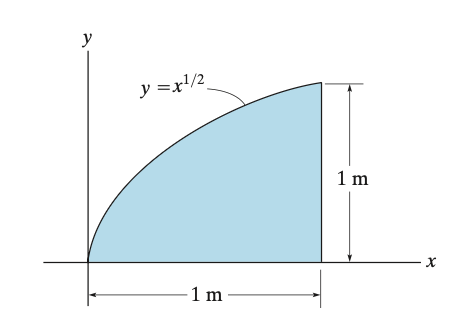
I x = ∫ y 2 d A I_{x} = \int_{}^{}y^{2}dA and d A = y d x = ( x 1 / 2 ) d x dA = ydx = (x^{1/2})dx

I x = ∫ 0 1 ( x 1 / 2 ) 2 ( x 1 / 2 ) d x = ∫ 0 1 x 3 / 2 d x = 0.40 m 4 I_{x} = \int_{0}^{1}(x^{1/2})^{2}(x^{1/2})dx = \int_{0}^{1}x^{3/2}dx = 0.40\ m^{4}

Example 1:
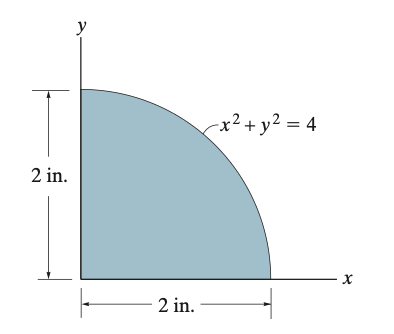
Find the product of inertia with respect to the x and y axes.
image

I x y = ∫ x y d A I_{xy} = \int_{}^{}xydA where: x = x , y = y 2 , d A = y d x x = x,\ y = \frac{y}{2},\ dA = ydx

y = y 2 y = \frac{y}{2} because the centroid of d A dA is halfway up its height

In terms of x x , y = 4 − x 2 y = \sqrt{4-x^2}

I x y = ∫ 0 2 ( x ) ( y 2 ) ( y d x ) = ∫ 0 2 ( x ) ( 4 − x 2 2 ) ( 4 − x 2 d x ) = 2 i n 4 I_{xy} = \int_{0}^{2}(x)(\frac{y}{2})(ydx) = \int_{0}^{2}(x)(\frac{\sqrt{4-x^2}}{2})(\sqrt{4-x^2} dx) = 2\ in^{4}

Example 2:
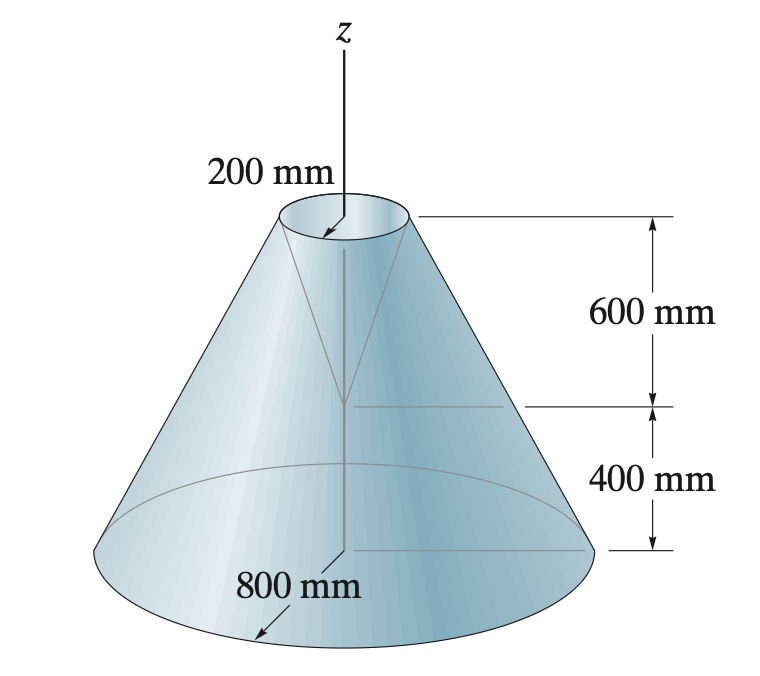
Find the mass moment of inertia of the frustum of the cone if ρ = 200 kg/m3.
image

For a solid cone about its center axis: I z = 3 10 m r 2 I_{z} = \frac{3}{10}mr^{2} , m = ρ V m = \rho V , V = 1 3 π r 2 h V = \frac{1}{3}\pi r^{2}h

I z = I l a r g e c o n e − I s m a l l c o n e o n t o p I_{z} = I_{large\ cone} - I_{small\ cone\ on\ top}

Solving for the height of the large and small cone:

0.2 h = 0.8 H = 0.8 h + 1 ⇒ 0.2 h = 0.8 h + 1 ⇒ h = 0.333 m ∴ H = 1.333 m \frac{0.2}{h} = \frac{0.8}{H} = \frac{0.8}{h + 1}\ \Rightarrow \ \frac{0.2}{h} = \frac{0.8}{h + 1}\ \Rightarrow \ h = 0.333\ m\ \ \therefore\ \ H = 1.333\ m

I l a r g e = 3 10 ( m l a r g e ) ( r l a r g e 2 ) = 3 10 ( 200 ( 1 3 π ( 0.8 ) 2 ( 1.333 ) ) ( 0.8 ) 2 = 34.306 k g ⋅ m 2 I_{large} = \frac{3}{10}{(m}_{large}{)(r}_{large}^{2}) = \frac{3}{10}(200(\frac{1}{3}\pi(0.8)^{2}(1.333))(0.8)^{2} = 34.306\ kg \cdot m^{2}

I s m a l l = 3 10 ( m s m a l l ) ( r s m a l l 2 ) = 3 10 ( 200 ( 1 3 π ( 0.2 ) 2 ( 0.333 ) ) ( 0.2 ) 2 = 0.0335 k g ⋅ m 2 I_{small} = \frac{3}{10}{(m}_{small}{)(r}_{small}^{2}) = \frac{3}{10}(200(\frac{1}{3}\pi(0.2)^{2}(0.333))(0.2)^{2} = 0.0335\ kg \cdot m^{2}

I z = I l a r g e c o n e − I s m a l l c o n e o n t o p = 34.306 k g ⋅ m 2 − 0.0335 k g ⋅ m 2 = 34.27 k g ⋅ m 2 I_{z} = I_{large\ cone} - I_{small\ cone\ on\ top} = 34.306\ kg \cdot m^{2} - 0.0335\ kg \cdot m^{2} = 34.27\ kg \cdot m^{2}

Example 3:
Find the moment of inertia of the beam about the y axis.
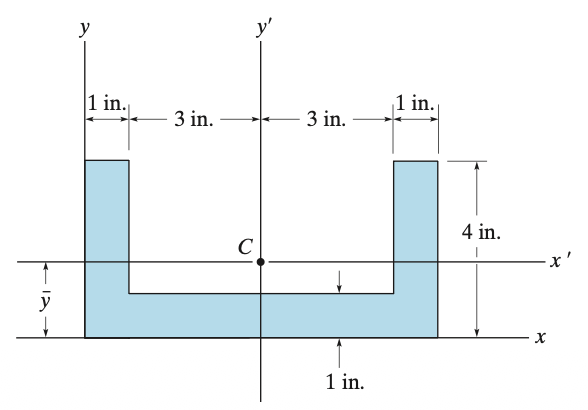
image

I y , r e c t a n g l e = 1 12 h b 3 I_{y,\ rectangle} = \frac{1}{12}hb^{3} , I p a r a l l e l = I c e n t r o i d + A d 2 I_{parallel} = I_{centroid} + Ad^{2}

Left 1x4

Middle 6x1

Right 1x4

I y I_{y} of centroid

1 12 ( 4 ) ( 1 ) 3 = 1 3 \frac{1}{12}(4)(1)^{3} = \frac{1}{3}

1 12 ( 1 ) ( 6 ) 3 = 18 \frac{1}{12}(1)(6)^{3} = 18

1 12 ( 4 ) ( 1 ) 3 = 1 3 \frac{1}{12}(4)(1)^{3} = \frac{1}{3}

Parallel axis distance

in

in

in

I = Σ ( I c e n t r o i d + A d 2 ) = ( 1 3 + ( 4 ) ( 0.5 ) 2 ) + ( 18 + ( 6 ) ( 4 ) 2 ) + ( 1 3 + ( 4 ) ( 7.5 ) 2 ) = 340.7 i n 4 I = \Sigma(I_{centroid} + Ad^{2}) = (\frac{1}{3} + (4)(0.5)^{2}) + (18 + (6)(4)^{2}) + (\frac{1}{3} + (4)(7.5)^{2}) = 340.7\ in^{4}