
Trusses: Method of Sections
Introduction
The method of sections is used to determine forces in specific truss members without solving the entire truss joint-by-joint. By passing an imaginary cut through the truss and analyzing one section using equilibrium equations, internal member forces can be solved directly. This method is especially efficient when only a few member forces are required.
Method of Sections Procedure
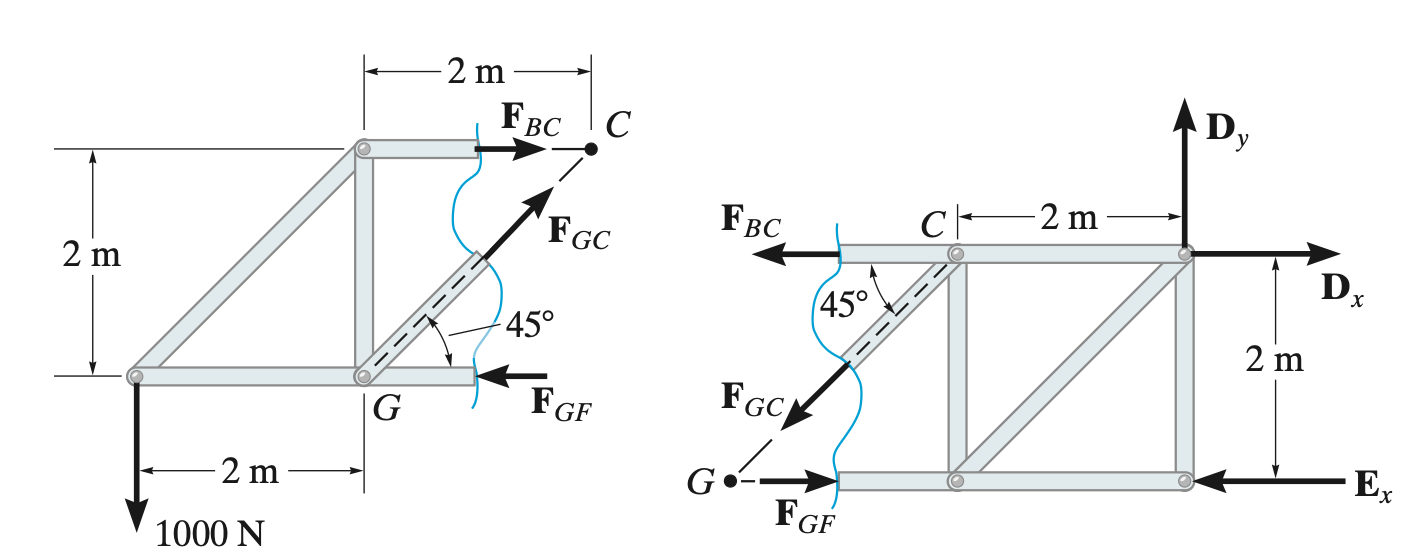
-
Solve support reactions using global equilibrium.
-
Cut a section through desired members.
-
Isolate one side of the truss.
-
Draw section free-body diagram.
-
Assume unknown member forces are in tension.
-
Apply equilibrium equations:
-
Positive result tension
-
Negative result compression
Choosing the Best Cut
-
Pass through the target members.
-
Cut through no more than 3 unknown members (3 unknown forces).
-
Use moments around intersection points of unknown members or joints where multiple unknowns pass through.
Example:
Find the force in member LK and if the member is in tension or compression.
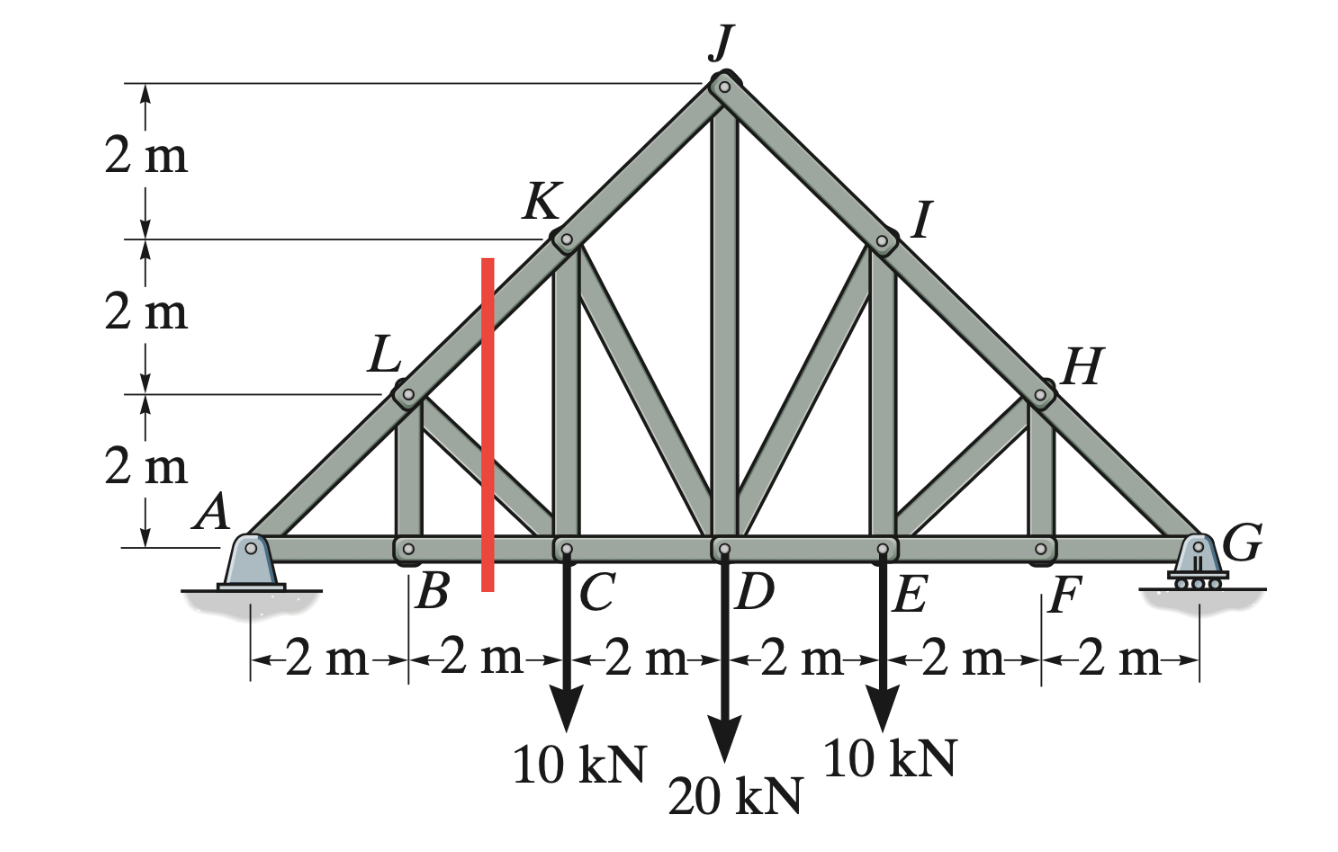
1) Start with Global Equilibrium to solve for Reaction Forces at points A and G:
Solving:
Substituting into :
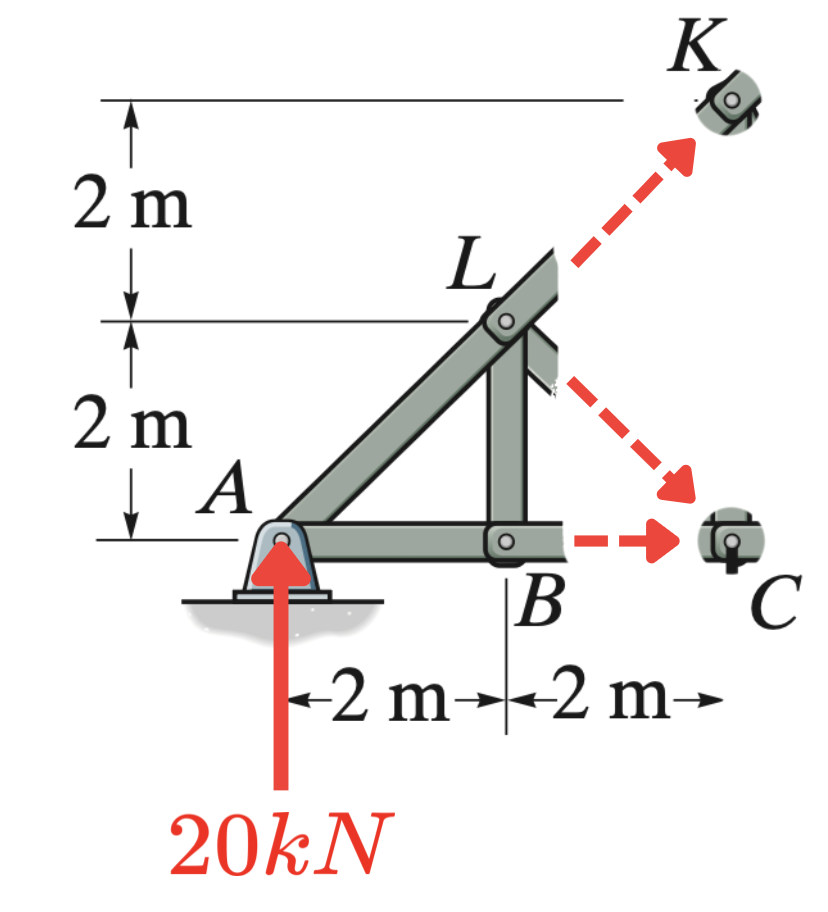
2) Cut the truss vertically through member LK, and take moments about point C to cancel out LC and BC
Moment arm from to point C is length LC, or
Moment arm from to point C is length AC, or
Solving: