Equilibrium Equations

Introduction

An equilibrium equation is the sum of forces in a direction or the sum of moments about a point. Static Mechanics focuses on analyzing systems that do not accelerate. In Engineering, this means that the sum of forces in all directions is zero ( Σ F → = m a → = 0 \Sigma\overrightarrow{F} = m\overrightarrow{a} = 0 ) and the sum of moments is equal to zero ( Σ M → = F → × r → = 0 \Sigma\overrightarrow{M} = \overrightarrow{F} \times \overrightarrow{r} = 0 ).

Notation

→ Σ F x = 0 \rightarrow \Sigma F_{x} = 0 ↑ Σ F y = 0 \uparrow \Sigma F_{y} = 0 \ ⟲ Σ M = 0 ⟲ \ \Sigma M = 0

Steps to Solve

  1. Draw a Free Body Diagram (FBD)

  2. Create equilibrium equations

  3. Solve reactionary forces

Example Problem:
image

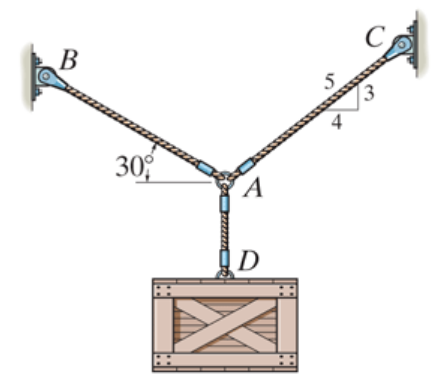
Problem F3-1: The crate has a weight of 550 lb. Determine the force in each supporting cable.

Solution:

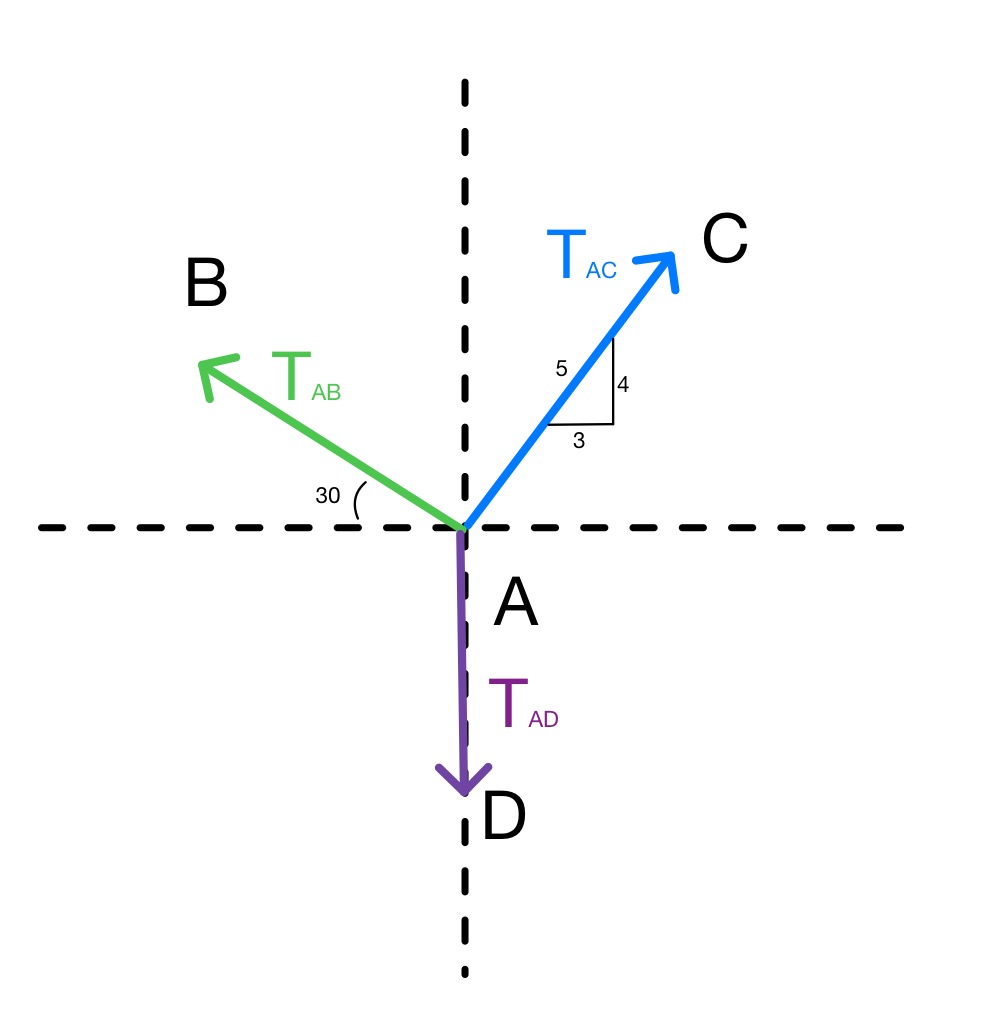
  1. Draw a FBD around point A

image

  1. Solve Equilibrium equations

    1. → Σ F x = 0 = 3 5 T A C − T A B c o s 30 \rightarrow \Sigma F_{x} = 0 = \frac{3}{5}T_{AC} - T_{AB}cos30

    2. ↑ Σ F y = 0 = 4 5 T A C + T A B s i n 30 − T A D \uparrow \Sigma F_{y} = 0 = \frac{4}{5}T_{AC\ } + T_{AB}sin30 - T_{AD}

  2. Manipulate Equations and plug in knowns

    1. T A D = 550 l b T_{AD} = 550lb

    2. T A C = 479.76 l b T_{AC} = 479.76lb

    3. T A B = 332.39 l b T_{AB} = 332.39lb