
Stress, Strain, and Material Properties
Normal Stress and Strain
Normal Stress: (Force/Area). Can only be valid if stress is uniformly distributed.
Normal Strain: (total elongation/total length).
Notation: Tensile stress or strain is positive. Compressive stress or strain is negative.
Stress-Strain Diagrams
This is the stress strain diagram for steel:
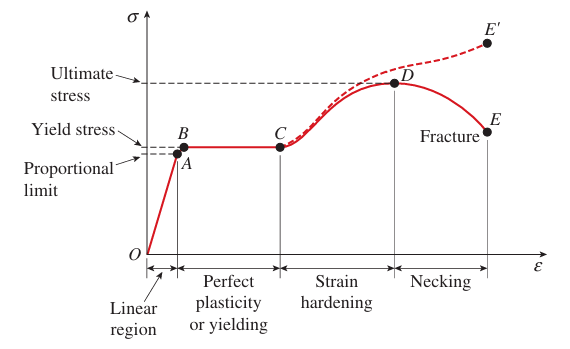
Proportional Limit (A): Where the proportionality between stress and strain ends.
Modulus of Elasticity (Slope of A-O): Measures a material’s stiffness; E =
Yield Stress (B): This point represents where permanent deformation of steel occurs.
Ultimate Stress (D): The maximum stress steel can withstand before necking begins
Ductility and Elongation
Ductility: A measure of the amount of permanent strain a material undergoes before failure occurs. Quantified using percent elongation and percent reduction in area.
|
Percent Elongation = |
Percent Reduction = |
|---|---|
Mechanical Properties
Elasticity: The material returns to its original dimensions during unloading.
Plasticity: The material undergoes inelastic strains beyond strain at the elastic limit
Creep: Strains that develop when a load is sustained for long periods of time.
Hooke’s Law
The linear relationship between stress and strain for a material in simple tension or compression. Only relates longitudinal stresses and strains.
(psi, ksi, or pascals)
Poisson’s Ratio
The relationship of lateral strain and axial strain of a bar after loading (think of stretching a rubber band).
(dimensionless)
Example 1:
Problem 1.4-3: Find maximum normal stress when the thickness of the tube is ¾ in.
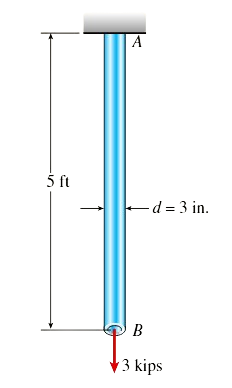
-
Use normal stress equation:
-
Find inner diameter:
,
-
Calculate cross sectional area:
-
Calculate normal stress:
Example 2:
Problem 1.7-7: Find the change in diameter and magnitude of P for the monel metal bar when L=9in, d=0.225in, and the bar elongates 0.0195in.
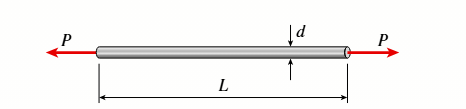
Change in diameter:
-
Find axial strain:
-
Find lateral strain:
Poison’s ration for monel (Appendix I):
-
Find change in diameter
Magnitude of P:
-
Find normal stress
Modulus of elasticity for monel (Appendix I): E = 25,000 ksi
-
Find cross-sectional area
-
Calculate P