Statically Indeterminate Structures

Change in Length Due to Axial Loads
image

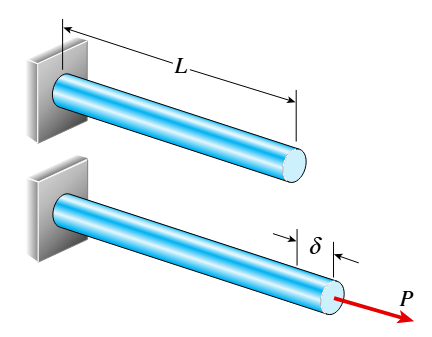
Elongation in a prismatic bar (linear elastic region): δ = P L E A \delta = \frac{PL}{EA}

Bars with Intermediate Axial Loads:

  1. Identify each section

  2. Determine internal axial loads in each section

  3. Determine change of length in each section using: δ = P L E A \delta = \frac{PL}{EA}

  4. Add together all the changes in length to find the total change of length Σ δ \Sigma\delta

Bars with prismatic sections: δ = ∑ i = 1 n N i L i E i A i \delta = \sum_{i = 1}^{n}\frac{N_{i}L_{i}}{E_{i}A_{i}}

Bars with varying loads and dimensions: δ = ∫ 0 L d δ = ∫ 0 L N ( x ) d x E A ( x ) \delta = \int_{0}^{L}d\delta = \int_{0}^{L}\frac{N(x)dx}{EA(x)}

Statically Indeterminate Structures

image image

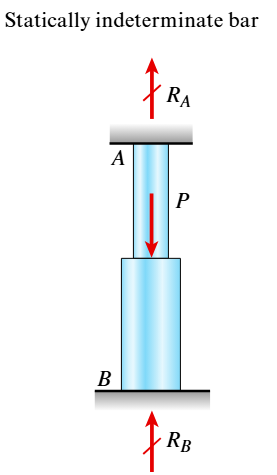
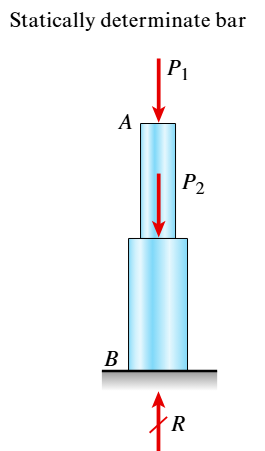
Statically Determinate Structures: Structures where the reactions and internal forces can be found using equilibrium equations

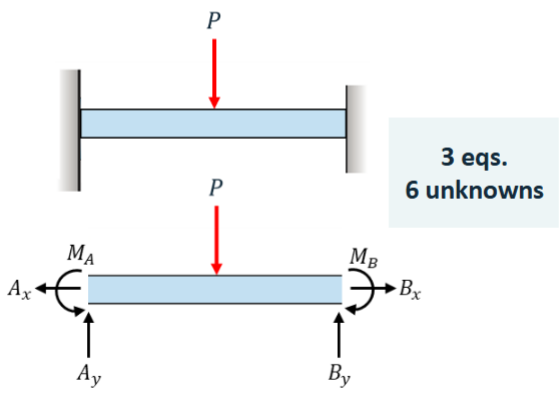
Statically Indeterminate Structures: Structures where the equilibrium equations are not enough to solve for the reactions. The other equations used are compatibility equations.

Compatibility Equations: The change in length of the statically indeterminate bar must match the conditions at the support. If both supports are fixed, the length does not change. δ A + δ B = δ A B \delta_{A} + \delta_{B} = \delta_{AB}

Force-Displacement Relations: The relationship between the force of the reactions and the change in length. The force-displacement relationship can be used in the compatibility equations. δ A = R A L A E A \delta_{A} = \frac{R_{A}L_{A}}{EA}

3 Step Approach:

image

  1. Equilibrium Equations and FBD

  2. Constitutive Equations (PLEA equation)

  3. Compatibility Equations (relating the PLEA equations)

Degree of indeterminacy = the number of unknowns - the number of equilibrium equations

Example: Problem 2.4-19:
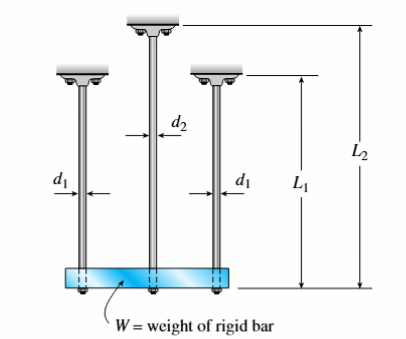
image

Given: W = 7200 l b W = 7200\ lb , the outer rods are aluminum, E 1 = 10 × 10 6 p s i E_{1} = 10 \times 10^{6}psi , d 1 = 0.4 i n . d_{1} = 0.4\ in. , L 1 = 40 i n . L_{1} = 40\ in. , the inner rod is magnesium, E 2 = 6.5 × 10 6 p s i E_{2} = 6.5 \times 10^{6}\ psi , σ 1 = 24 , 000 p s i \sigma_{1} = 24,000\ psi , and σ 2 = 13 , 000 p s i \sigma_{2} = 13,000\ psi

Find: L 2 L_{2} and d 2 d_{2} when all three rods are loaded to their maximum values.
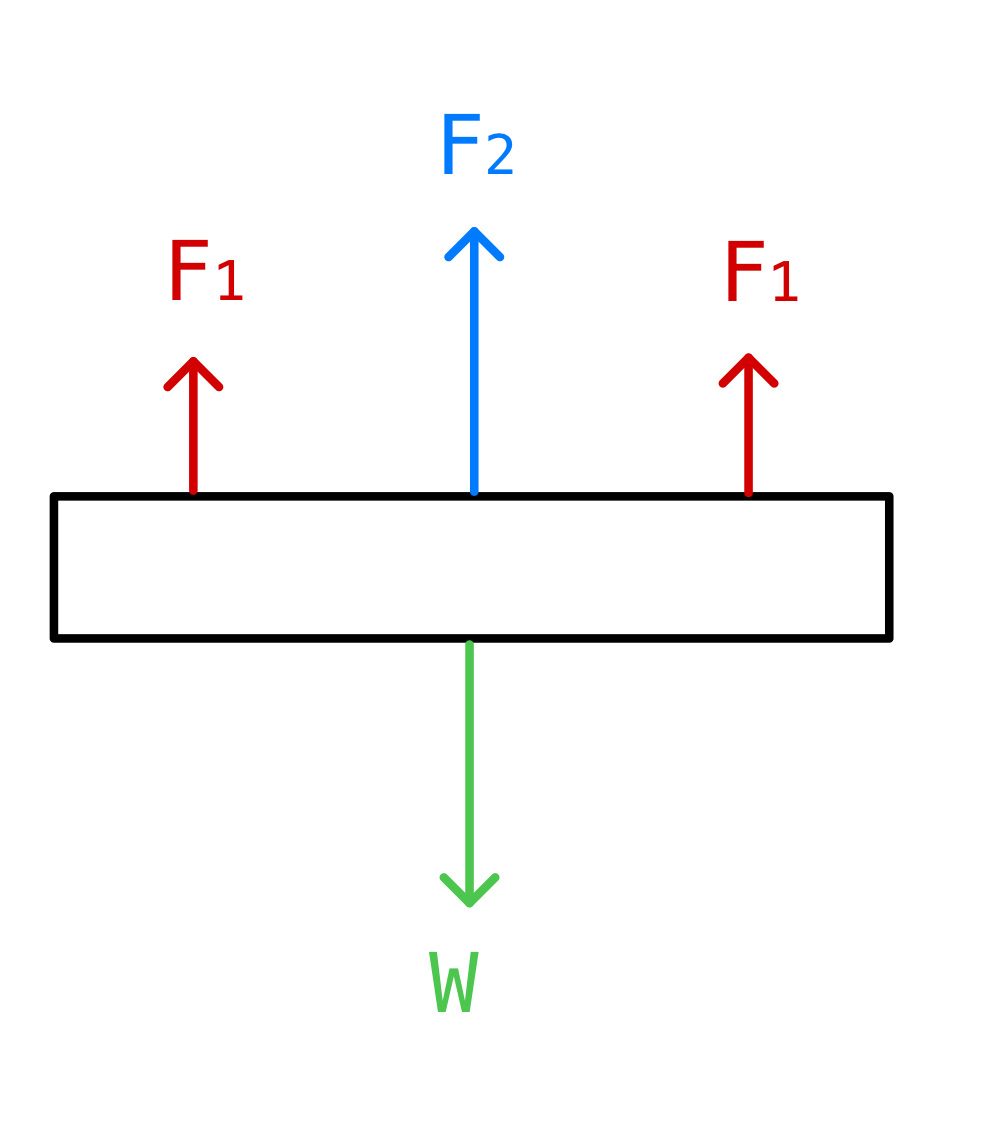
image

  1. FBD and equilibrium equations

↑ Σ F y = 0 = 2 F 1 + F 2 − W \uparrow \Sigma F_{y} = 0 = 2F_{1} + F_{2} - W

7200 l b = 2 F 1 + F 2 7200\ lb = 2F_{1} + F_{2}

F 1 = σ 1 A 1 = 24 , 000 p s i ⋅ π 4 ( 0.4 i n ) 2 = 960 π l b F_{1} = \sigma_{1}A_{1} = 24,000\ psi \cdot \frac{\pi}{4}{(0.4in)}^{2} = 960\pi\ lb

F 2 = σ 2 A 1 = 13 , 000 p s i ⋅ π 4 d 2 2 = 3250 π d 2 2 l b F_{2} = \sigma_{2}A_{1} = 13,000\ psi \cdot \frac{\pi}{4}d_{2}^{2} = 3250\pi d_{2}^{2}\ lb

7200 l b = 2 ( 960 π l b ) + 3250 π d 2 2 l b 7200\ lb = 2(960\pi\ lb) + 3250\pi d_{2}^{2}\ lb

d 2 = 0.338 i n . d_{2} = 0.338\ in.

F 2 = 372 π F_{2} = 372\pi

  1. Constitutive equations

δ 1 = F 1 L 1 E 1 A 1 = ( 960 π l b ) ⋅ ( 40 i n . ) ( 10 × 10 6 p s i ) ⋅ ( π / 4 ) ( 0.4 i n . ) 2 = 0.096 i n . \delta_{1} = \frac{F_{1}L_{1}}{E_{1}A_{1}} = \frac{(960\pi\ lb) \cdot (40\ in.)}{(10 \times 10^{6}\ psi) \cdot (\pi/4){(0.4\ in.)}^{2}} = 0.096\ in.

δ 2 = F 2 L 2 E 2 A 2 = ( 372 π l b ) ⋅ L 2 ( 6.5 × 10 6 p s i ) ⋅ ( π / 4 ) ( 0.338 i n . ) 2 = 0.002 L 2 i n . \delta_{2} = \frac{F_{2}L_{2}}{E_{2}A_{2}} = \frac{(372\pi\ lb) \cdot L_{2}}{(6.5 \times 10^{6}\ psi) \cdot (\pi/4){(0.338\ in.)}^{2}} = 0.002L_{2}\ in.

  1. Compatibility Equations

Since the change in length of the rods has to be the same, the compatibility equation is:

δ 1 = δ 2 \delta_{1} = \delta_{2}

0.096 i n . = 0.002 L 2 i n . ⇒ L 2 = 48 i n . 0.096\ in.\ = \ 0.002L_{2}\ in. \Rightarrow L_{2} = 48\ in.