
Voltage, Current, Resistance, Ohm’s Law, Power, and Energy
Introduction
Voltage, current, resistance, power, and energy are fundamental quantities to describe the behavior of electrical circuits. These quantities are related through Ohm’s Law and the basic relationships between charge, energy, power, and time.
Voltage
Voltage is the electric energy required per unit charge to move a charge between two points.
1 Volt (V) is 1 Joule per Coulomb (J/C):
, where is energy (J) and is charge (C)
Current
Current is the rate of flow of electric charge. 1 Ampere (A) is 1 Coulomb per second (C/s):
, where is charge (C) and is time (s)
Resistance
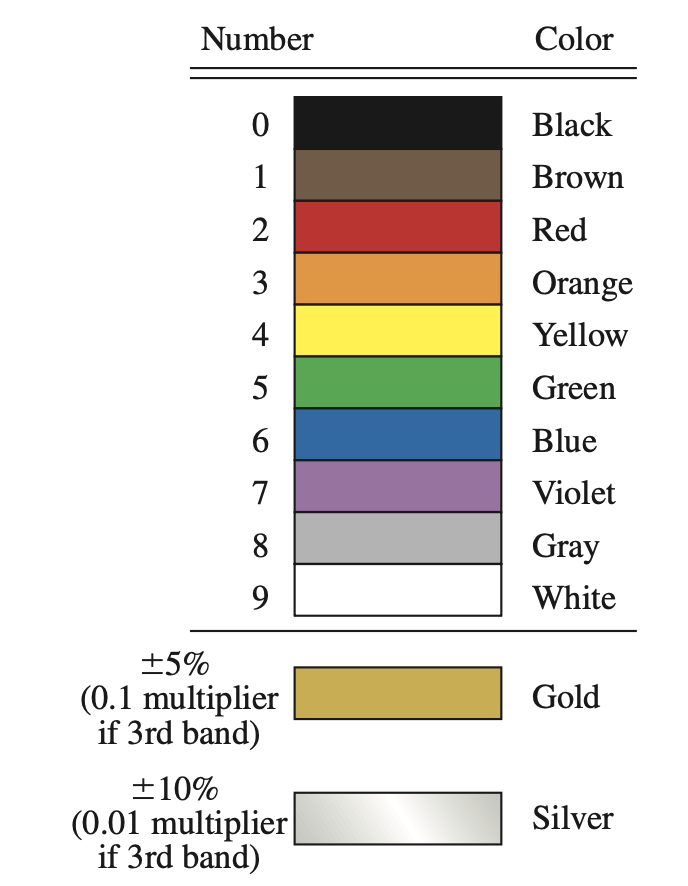
Resistance is the opposition to the flow of current and can be found with Ohm’s Law below. Resistors are color coded to define their resistance. The first two bands are the first and second digits, and the third band gives the power-of-ten multiplier.
Conductance describes how easily current flows through a resistance:
, where is resistance () and is conductance ( or Siemens)
Ohm’s Law
Ohm’s Law gives the equation , and can be arranged to find any of the three quantities. Voltage is in Volts (), current is in Amperes (), and resistance is in Ohms ().
For a graph of voltage vs. resistance, the slope is the current. Conversely, a graph of current vs. voltage has a slope of .
Power & Energy
Power is the rate at which electrical energy is transferred or converted. 1 Watt (W) is 1 Joule per second (J/s):
, where is energy (J) and is time (s)
For circuits,
Maximum Permissible Current:
Maximum Permissible Voltage:
Efficiency:
Example 1: Find the current through a 4.7 kΩ resistor connected to a 12 V source
Example 2: Find the power dissipated by a 100 Ω resistor with 2 A flowing through it
Alternatively,
Example 3: Find the energy used by a 60 W light bulb operating for 2 hours
Example 4: Find the maximum permissible current through a 50 Ω resistor rated for 100 W
Example 5: Find the efficiency of a portable generator that receives 500 kJ of energy from fuel and converts 375 kJ into useful electrical energy