
Parallel and Combinational DC Circuits
Introduction
Parallel and combinational DC circuits contain multiple paths for current and may include both series and parallel connections. Using relationships between voltage, current, and resistance allows these circuits to be reduced into simpler equivalent circuits.
Parallel Circuits
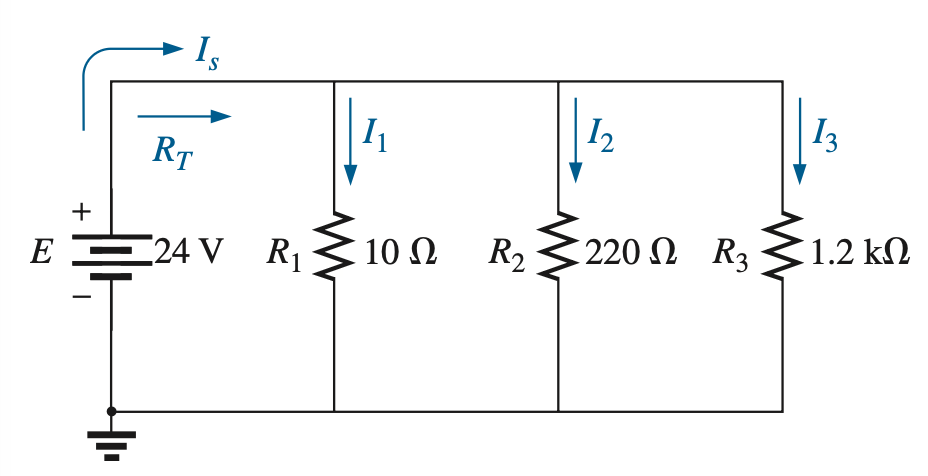
Elements are connected in parallel when they are connected across the same two nodes. Because both ends of each element are connected to the same points, parallel resistors have the same voltage:
The total current is the sum of the branch currents (), and the total resistance can be calculated with:
Circuit Current & Current Across Parallel Resistors
Once the total resistance is known, use Ohm’s Law to calculate the circuit current:
Since every resistor/branch of a parallel circuit has the same voltage, the current across each resistor/branch can be calculated using Ohm’s Law:
. . .
Kirchoff’s Current Law (KCL)
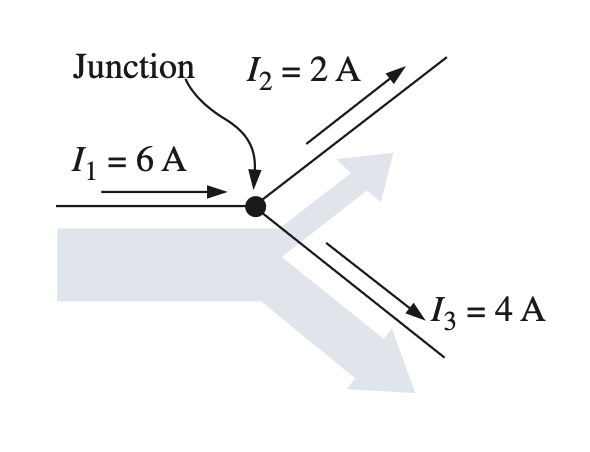
Kirchoff’s Current Law states that the total current entering a node/junction equals the total current leaving the node:
For a source feeding parallel branches:
Current Divider Rule
In a parallel circuit, current divides between parallel branches based on their resistances. For two parallel resistors:
Combinational DC Circuits
A combinational circuit contains both series and parallel portions. Identify series and parallel groups (simplest first), and replace the group with the equivalent resistance until there’s only one resistor left with the total equivalent resistance.
Example 1: Find the total resistance, total current, and current through each branch
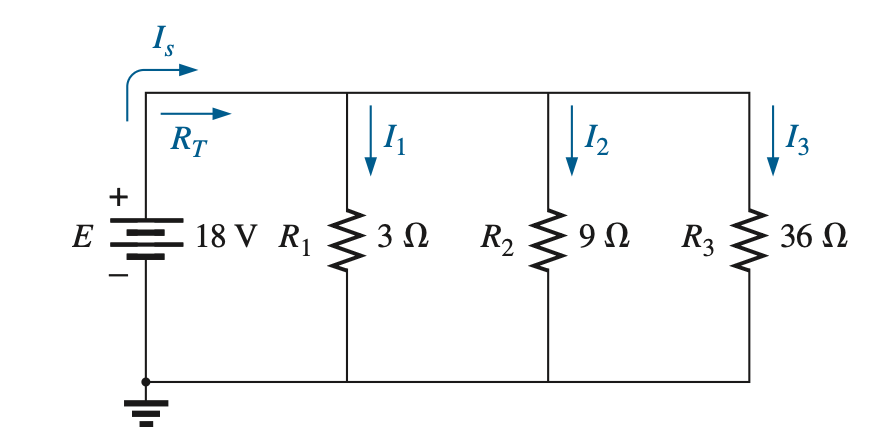
1) With all three resistors in parallel, the total resistance is:
2) Given the source voltage and the total resistance, the total current is:
3) With all three resistors in parallel, the total voltage across each resistor is equal. Therefore, the current through each resistor/branch can be calculated as:
Note that the sum of the currents in all the branches equals the total current, 8.5 A, which is consistent with Kirchoff’s current law.
Example 2: Find the total resistance of the combinational circuit.
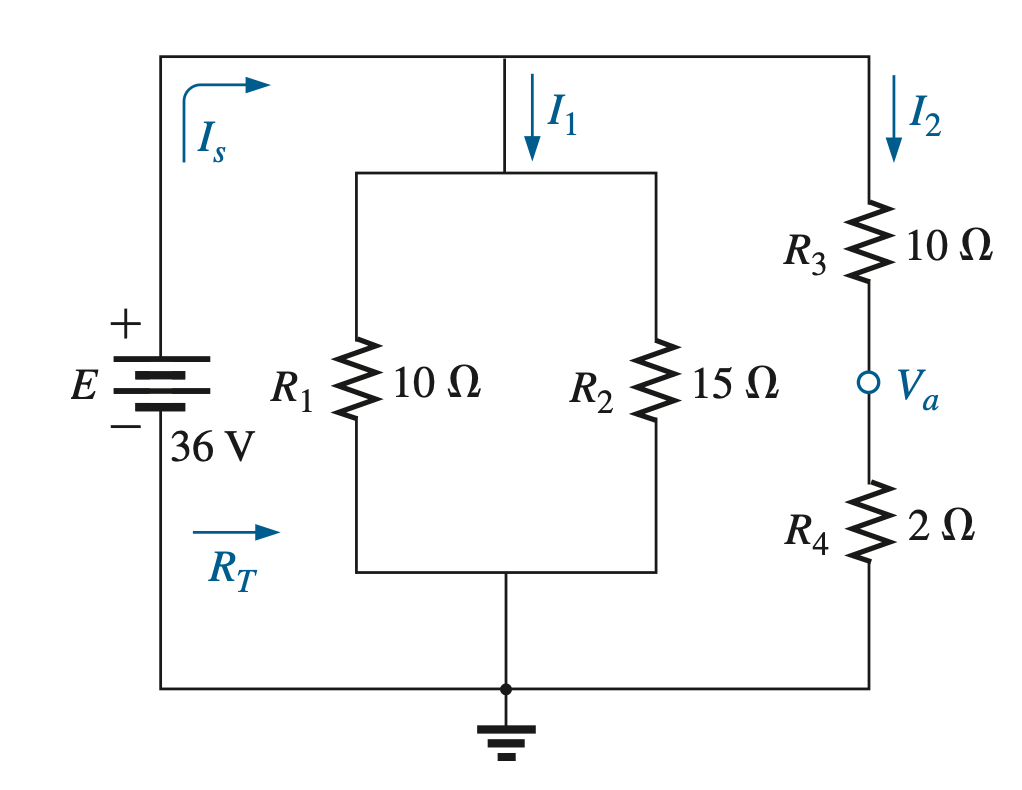
1) and are in parallel with each other, so let’s resolve them into an equivalent resistor:
2) and are in series with each other, so
3) and are together in parallel with and , so we can resolve the circuit into the final equivalent resistance: