Work and Energy

Introduction

The principle of work and energy relates the work done by forces to changes in a particle’s kinetic energy. Rather than solving for acceleration and time, energy methods allow motion to be analyzed using only initial and final states. This is useful when forces vary with position.

Principle of Work and Energy

The total work done by all forces equals the change in kinetic energy. This equation is derived using Σ F = m a \Sigma F = ma and a d s = v d v ads = vdv :

T 1 + Σ U 1 → 2 = T 2 T_{1} + \Sigma U_{1 \rightarrow 2} = T_{2}

Work of Common Forces

Kinetic energy = T = 1 2 m v 2 = T = \frac{1}{2}mv^{2}

Gravitational potential energy = V = m g h = V = mgh

Variable force: U = ∫ s 1 s 2 F d s U = \int_{s_{1}}^{s_{2}}Fds

Spring potential energy = F s = 1 2 k x 2 = F_{s} = \frac{1}{2}kx^{2}

Constant Force: U = F ( s 2 − s 1 ) c o s θ U = F(s_{2} - s_{1})cos\theta

If θ = 0 ∘ \theta = 0{^\circ} , U = F Δ s U = F\Delta s

Gravitational potential energy can be positive or negative while kinetic energy is always positive.

Conservation of Energy

A conservative force is one whose work depends only on the initial and final positions, not on the path taken. Common conservative forces are gravity and spring force. Nonconservative forces depend on the path taken, and include friction and drag.

If only conservative forces act:

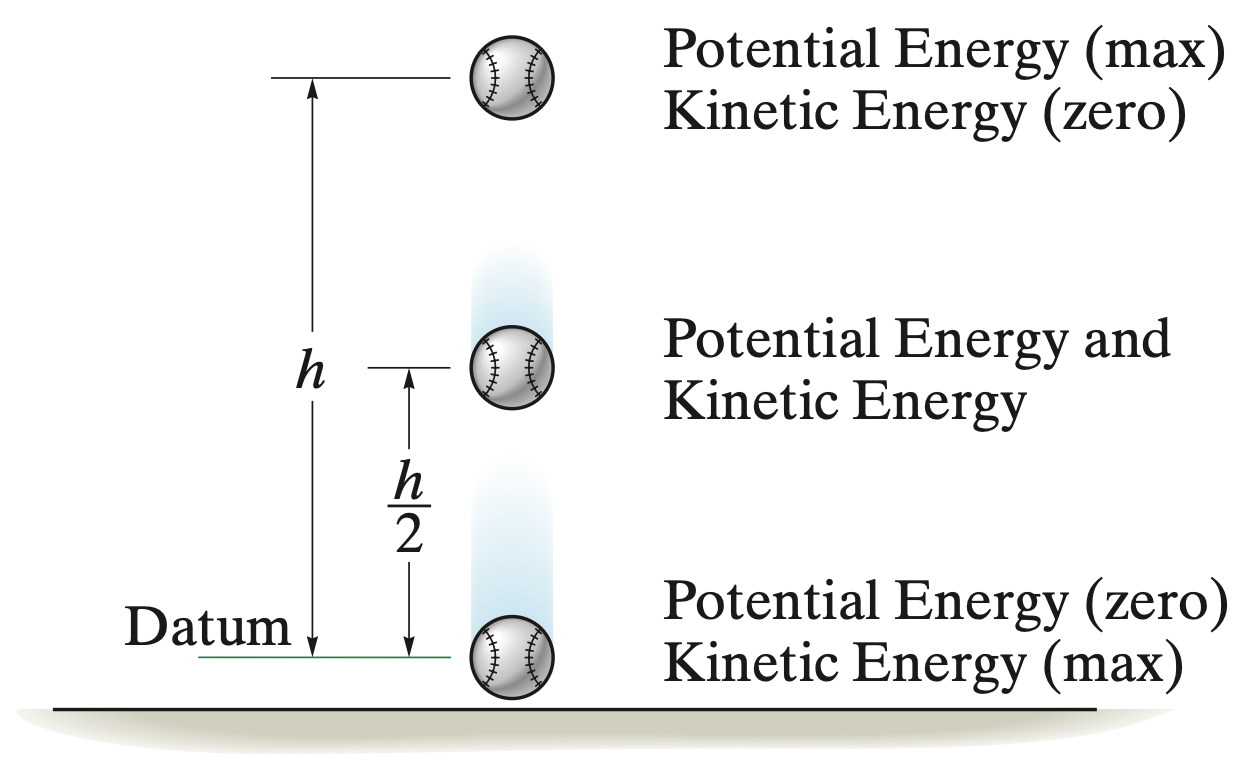
T 1 + V 1 = T 2 + V 2 T_{1} + V_{1} = T_{2} + V_{2}

In other words, K E 1 + P E 1 = K E 2 + P E 2 {KE}_{1} + {PE}_{1} = {KE}_{2} + {PE}_{2}

image

Common applications of conservation:

Spring energy → \rightarrow Kinetic energy (spring → \rightarrow velocity)

Kinetic energy → \rightarrow Potential energy (velocity → \rightarrow height)

Potential energy → \rightarrow Kinetic energy (height → \rightarrow velocity)

Power and Efficiency

Power is the rate at which work is done: P = d U d t = F → ⋅ v → = F v c o s θ P = \frac{dU}{dt} = \overrightarrow{F} \cdot \overrightarrow{v} = Fvcos\theta

Efficiency η = p o w e r o u t p u t p o w e r i n p u t = e n e r g y o u t p u t e n e r g y i n p u t \eta = \frac{power\ output}{power\ input} = \frac{energy\ output}{energy\ input}

Example 1:
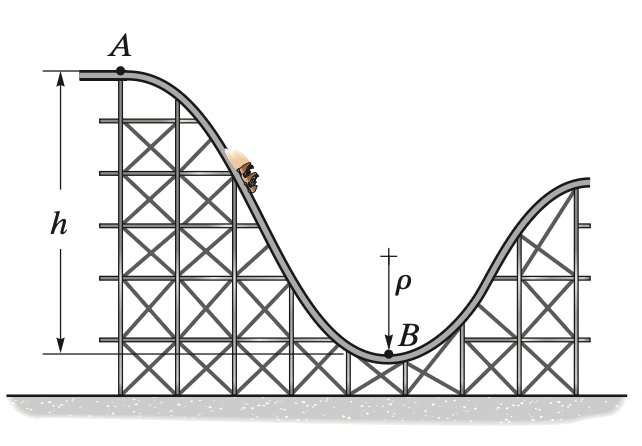
Find: Height of the roller coaster to achieve a speed of 100 km/hr at point B.

image

( 100 k m h r ) ( 1000 m k m ) ( 1 h r 3600 s ) = 27.78 m / s (\frac{100\ km}{hr})(\frac{1000\ m}{km})(\frac{1\ hr}{3600\ s}) = 27.78\ m/s

Potential energy → \rightarrow kinetic energy:

m g h = 1 2 m v 2 mgh = \frac{1}{2}mv^{2}

m ( 9.81 m / s 2 ) ( h ) = 1 2 m ( 27.78 m / s ) 2 m(9.81\ m/s^{2})(h) = \frac{1}{2}m(27.78\ m/s)^{2} ⇒ h = 39.33 m \Rightarrow h = 39.33\ m

Example 2:
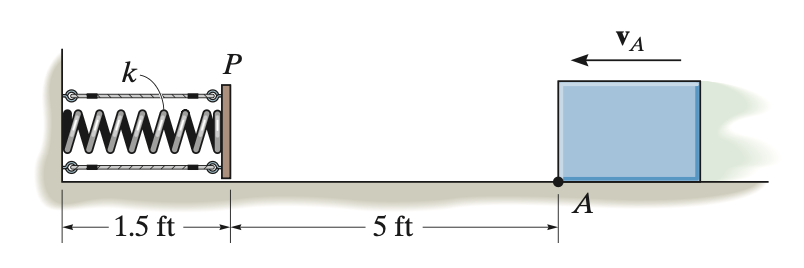
Find the required unstretched length of spring if the spring is compressed 0.2 feet when the 4-lb block slides into it at 9 ft/s. The spring is confined by a plate so that its initial length is 1.5 ft. Neglect any friction or energy loss.

image

Initially, the spring is compressed x i = L o − 1.5 f t x_{i} = L_{o} - 1.5\ ft

At the end, the spring is compressed an additional 0.2 f t 0.2\ ft , so x f = L o − 1.3 f t x_{f} = L_{o} - 1.3\ ft

Kinetic energy + spring potential energy → \rightarrow spring potential energy:

1 2 m v 2 + 1 2 k x 2 = 1 2 k x 2 \frac{1}{2}mv^{2} + \frac{1}{2}kx^{2} = \frac{1}{2}kx^{2}

1 2 ( 4 l b / 32.2 ) ( 9 f t / s ) 2 + 1 2 ( 50 l b / f t ) ( L o − 1.5 f t ) 2 = 1 2 ( 50 l b / f t ) ( L o − 1.3 f t ) 2 \frac{1}{2}(4\ lb/32.2)(9\ ft/s)^{2} + \frac{1}{2}(50\ lb/ft)(L_{o} - 1.5\ ft)^{2} = \frac{1}{2}(50\ lb/ft)(L_{o} - 1.3\ ft)^{2}

L o = 1.9 f t L_{o} = 1.9\ ft

Example 3:
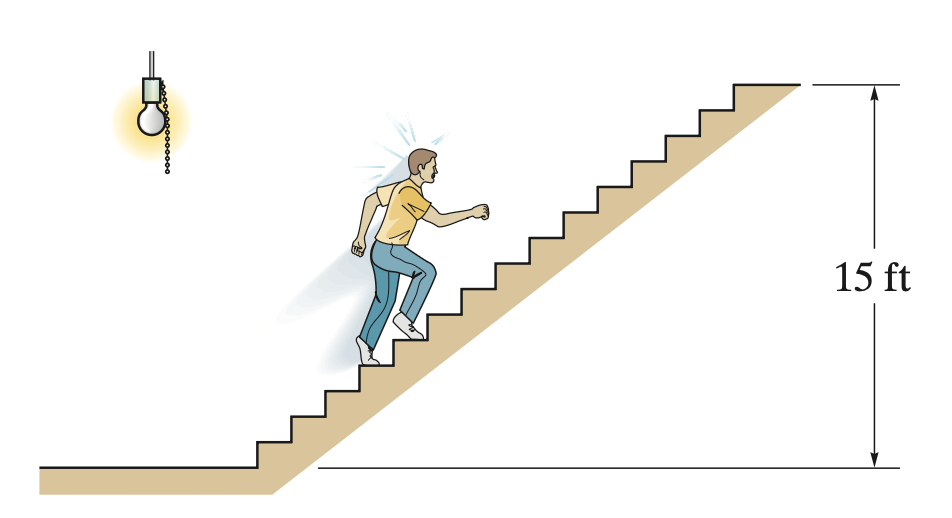
Find the power generated by a 150-lb man running up 15-ft high stairs in 4 s.

image

Work done against gravity: U = W h = ( 150 l b ) ( 15 f t ) = 2250 l b ⋅ f t U = Wh = (150\ lb)(15\ ft) = 2250\ lb \cdot ft

P = d U d t = 2250 l b ⋅ f t 4 s = 562.5 f t ⋅ l b / s ≈ 763 W = 763 J / s P = \frac{dU}{dt} = \frac{2250\ lb \cdot ft}{4\ s} = 562.5\ ft \cdot lb/s \approx 763\ W = 763\ J/s

Example 4:
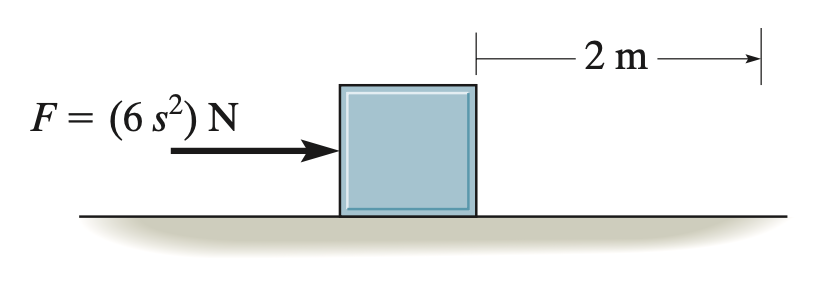
Find the work of the force when it displaces 2 m.
image

U = ∫ s 1 s 2 F d s = ∫ 0 2 ( 6 s 2 ) d s = 16 J U = \int_{s_{1}}^{s_{2}}Fds = \int_{0}^{2}(6s^{2})ds = 16\ J