Rotational Kinematics
Introduction
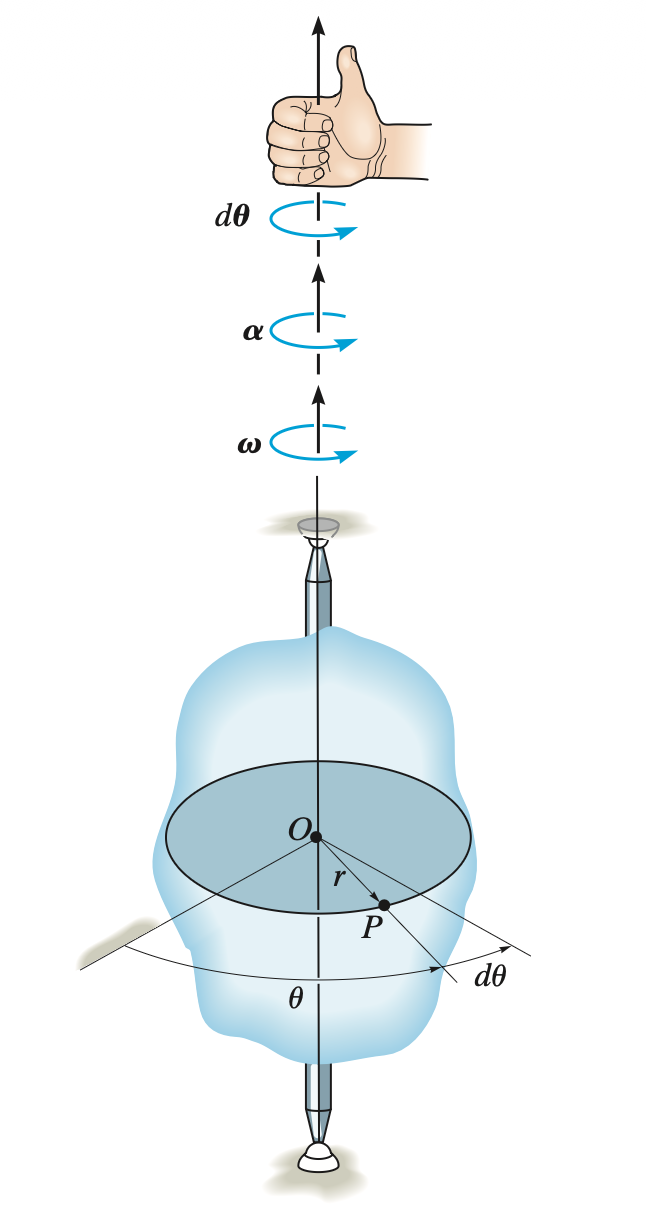
Rotational kinematics describes the motion of rigid bodies rotating about a fixed axis. It relates angular position, velocity, and acceleration without considering the forces or moments causing the motion. These relationships are directly analogous to linear kinematics.
Angular Position, Velocity, and Acceleration
Angular position is measured in , and .
Angular velocity is measured in , and
Angular acceleration is measured in , and
and
Constant Angular Acceleration
The equations are analogous to the constant-acceleration equations for linear motion:
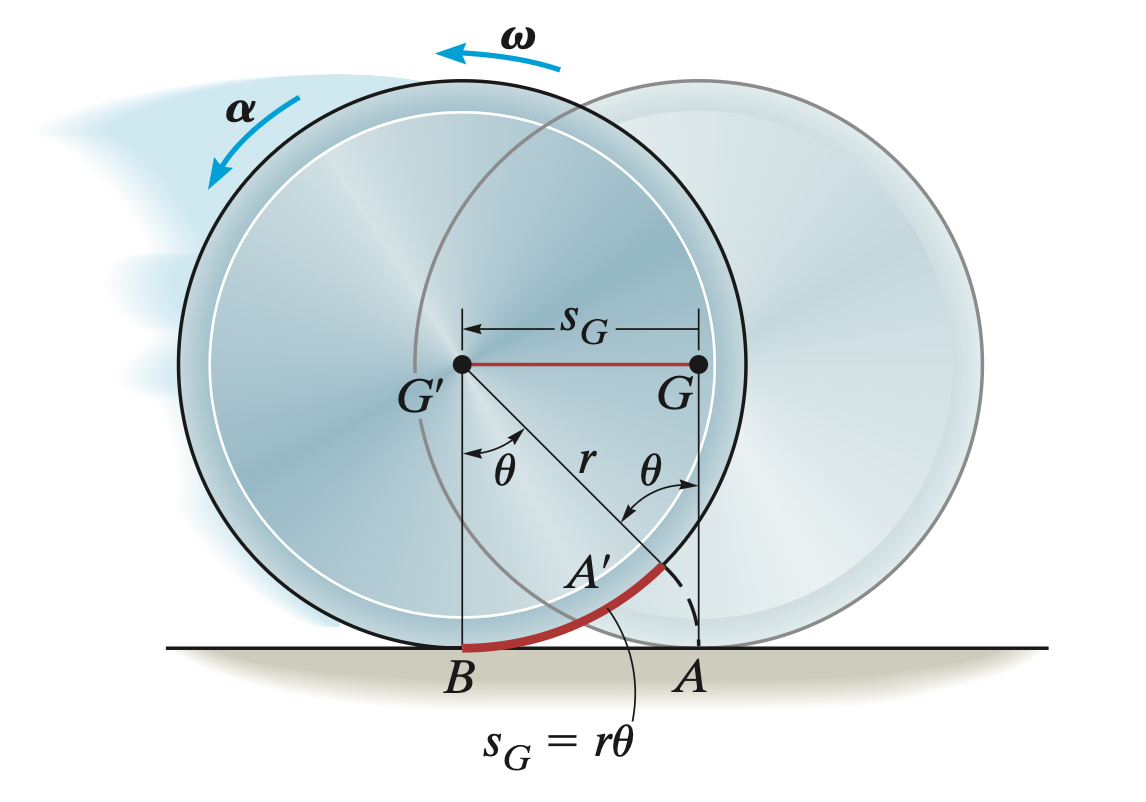
Rolling Without Slipping
For pure rolling,
Varying Angular Acceleration
When is changing over time, calculus is required:
When , use :
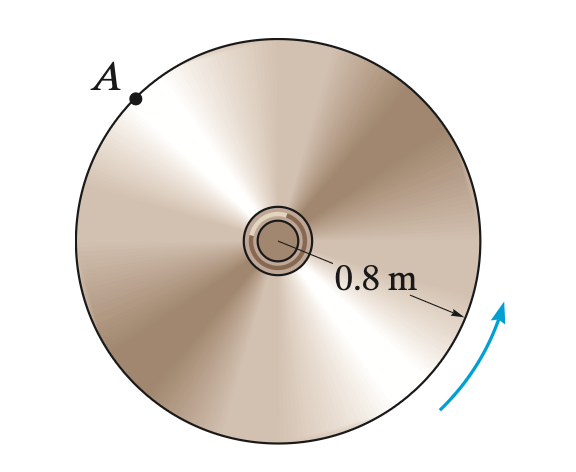
Example 1:
Find the magnitude of velocity and acceleration of point A on the disk when t = 0.5 s if .
At t = 0.5 s:
ans.
ans.
Example 2:
Find the number of revolutions a wheel must undergo to acquire a clockwise angular velocity of 15 rad/s with initial angular velocity of 10 rad/s and constant angular acceleration of 3 rad/s2.
Example 3:
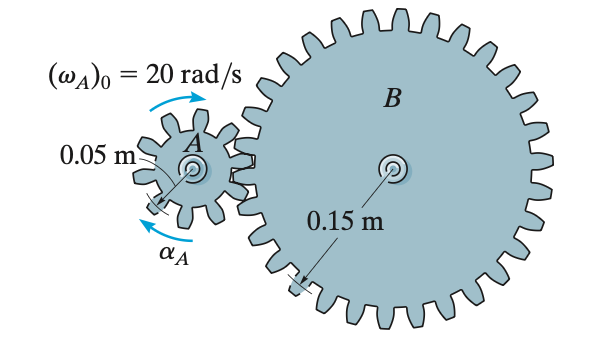
Find: Angular velocity of gear B when t = 2 s if gear A has an angular acceleration of (4t3) rad/s2 and the gear is initially turning at 20 rad/s.
Find angular velocity of gear A:
Since the gears roll without slipping: