Rectilinear Kinematics

Introduction

Particle kinematics describes the motion of a particle without considering the forces that cause it. The main focus is rectilinear motion: position, velocity, and acceleration along a straight line. Problems include constant or variable acceleration motion and motion from graphs.

Kinematic Variables

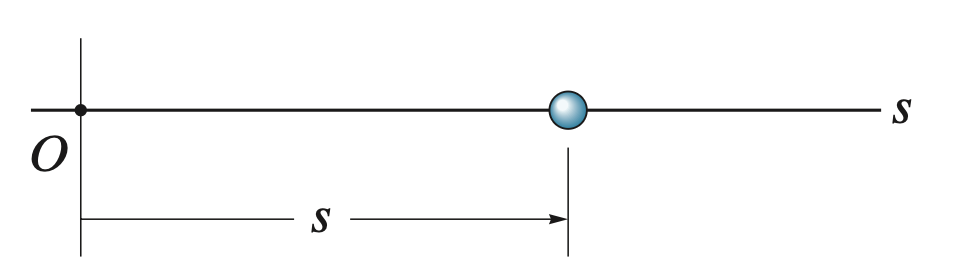
Position: s = s ( t ) s = s(t{)^{}}^{}
image

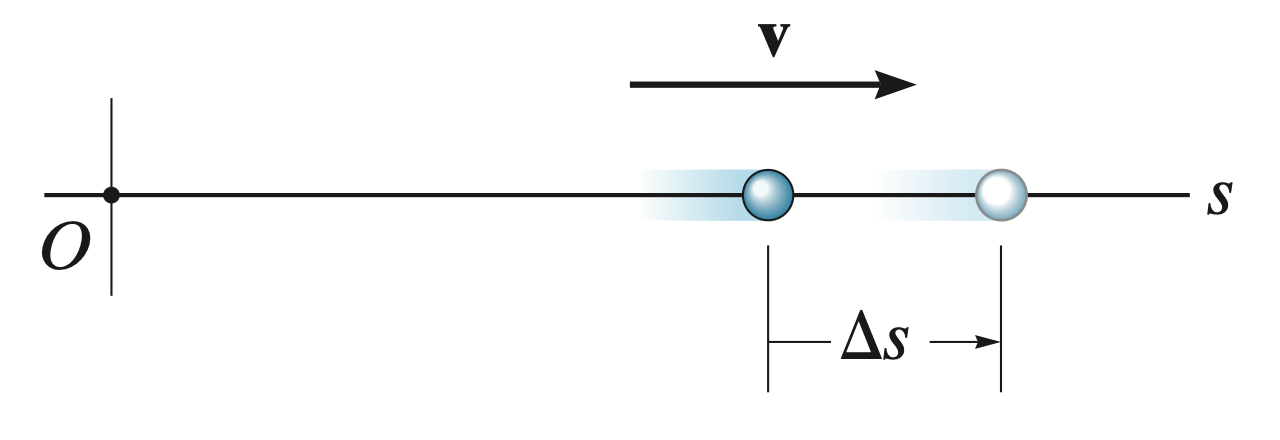
Velocity: v = d s d t v = \frac{ds}{dt}^{}

image

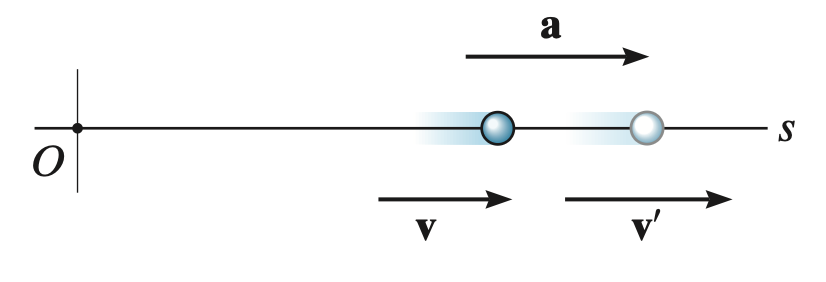
Acceleration: a = d v d t = d 2 s d t 2 a = \frac{dv}{dt} = \frac{d^{2}s}{dt^{2}}

image

Constant Acceleration

When acceleration is constant (i.e. gravity), these equations are valid:

s = s 0 + v 0 t + 1 2 a t 2 s = s_{0} + v_{0}t + \frac{1}{2}at^{2}

v = v 0 + a t v = v_{0} + at

v 2 = v 0 2 + 2 a ( s − s 0 ) v^{2} = v_{0}^{2} + 2a(s - s_{0})

Variable Acceleration

When acceleration is changing over time, calculus is required:

a ( t ) = d v d t a(t) = \frac{dv}{dt} ⇒ \Rightarrow v = ∫ a ( t ) d t v = \int_{}^{}a(t)dt

v ( t ) = d s d t v(t) = \frac{ds}{dt}^{} ⇒ \Rightarrow s = ∫ v ( t ) d t s = \int_{}^{}v(t)dt

If acceleration is given as a function of position, use a d s = v d v ads = vdv : ∫ s 0 s a d s = ∫ v 0 v v d v \int_{s_{0}}^{s}ads = \int_{v_{0}}^{v}vdv

image

Graphical Relationships

Position-Time Graph:

  • slope = velocity

Velocity-Time Graph:

  • slope = acceleration

  • area under curve = change in position (displacement)

Acceleration-Time Graph:

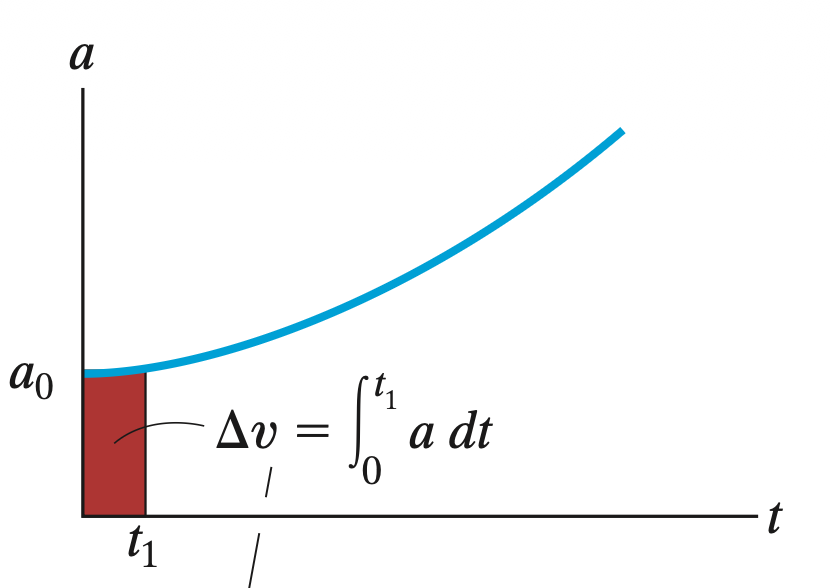
  • area under curve = change in velocity

Example 1:
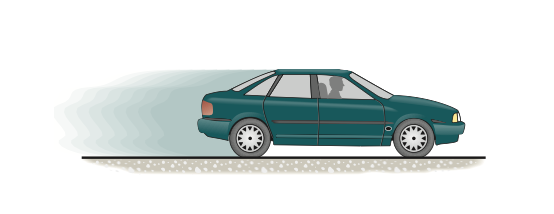
Find the constant acceleration of the car if the car’s velocity decreases from 35 m/s to 10 m/s in 15 s.
image

v = v 0 + a t v = v_{0} + at

10 m / s = 35 m / s + a ( 15 s ) 10\ m/s = 35\ m/s + a(15\ s)

a = − 1.67 m / s 2 a = - 1.67\ m/s^{2}

image

Example 2:
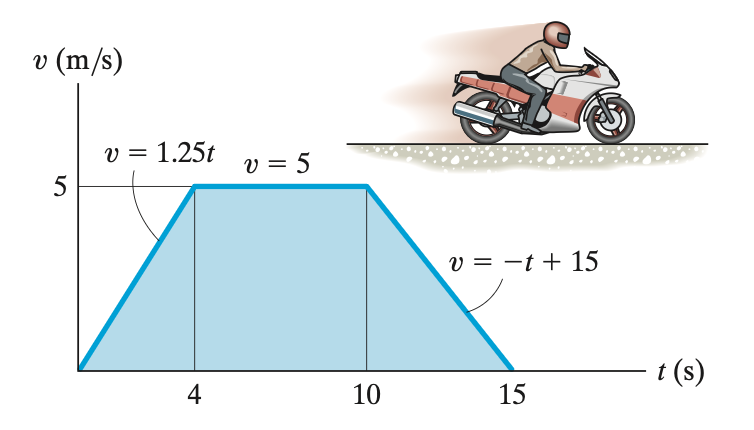
Find the total distance the motorcycle travels until at t = 15 s.

s = ∫ 0 15 v ( t ) d t = ∫ 0 4 1.25 t d t + ∫ 4 10 5 d t + ∫ 10 15 ( − t + 15 ) d t s = \int_{0}^{15}v(t)dt = \int_{0}^{4}1.25t\ dt + \int_{4}^{10}5\ dt + \int_{10}^{15}( - t + 15)\ dt

s = 52.5 m s = 52.5\ m

Example 3:
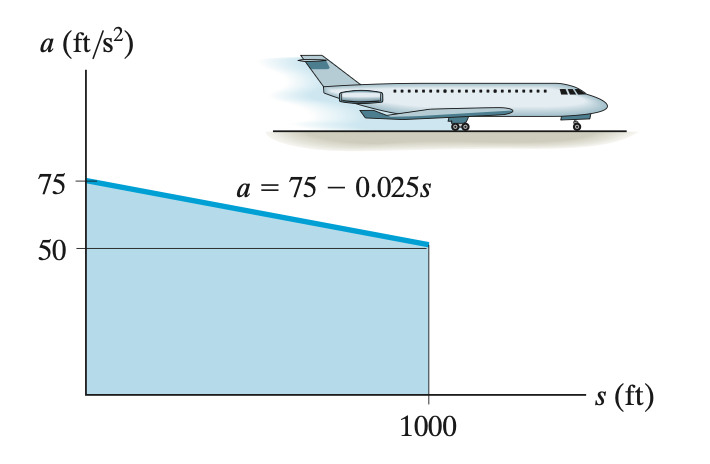
Find the velocity of the plane when it has traveled 1000 ft if it starts from rest.
image

Since we are given a ( s ) a(s) , we have to use a d s = v d v ads = vdv .

∫ s 0 s a ( s ) d s = ∫ v 0 v v d v \int_{s_{0}}^{s}a(s)ds = \int_{v_{0}}^{v}vdv

∫ 0 1000 ( 75 − 0.025 s ) d s = ∫ 0 v v d v \int_{0}^{1000}(75 - 0.025s)ds = \int_{0}^{v}vdv

62500 = 1 2 v 2 62500 = \frac{1}{2}v^{2}

v = 353.6 f t / s v = 353.6\ ft/s