Projectile Motion
Introduction
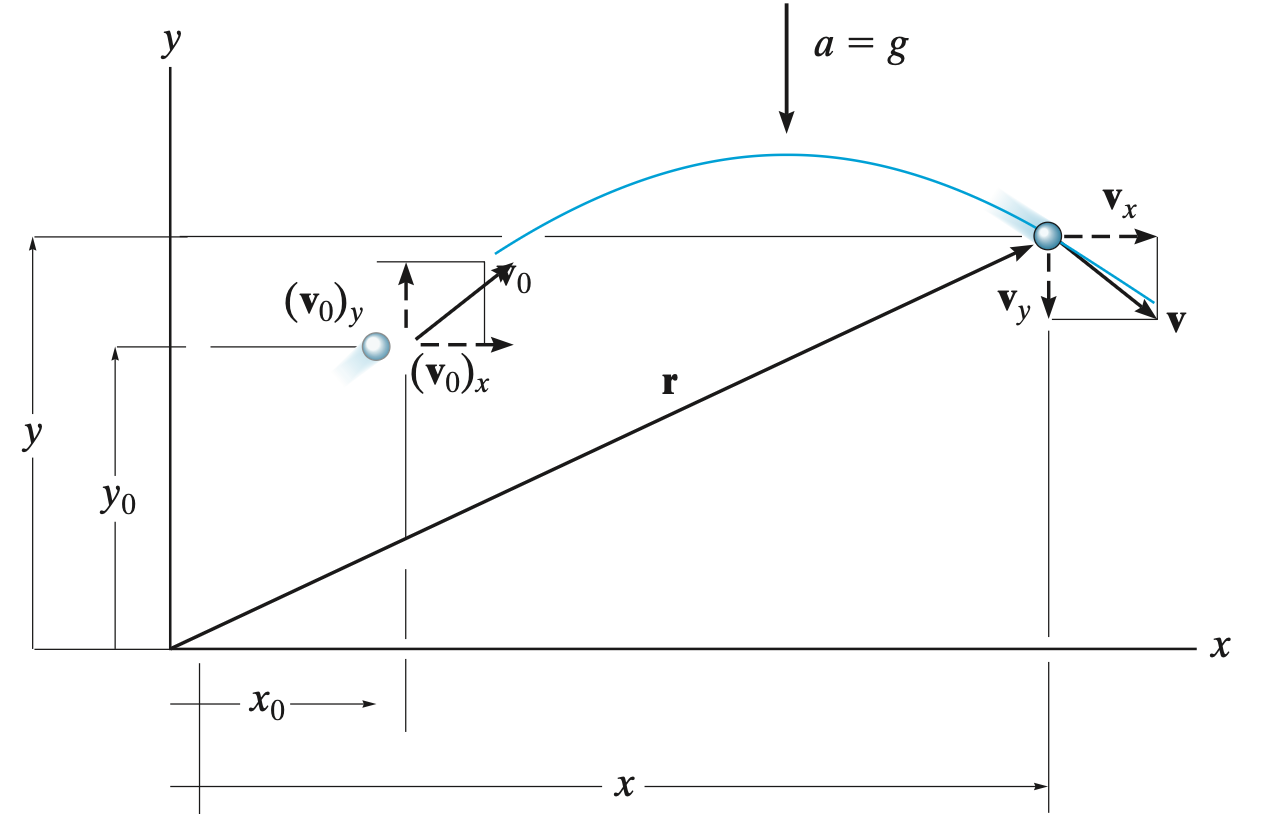
Projectile motion is a special case of particle kinematics where motion occurs simultaneously in two independent rectilinear directions: horizontal and vertical. The motion in each individual direction is analyzed using the same rectilinear kinematic equations. The horizontal motion has constant velocity, while the vertical motion has constant acceleration due to gravity. By separating the motion into and components, projectile problems can be solved using kinematic relationships.
Initial Velocity Components
If the projectile is launched with speed at angle :
Horizontal Motion
Since ,
horizontal velocity stays constant:
Vertical Motion
Since
-
-
-:
Maximum Height & Impact Velocity
At the top of the trajectory,
At any time,
and the direction of the velocity is
.
Inclined Surfaces
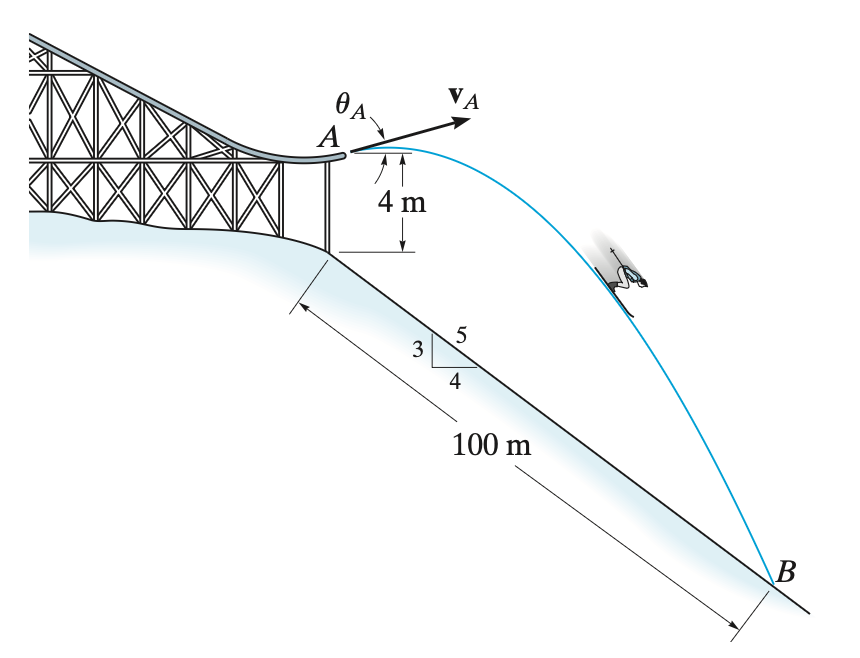
A projectile can land on an inclined surface or curve instead of
level ground. In these problems, make a surface equation and a motion
equation and solve for the intersection. For instance, on a constant
incline,
.
For a curve with an equation,
is given. A slope triangle may also be provided.
Using the three equations:
We can solve for
(the range),
,
and
(time of flight).
Example 1:
Find the time of flight and range of the ball.
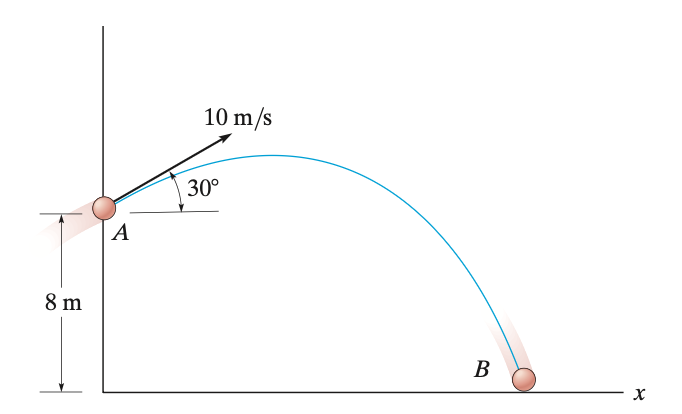
Horizontal component:
Vertical component:
Solving for time of flight given
:
Solving by graphing
Solving for range with the time of flight:
Example 2:
Find the initial speed and time of flight if the skier leaves
the ramp at an angle of 25°.
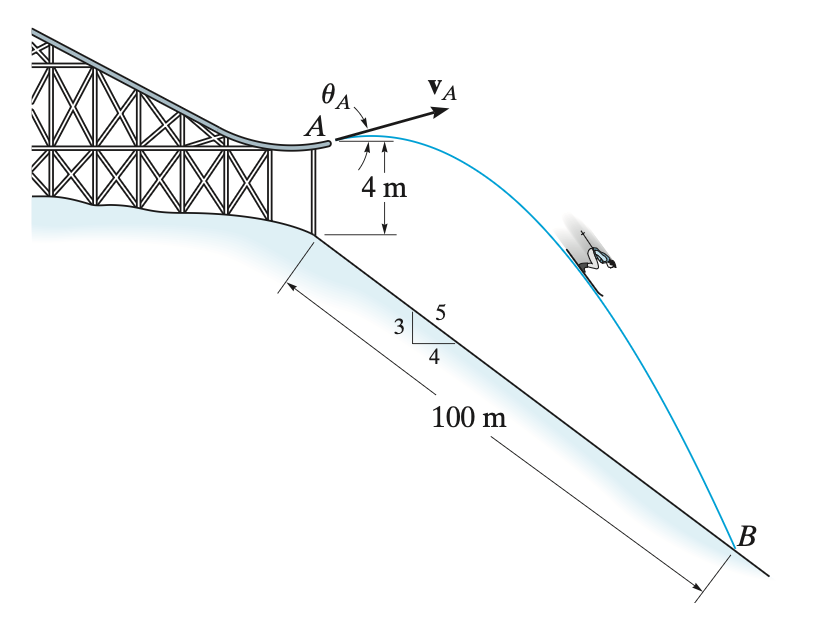
Horizontal component of velocity:
Vertical component of velocity:
Total horizontal distance traveled:
Total vertical distance traveled:
Solve by graphing both equations:
,