
Kinetics of Rigid Bodies
Introduction
Rigid body kinetics relates the forces and moments acting on a rigid body to its translational and rotational motion. Unlike particle kinetics, rigid bodies have both linear and angular acceleration, so Newton's Second Law must be applied to both translation and rotation simultaneously.
Mass Moment of Inertia
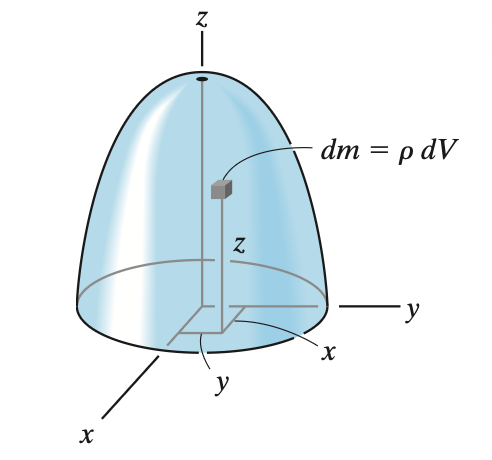
The mass moment of inertia () measures a body’s resistance to angular acceleration, just as mass measures resistance to linear acceleration.
, where
Common Formulas:
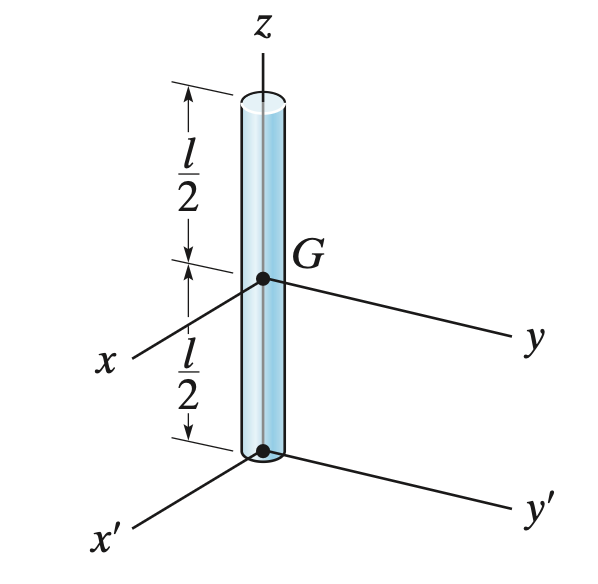
Point mass:
Radius of gyration:
Slender rod (center):
Slender rod (about end):
Solid disk:
Rectangular plate:
Parallel-Axis Theorem
The parallel-axis theorem allows you to find the mass moment of inertia about any axis parallel to the centroidal axis. Use when the axis of rotation does not pass through the centroid:
where is the moment of inertia about another axis and is about the centroidal axis
is the distance between the two parallel axes
Newton’s Second Law for Rotation
After applying to the center of mass, apply the rotational equation:
where is the mass moment of inertia about the center of mass.
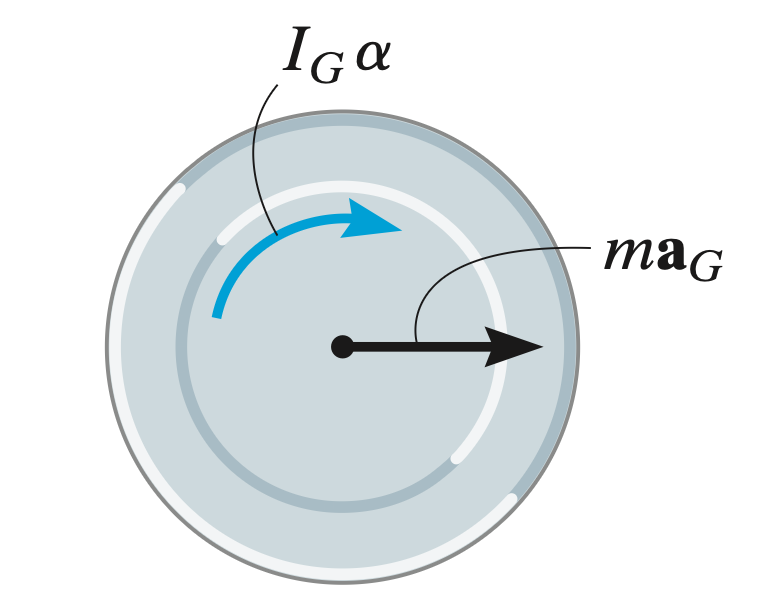
Solving Rigid Bodies Kinetics Problems
-
Draw a FBD and identify the center of mass G.
-
Draw the kinetic diagram showing and .
-
Apply to solve for translational motion.
-
Determine the mass moment of inertia from the radius of gyration, formulas, etc.
-
Apply to solve for rotational motion.
-
Use kinematics relationships to relate and as needed.
Example 1:
Find the radius of gyration (k) about the axis passing through point O of the pendulum consisting of a 4-kg circular disk and a 2-kg slender rod.
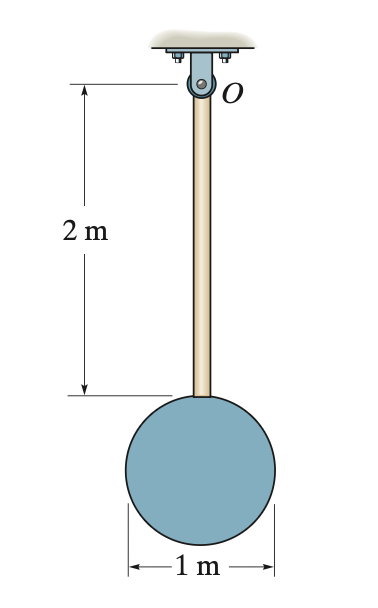
Moment of inertia of rod about end:
Moment of inertia of disk about center:
Parallel axis theorem for disk:
Radius of gyration:
Example 2:
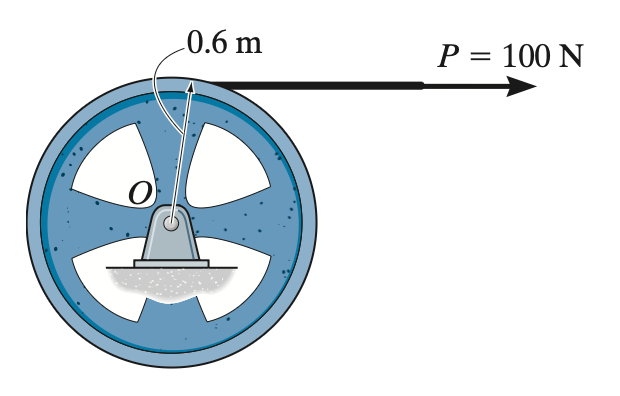
Find the angular velocity at t = 3 s if the 100-kg wheel starts from rest and has a radius of gyration about its center O of 500 mm.
Example 3:
Find the angular acceleration and acceleration of the center of the 120-kg beam if cord B is suddenly cut. The beam is a uniform slender rod.
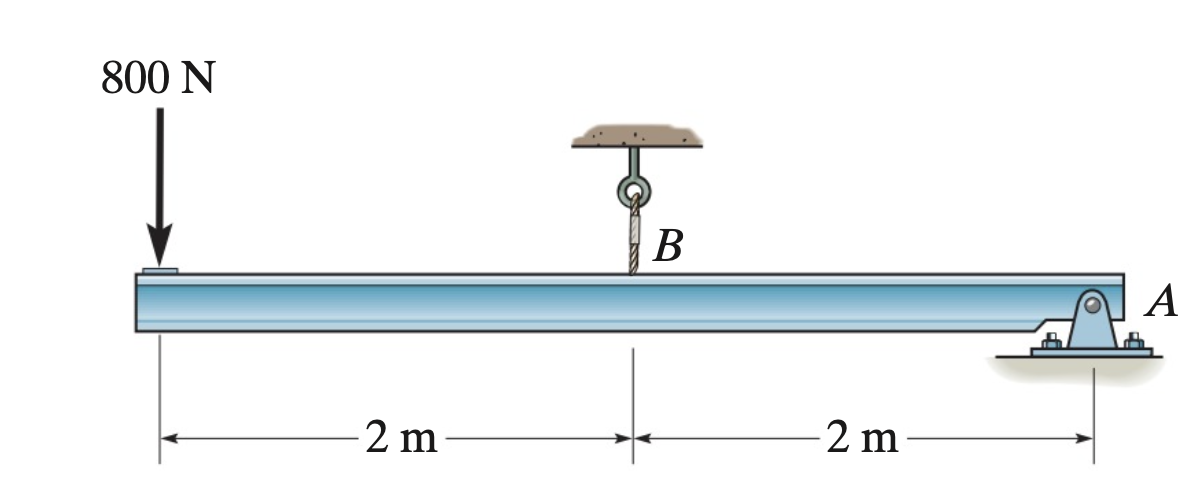
acting at 2 m
Acceleration of the center: