Impulse, Momentum, and Impact

Introduction

Impulse and momentum methods are useful when forces act over a short time interval or when we are interested in the velocities before and after an event. Rather than relating force to acceleration, these methods relate force and time to changes in momentum.

Linear Momentum

Linear momentum is the vector quantity equal to a particle’s mass times its velocity:

L → = m v → \overrightarrow{L} = m\overrightarrow{v}

Linear Impulse

Impulse is the effect of a force over a time interval and is equal to the area under a force-time curve:

I → = ∫ t 1 t 2 F → d t \overrightarrow{I} = \int_{t_{1}}^{t_{2}}\overrightarrow{F}dt

For a constant force, I → = F Δ t \overrightarrow{I} = F\Delta t .

Angular Momentum

Angular momentum of a particle is the “moment” of the particle’s linear momentum:

H → O = r → × m v → {\overrightarrow{H}}_{O} = \overrightarrow{r} \times m\overrightarrow{v}

Principles of Impulse and Momentum

The net linear/angular impulse acting on a particle equals its change in linear/angular momentum:

Linear: m v 1 + Σ ∫ t 1 t 2 F d t = m v 2 mv_{1} + \Sigma\int_{t_{1}}^{t_{2}}Fdt = mv_{2}

Angular: ( H O ) 1 + Σ ∫ t 1 t 2 M O d t = ( H O ) 2 {{(H}_{O})}_{1} + \Sigma\int_{t_{1}}^{t_{2}}M_{O}dt = {{(H}_{O})}_{2}

Conservation of Linear Momentum

image

If the net external impulse is zero:

Σ L i n i t i a l = Σ L f i n a l \Sigma L_{initial} = \Sigma L_{final}

For a system of two particles:

( m 1 v 1 + m 2 v 2 ) i n i t i a l = ( m 1 v 1 + m 2 v 2 ) f i n a l {{(m}_{1}v_{1} + m_{2}v_{2})}_{initial} = {{(m}_{1}v_{1} + m_{2}v_{2})}_{final}

Impact

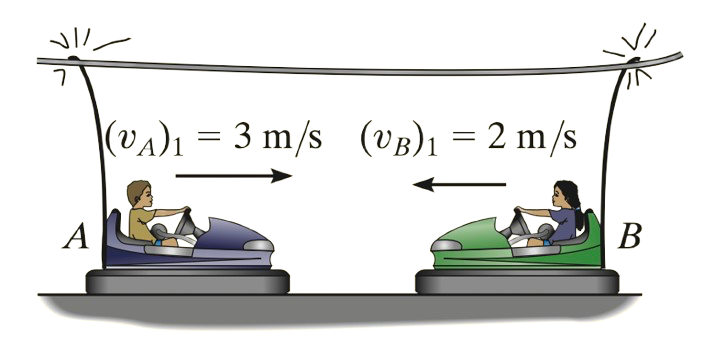
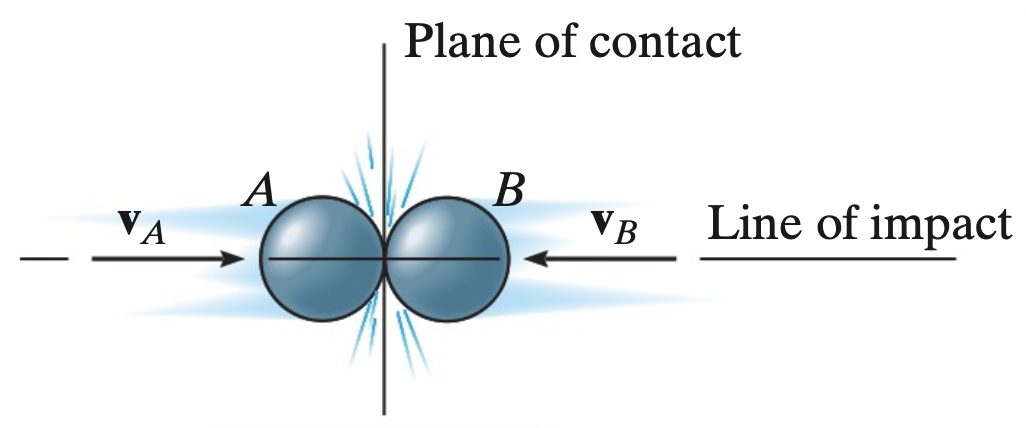
image

Coefficient of restitution e = ( v B ) 2 − ( v A ) 2 ( v A ) 1 − ( v B ) 1 e = \frac{(v_{B})_{2}\ - \ (v_{A})_{2}\ }{(v_{A})_{1} - \ (v_{B})_{1}\ \ }

For a perfectly plastic impact, the particles stick together at the end:

( m 1 v 1 + m 2 v 2 ) i n i t i a l = ( m 1 + m 2 ) v f i n a l {(m_{1}v_{1} + m_{2}v_{2})}_{initial} = (m_{1} + m_{2})v_{final}

For an oblique impact, the restitution equation above applies only to the normal direction.

Example 1:
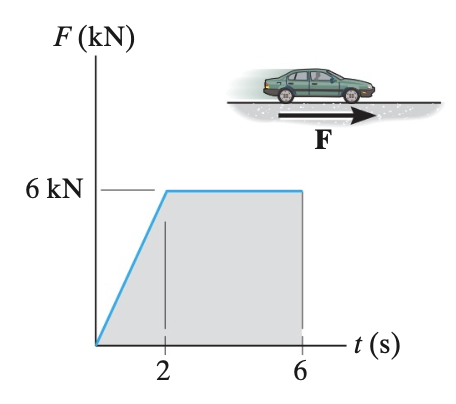
Find the final speed at t = 6 s of 1500-kg car that starts from rest.

image

Area under the curve = 2 ( 6 ) 2 + 4 ( 6 ) = 30 k N ⋅ s = 30000 N ⋅ s = \frac{2(6)}{2} + 4(6) = 30\ kN \cdot s = 30000\ N \cdot s

m v 1 + ∫ t 1 t 2 F d t = m v 2 mv_{1} + \int_{t_{1}}^{t_{2}}Fdt = mv_{2}

0 + 30000 N ⋅ s = ( 1500 k g ) ( v 2 ) ⇒ v 2 = 20 m / s 0 + 30000\ N \cdot s = (1500\ kg)(v_{2}) \Rightarrow v_{2} = 20\ m/s

Example 2:
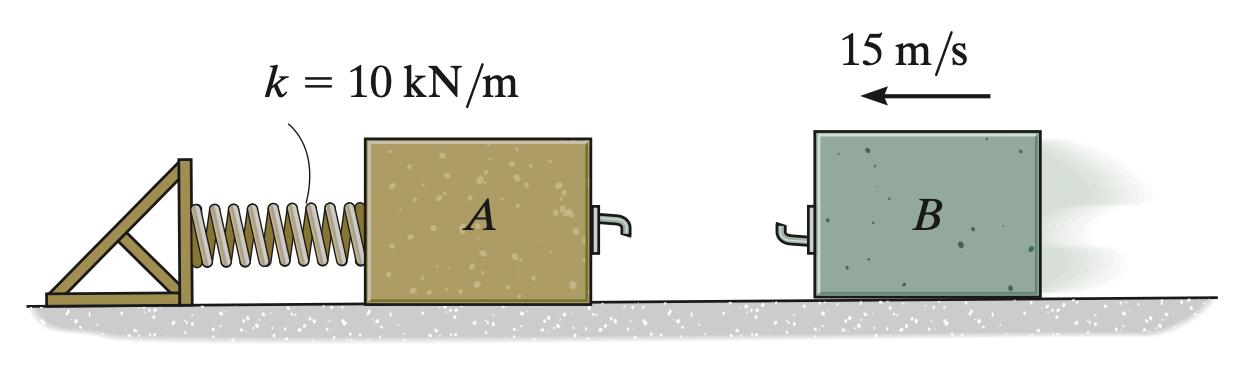
Find the final velocity after impact and maximum compression of the spring if A (15 kg) is stationary and B (10 kg) has a velocity of 15 m/s before collision.

image

1) Velocity directly after impact:

( m A v A + m B v B ) i n i t i a l = ( m A + m B ) v f i n a l {(m_{A}v_{A} + m_{B}v_{B})}_{initial} = (m_{A} + m_{B})v_{final}

15 k g ⋅ 0 + 10 k g ⋅ 15 m / s = ( 15 k g + 10 k g ) ( v f i n a l ) ⇒ 15\ kg \cdot 0 + 10\ kg \cdot 15\ m/s = (15\ kg + 10\ kg)(v_{final}) \Rightarrow v f i n a l = 6 m / s v_{final} = 6\ m/s

2) Maximum compression:

kinetic energy → \rightarrow spring potential energy

1 2 m v 2 = 1 2 k x 2 \frac{1}{2}mv^{2} = \frac{1}{2}kx^{2}

1 2 ( 15 k g + 10 k g ) ( 6 m / s ) 2 = 1 2 ( 10000 N / m ) ( x ) 2 ⇒ x = 0.3 m \frac{1}{2}(15\ kg + 10\ kg)(6\ m/s)^{2} = \frac{1}{2}(10000\ N/m)(x)^{2} \Rightarrow x = 0.3\ m

Example 3:
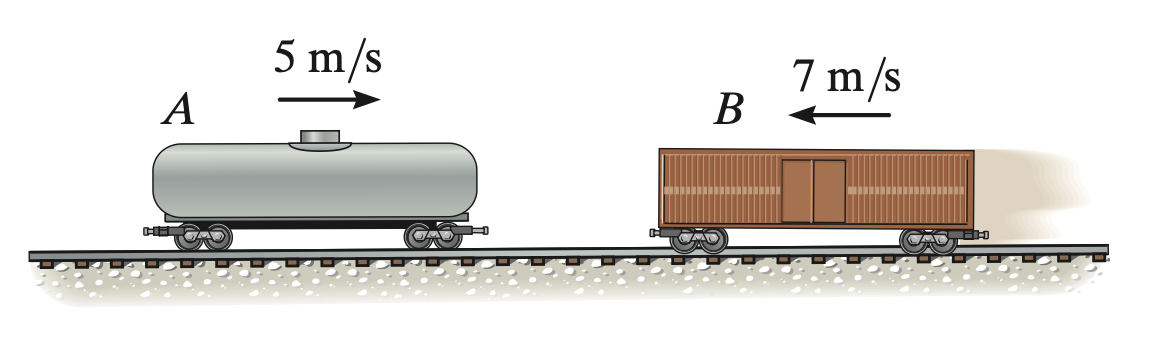
Find the velocity of each car after the collision. Car A is 15 Mg, Car B is 25 Mg, and e = 0.6.

image

( m A v A + m B v B ) i n i t i a l = ( m A v A + m B v B ) f i n a l {{(m}_{A}v_{A} + m_{B}v_{B})}_{initial} = {{(m}_{A}v_{A} + m_{B}v_{B})}_{final}

( 15000 k g ) ( 5 m / s ) + ( 25000 k g ) ( − 7 m / s ) = ( 15000 k g ) ( v A ) + ( 25000 k g ) ( v B ) (15000\ kg)(5\ m/s) + (25000\ kg)( - 7\ m/s) = (15000\ kg)(v_{A}) + (25000\ kg)(v_{B})

(1) − 100000 = 15000 v A + 25000 v B - 100000 = 15000v_{A} + 25000v_{B}

(2) e = ( v B ) 2 − ( v A ) 2 ( v A ) 1 − ( v B ) 1 ⇒ 0.6 = v B − v A 5 m / s − ( − 7 m / s ) ⇒ 7.2 = v B − v A e = \frac{(v_{B})_{2}\ - \ (v_{A})_{2}\ }{(v_{A})_{1} - \ (v_{B})_{1}\ \ }\ \Rightarrow \ 0.6 = \frac{v_{B} - {\ v}_{A}}{5\ m/s\ - \ ( - 7\ m/s)}\ \Rightarrow \ 7.2 = v_{B} - {\ v}_{A}

Solving system of equations: v A = − 7 m / s v_{A} = - 7\ m/s and v B = 0.2 m / s v_{B} = 0.2\ m/s