Impulse and Momentum of Rigid Bodies

Introduction

Impulse and momentum methods for rigid bodies relate external impulses to changes in both linear and angular momentum. Once again, this method is especially useful for impacts and short-duration forces when acceleration is difficult to determine.

Angular Momentum

image

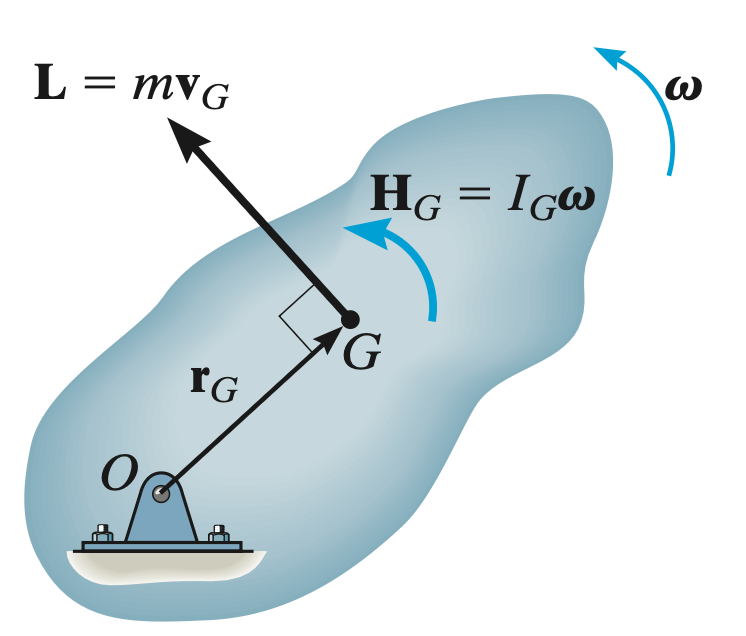
For planar motion where a body rolls without slipping:

H O = I G ω + m v r ⊥ = I G ω + m r 2 ω H_{O} = I_{G}\omega + mvr_{\bot} = I_{G}\omega + mr^{2}\omega

When a body is translating and rotating:

H O = I G ω + r → G / O × m v → G H_{O} = I_{G}\omega + {\overrightarrow{r}}_{G/O} \times m{\overrightarrow{v}}_{G}

Principle of Angular Impulse and Momentum

The net angular impulse acting on a rigid body equals its change in angular momentum:

( H O ) 1 + Σ ∫ t 1 t 2 M O d t = ( H O ) 2 {{(H}_{O})}_{1} + \Sigma\int_{t_{1}}^{t_{2}}M_{O}dt = {{(H}_{O})}_{2}

If an applied moment is constant:

( H O ) 1 + M Δ t = ( H O ) 2 {{(H}_{O})}_{1} + M\Delta t = {{(H}_{O})}_{2}

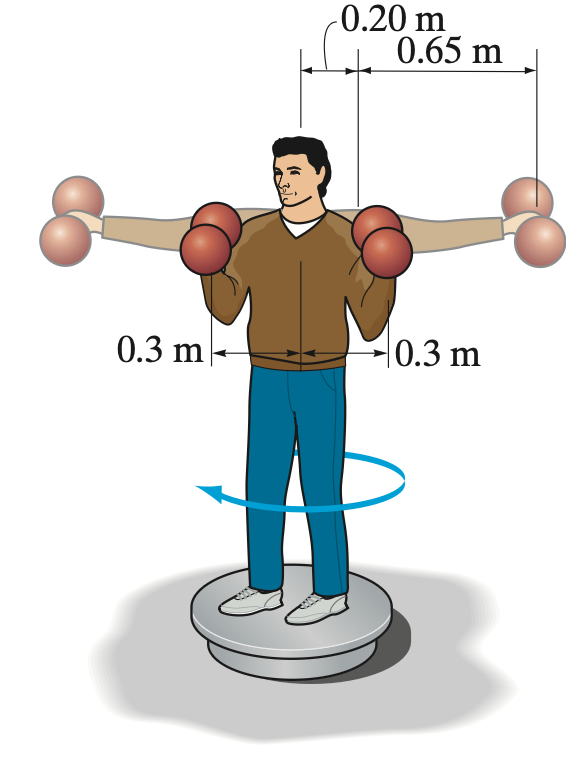
Conservation of Angular Momentum

image

If the external impulsive moment about a point is zero:

H 1 = H 2 H_{1} = H_{2}

For rotation about a fixed axis:

I 1 ω 1 = I 2 ω 2 I_{1}\omega_{1} = I_{2}\omega_{2}

If the bodies “stick together”:

( I 1 ω 1 + I 2 ω 2 ) i n i t i a l = ( I 1 + I 2 ) ω f i n a l {{(I}_{1}\omega_{1}{+ I}_{2}\omega_{2})}_{initial} = (I_{1} + I_{2})\omega_{final}

Example 1:
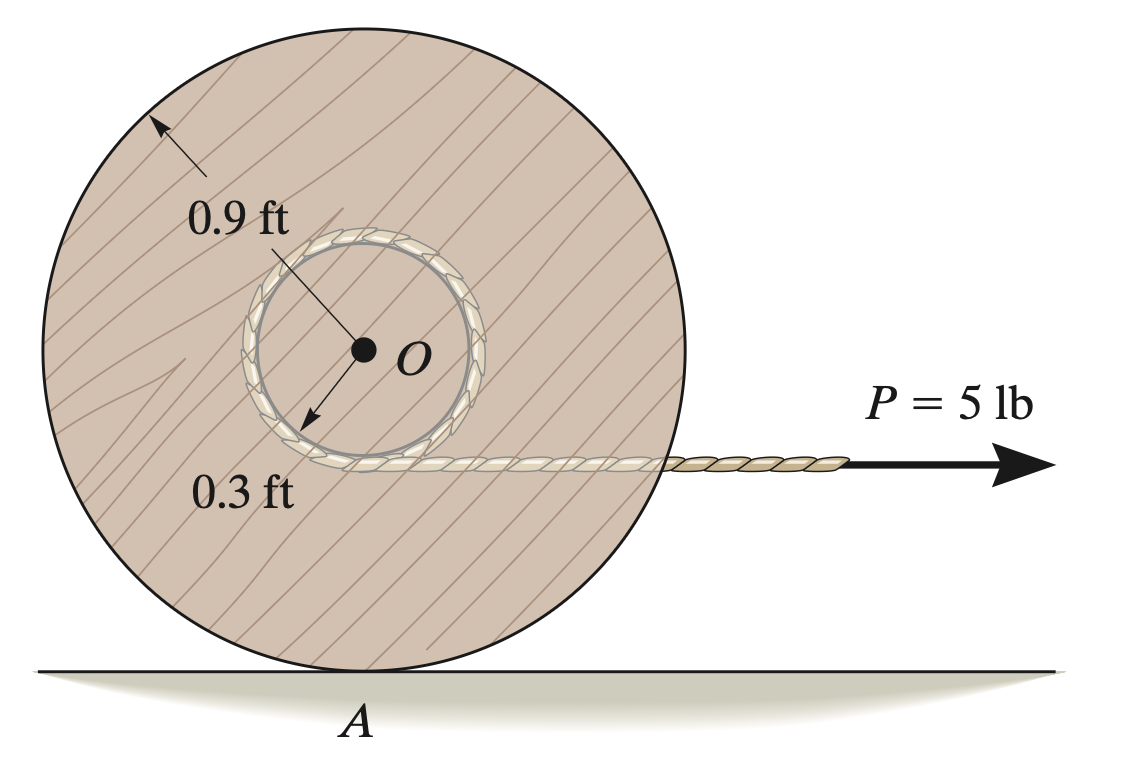
Find: Angular velocity in 4 s of the 30-lb spool with a radius of gyration of 0.45 ft and a horizontal force P of 5 lb. The spool rolls without slipping.

image

I O = m k O 2 = ( 30 l b / 32.2 ) ( 0.45 f t ) 2 = 0.189 s l u g ⋅ f t 2 I_{O} = mk_{O}^{2} = (30\ lb/32.2)(0.45\ ft)^{2} = 0.189\ slug \cdot ft^{2}

Angular impulse and momentum about A:

( H A ) 1 + M Δ t = ( H A ) 2 {{(H}_{A})}_{1} + M\Delta t = {{(H}_{A})}_{2}

0 + ( 5 l b ⋅ 0.6 f t ) ( 4 s ) = H A 0 + (5\ lb \cdot 0.6\ ft)(4\ s) = H_{A}

H A = 12 s l u g ⋅ f t 2 / s H_{A} = 12\ slug \cdot ft^{2}/s

Angular momentum about A:

H A = I O ω + m r 2 ω H_{A} = I_{O}\omega + mr^{2}\omega

12 s l u g ⋅ f t 2 / s = ( 0.189 s l u g ⋅ f t 2 ) ( ω ) + ( 30 l b 32.2 ) ( 0.9 f t ) ( ω ) 12slug \cdot ft^{2}/s = (0.189\ slug \cdot ft^{2})(\omega) + (\frac{30\ lb}{32.2})(0.9\ ft)(\omega)

ω = 12.7 r a d / s \omega = 12.7\ rad/s

Example 2:
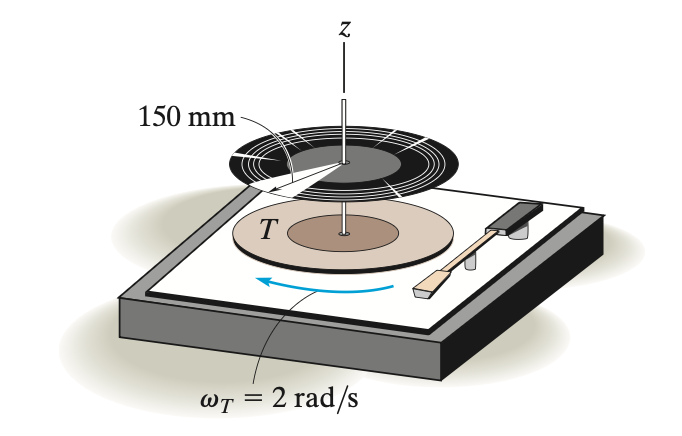
Find: Final angular velocity of the 0.75-kg turntable with a radius of gyration of 125 mm when a 50-g record (thin disk) falls on it. The initial angular velocity of the turntable is 2 rad/s and it turns freely.

image

I t u r n t a b l e = m k z 2 = ( 0.75 k g ) ( 0.125 m ) 2 = 0.0117 k g ⋅ m 2 I_{turntable} = mk_{z}^{2} = (0.75\ kg)(0.125\ m)^{2} = 0.0117\ kg \cdot m^{2}

I r e c o r d = 1 2 m r 2 = 1 2 ( 0.05 k g ) ( 0.15 m ) 2 = 0.0005625 k g ⋅ m 2 I_{record} = \frac{1}{2}mr^{2} = \frac{1}{2}(0.05\ kg)(0.15\ m)^{2} = 0.0005625\ kg \cdot m^{2}

( I r ω r + I T ω T ) i n i t i a l = ( I r + I T ) ω f i n a l {{(I}_{r}\omega_{r}{+ I}_{T}\omega_{T})}_{initial} = (I_{r} + I_{T})\omega_{final}

0 + ( 0.0117 k g ⋅ m 2 ) ( 2 r a d / s ) = ( 0.0005625 k g ⋅ m 2 + 0.0117 k g ⋅ m 2 ) ω f i n a l 0 + (0.0117\ kg \cdot m^{2})(2\ rad/s) = (0.0005625\ kg \cdot m^{2} + 0.0117\ kg \cdot m^{2})\omega_{final}

ω f i n a l = 1.91 r a d / s \omega_{final} = 1.91\ rad/s