Cylindrical Components

Introduction

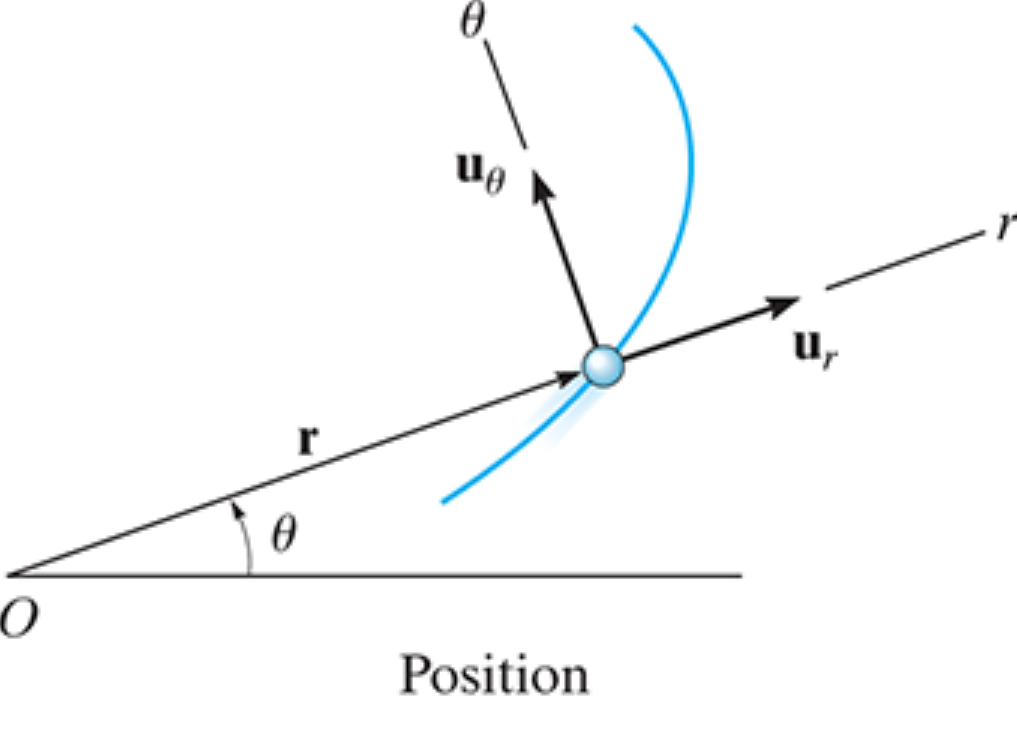
Cylindrical coordinates are used when an object is rotating around a fixed point or axis. An example of this would be a car going around a bend. The motion of the particle is described in terms of radial distance r r , angular position θ \theta , and, when necessary, a vertical position z z .

Polar Coordinates

image

The radial coordinate ( r r ) extends from the origin to the particle. It is notated as u r → \overrightarrow{u_{r}} .The transverse coordinate ( θ ) \theta) is the counterclockwise angle from a reference line and the r-axis. It is notated as u θ → \overrightarrow{u_{\theta}} . The position vector is r → = r u r → \overrightarrow{r} = r\overrightarrow{u_{r}} .

Velocity Components

image

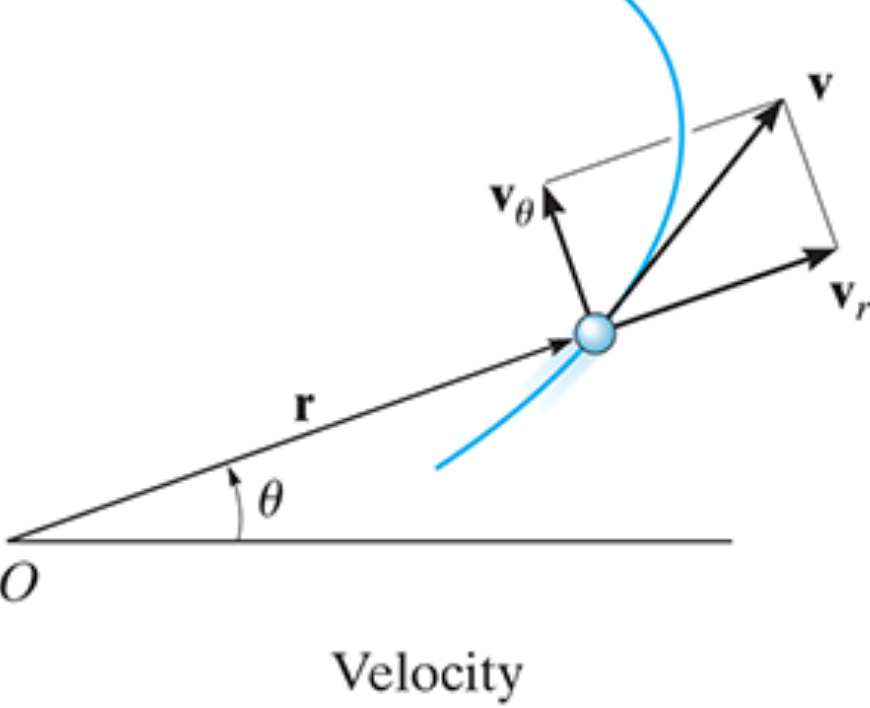
Radial velocity: v r = r ̇ v_{r} = \dot{r}

Transverse velocity: v θ = r θ ̇ v_{\theta} = r\dot{\theta}

Therefore, the velocity vector is v = r ̇ u r → + v = \dot{r}\overrightarrow{u_{r}} + r θ ̇ u θ → r\dot{\theta}\overrightarrow{u_{\theta}} , with a magnitude of v = v r 2 + v θ 2 v = \sqrt{v_r^2+v_\theta^2}

For 3-dimensional motion, v = v r 2 + v θ 2 + z ̇ 2 = ( r ̇ ) 2 + ( r θ ̇ ) 2 + ( z ̇ ) 2 v = \sqrt{v_r^2 + v_\theta^2 + \dot{z}^2} = \sqrt{(\dot{r})^2 + (r\dot{\theta})^2 + (\dot{z})^2}

Acceleration Components

image

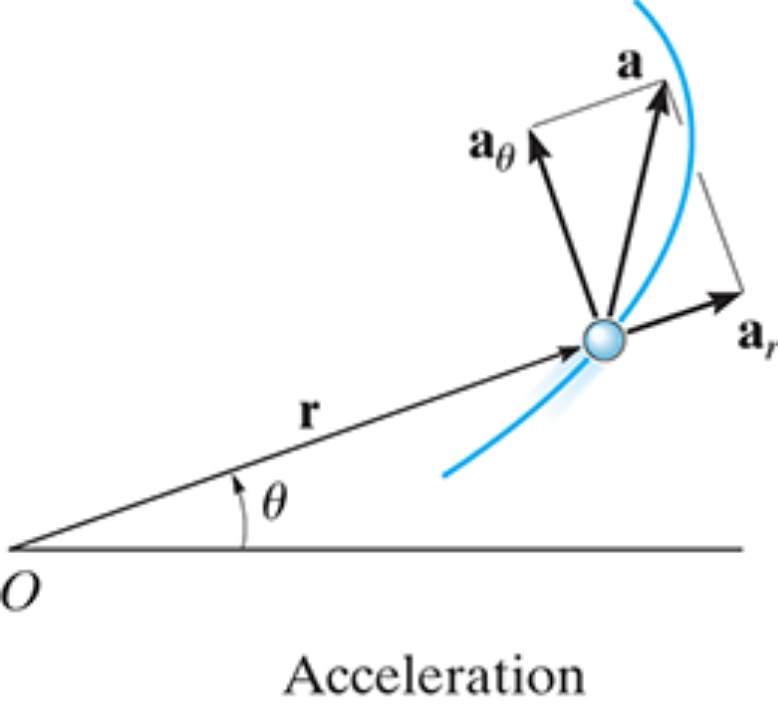
Radial acceleration: a r = r ̈ − r θ ̇ 2 a_{r} = \ddot{r} - r\dot{\theta}\ ^{2}

Transverse acceleration: a θ = r θ ̈ + 2 r ̇ θ ̇ a_{\theta} = r\ddot{\theta} + 2\dot{r}\dot{\theta}

For 3-dimensional motion, a = a r 2 + a θ 2 + z ̈ 2 = ( r ̈ − r θ ̇ 2 ) 2 + ( r θ ̈ + 2 r ̇ θ ̇ ) 2 + ( z ̈ ) 2 a = \sqrt{a_r^2 + a_\theta^2 + \ddot{z}^2} = \sqrt{(\ddot{r} - r\dot{\theta}^2)^2 + (r\ddot{\theta} + 2\dot{r}\dot{\theta})^2 + (\ddot{z})^2}

Chain Rule Relationships

When r r is given as a function of θ \theta instead of time, chain rule is required. If r = f ( θ ) r = f(\theta) , then r ̇ = d r d θ θ ̇ \dot{r} = \frac{dr}{d\theta}\dot{\theta} . For instance, if r = s i n ( θ ) r = sin(\theta) and θ = 8 t \theta = 8t , then r ̇ = θ ̇ c o s ( θ ) = 8 c o s ( θ ) \dot{r} = \dot{\theta}cos(\theta) = 8cos(\theta) . Alternatively, you can substitute θ \theta immediately. In this example, r = s i n ( θ ) = s i n ( 8 t ) r = sin(\theta) = sin(8t) , and you can take the derivatives as normal with chain rule.

Special Cases

If constant radius, then r = c o n s t a n t r = constant , r ̇ = 0 \dot{r} = 0 , and r ̈ = 0 \ddot{r} = 0 .

If constant angular velocity, then θ ̇ = ω = d θ d t \dot{\theta} = \omega = \frac{d\theta}{dt}

Example:
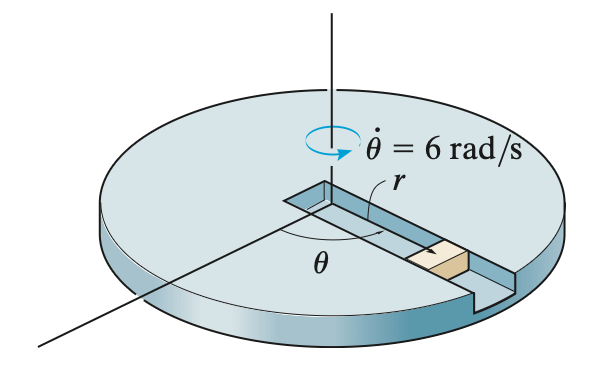
Find the magnitude of the block’s velocity and acceleration when t = 1s. The block moves along the sling with a speed of r ̇ = ( 4 t ) m / s \dot{r} = (4t)\ m/s and the platform rotates at a constant rate of 6 rad/s.
image

1) Find r , r ̇ , r ̈ , θ ̇ , θ ̈ a t t = 1 r,\ \dot{r},\ \ddot{r},\ \dot{\theta},\ \ddot{\theta}\ \ at\ t = 1

Integrate r ̇ \dot{r} to get r r : r = ∫ 4 t d t = 2 t 2 r = \int_{}^{}4t\ dt = 2t^{2}

Differentiate r ̇ \dot{r} to get r ̈ \ddot{r} : r ̈ = 4 \ddot{r} = 4

Evaluate everything at t = 1 t = 1 :

r r

r ̇ \dot{r}

r ̈ \ddot{r}

θ ̇ \dot{\theta}

θ ̈ \ddot{\theta}

2 ( 1 ) 2 = 2 m 2(1)^{2} = 2\ m

4 ( 1 ) = 4 m / s 4(1) = 4\ m/s

4 m / s 2 4\ m/s^{2}

6 r a d / s 6\ rad/s

0 0

2) Velocity

Radial velocity: v r = r ̇ = 4 m / s v_{r} = \dot{r} = 4\ m/s

Transverse velocity: v θ = r θ ̇ = ( 2 m ) ( 6 r a d / s ) = 12 m / s v_{\theta} = r\dot{\theta} = (2\ m)(6\ rad/s) = 12\ m/s

v = v r 2 + v θ 2 = ( 4 m / s ) 2 + ( 12 m / s ) 2 = 12.65 m / s v = \sqrt{v_r^2 + v_\theta^2} = \sqrt{(4\,m/s)^2 + (12\,m/s)^2} = 12.65\,m/s

3) Acceleration

Radial acceleration: a r = r ̈ − r θ ̇ 2 = 4 m / s 2 − ( 2 m ) ( 6 r a d / s ) 2 = − 68 m / s 2 a_{r} = \ddot{r} - r\dot{\theta}\ ^{2} = 4\ m/s^{2} - (2\ m)(6\ rad/s)^{2} = \ - 68\ m/s^{2}

Transverse acceleration: a θ = r θ ̈ + 2 r ̇ θ ̇ = ( 2 m ) ( 0 ) + 2 ( 4 m / s ) ( 6 r a d / s ) = 48 m / s 2 a_{\theta} = r\ddot{\theta} + 2\dot{r}\dot{\theta} = (2\ m)(0) + 2(4\ m/s)(6\ rad/s) = 48\ m/s^{2}

a = a r 2 + a θ 2 = ( − 68 m / s 2 ) 2 + ( 48 m / s 2 ) 2 = 83.28 m / s 2 a = \sqrt{a_r^2 + a_\theta^2} = \sqrt{(-68\,m/s^2)^2 + (48\,m/s^2)^2} = 83.28\,m/s^2