Curvilinear Motion

Introduction

Curvilinear motion describes the motion of a particle along a curved path in a plane. Even though the path is curved, the motion is still analyzed using rectilinear kinematics by breaking position, velocity, and acceleration into components. Instantaneous velocity is tangent to the path, while acceleration can be split into normal and tangential components.

Tangential Velocity

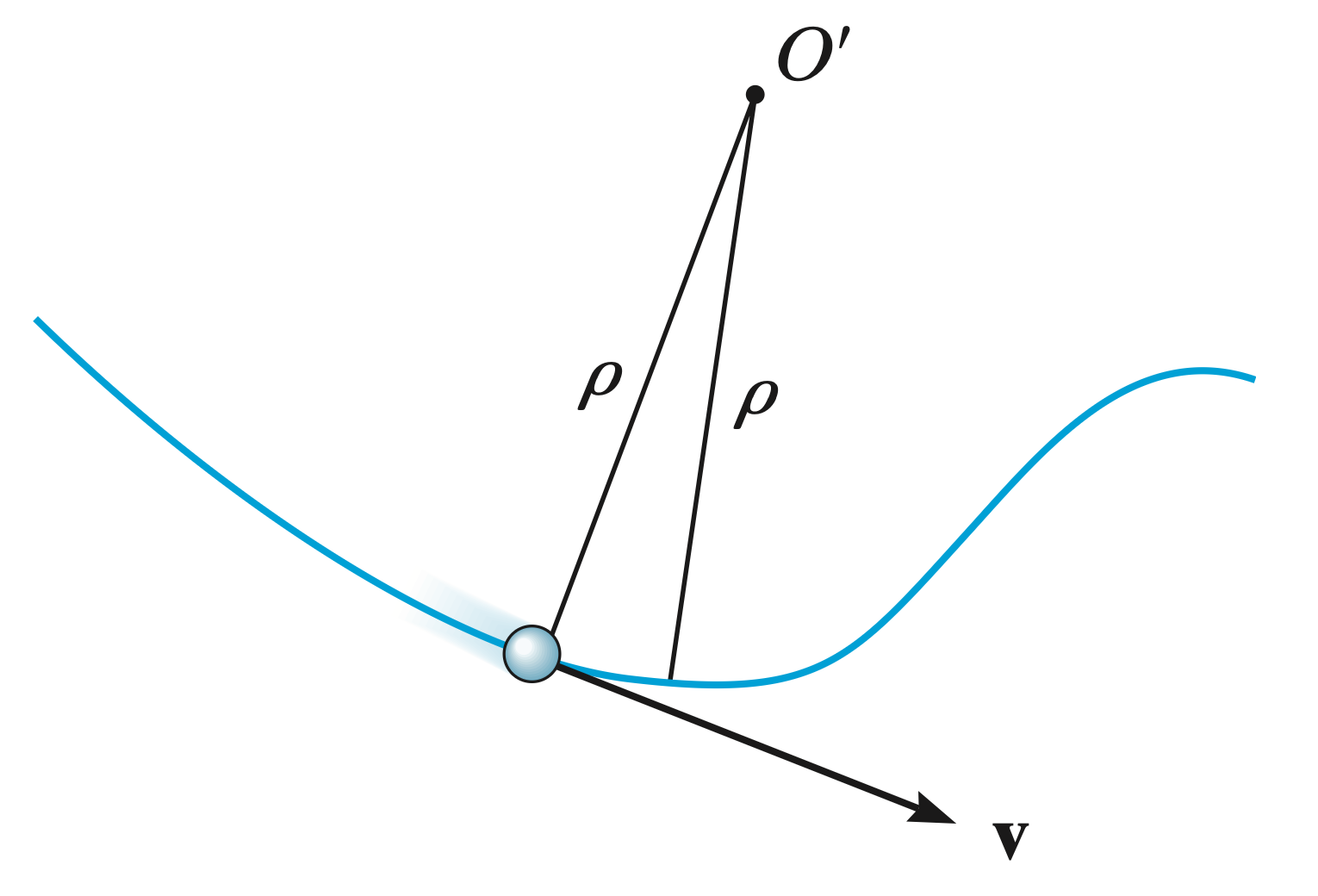
For motion along a curved path, velocity is tangent to the path.
image

v = d s d t v = \frac{ds}{dt}

Normal and Tangential Acceleration

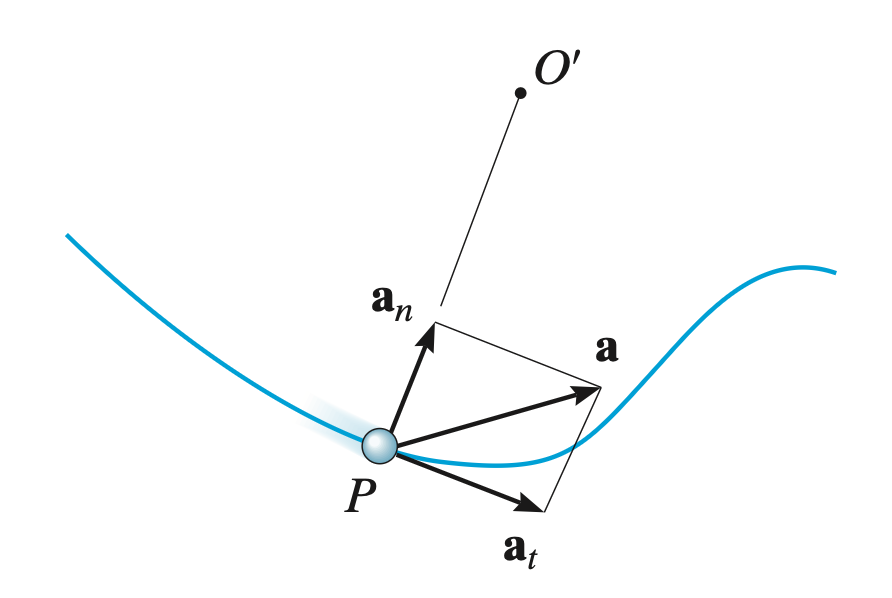
For motion along a curved path, acceleration is split into components:
image

a = a t u t + a n u n a = a_{t}u_{t} + a_{n}u_{n}

( u t u_{t} and u n u_{n} are the unit vectors for the directions)

Tangential acceleration: a t = v ̇ = d v d t a_{t} = \dot{v} = \frac{dv}{dt}

Normal acceleration: a n = v 2 ρ a_{n} = \frac{v^{2}}{\rho} ( ρ \rho is the radius of curvature)

Tangential acceleration changes the speed while normal acceleration changes the direction.

Magnitude of acceleration: a = a t 2 + a n 2 a = \sqrt{a_t^2+a_n^2}

Radius of Curvature

For a path defined as y = f ( x ) y = f(x) :

ρ = [ 1 + ( d y d x ) 2 ] 3 / 2 | d 2 y d x 2 | \rho = \frac{\left\lbrack 1 + (\frac{dy}{dx})^{2} \right\rbrack^{\ 3/2}}{\left| \frac{d^{2}y}{dx^{2}} \right|}

Kinematic Relationships

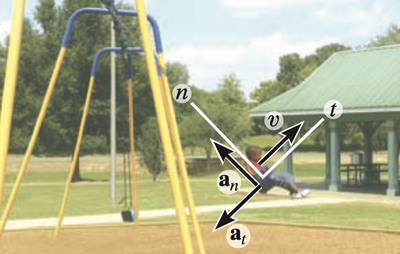
The kinematic relationships developed for rectilinear motion still hold. The primary difference is that the distance variable s s now represents distance along the path rather than along a straight line.
image

v = d s d t ⇒ ∫ 0 t v d t = ∫ s 0 s d s v = \frac{ds}{dt}\ \ \ \ \ \Rightarrow \ \ \ \int_{0}^{t}vdt = \int_{s_{0}}^{s}ds

a t = d v d t ⇒ ∫ 0 t a t d t = ∫ v 0 v d v a_{t} = \frac{dv}{dt}\ \ \ \ \ \Rightarrow \ \ \ \int_{0}^{t}a_{t}dt = \int_{v_{0}}^{v}dv

a t d s = v d v ⇒ ∫ s 0 s a t d s = ∫ v 0 v v d v a_{t}ds = vdv\ \Rightarrow \ \ \ \int_{s_{0}}^{s}a_{t}ds = \int_{v_{0}}^{v}vdv

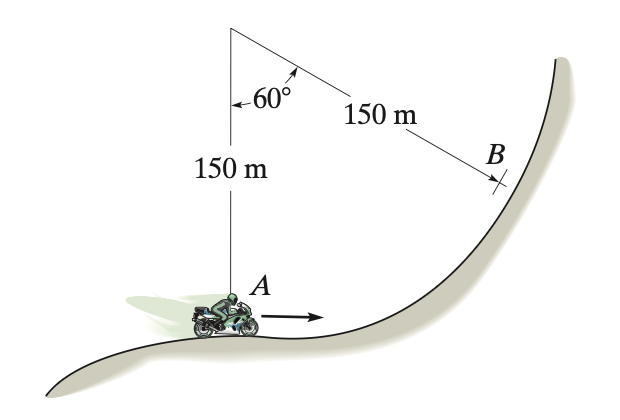
Example 1:
Find the total acceleration at point B if the initial speed is 40 m/s and the car decelerates at v ̇ = ( − 0.05 s ) m / s 2 \dot{v} = ( - 0.05s)\ m/s^{2}
image

Arc length = 2 π ( 150 m ) ( 60 deg 360 deg ) = 157.08 m = 2\pi(150\ m)(\frac{60\ \deg}{360\ \deg}) = 157.08\ m

Tangential acceleration at B: a t | s = 157.08 m = v ̇ = − 0.05 ( 157.08 ) = − 7.854 m / s 2 a_{t}{\ |}_{s = 157.08\ m} = \dot{v} = - 0.05(157.08) = - 7.854\ m/s^{2}

Velocity at B: a t d s = v d v ⇒ ∫ s 0 s a t d s = ∫ v 0 v v d v = ∫ 0 157.08 ( − 0.05 s ) d s = ∫ 40 v v d v ⇒ v = 19.1 m / s a_{t}ds = vdv \Rightarrow \int_{s_{0}}^{s}a_{t}ds = \int_{v_{0}}^{v}vdv = \int_{0}^{157.08}( - 0.05s)ds = \int_{40}^{v}vdv \Rightarrow v = 19.1\ m/s

Normal acceleration at B: a n = v 2 ρ = ( 19.1 m / s ) 2 150 m = 2.44 m / s 2 a_{n} = \frac{v^{2}}{\rho} = \frac{(19.1\ m/s)^{2}}{150\ m} = 2.44\ m/s^{2}

Total acceleration at B: a = a t 2 + a n 2 = ( − 7.854 ) 2 + ( 2.44 ) 2 = 8.22 m / s 2 a = \sqrt{a_t^2+a_n^2} = \sqrt{(-7.854)^2+(2.44)^2} = 8.22\ m/s^{2}

Example 2:
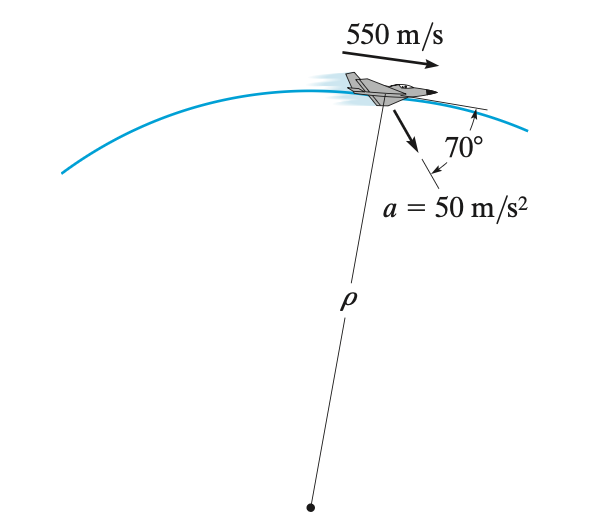
Find the rate of increase of the plane’s speed and the radius of curvature of the path.

image

Since total acceleration is 50 m / s 2 50\ m/s^{2} , we have to break that into normal and tangential components.

a n = 50 s i n ( 70 ) = 46.98 m / s 2 a_{n} = 50sin(70) = 46.98\ m/s^{2}

a t = 50 c o s ( 70 ) = 17.10 m / s 2 a_{t} = 50cos(70) = 17.10\ m/s^{2}

Since a t a_{t} is the rate of increase of the plane’s speed ( v ̇ \dot{v} ), the plane speed is increasing at 17.1 m / s 2 17.1\ m/s^{2} .

To find radius of curvature, we use the normal acceleration:

a n = v 2 ρ = ( 55 0 m / s ) 2 ρ = 46.98 m / s 2 a_{n} = \frac{v^{2}}{\rho} = \frac{(55{0\ m/s)}^{2}}{\rho} = 46.98\ m/s^{2}

Solving: ρ = 6438.9 m = 6.44 k m \rho = 6438.9\ m = 6.44\ km