Absolute Dependent and Relative Motion
Introduction
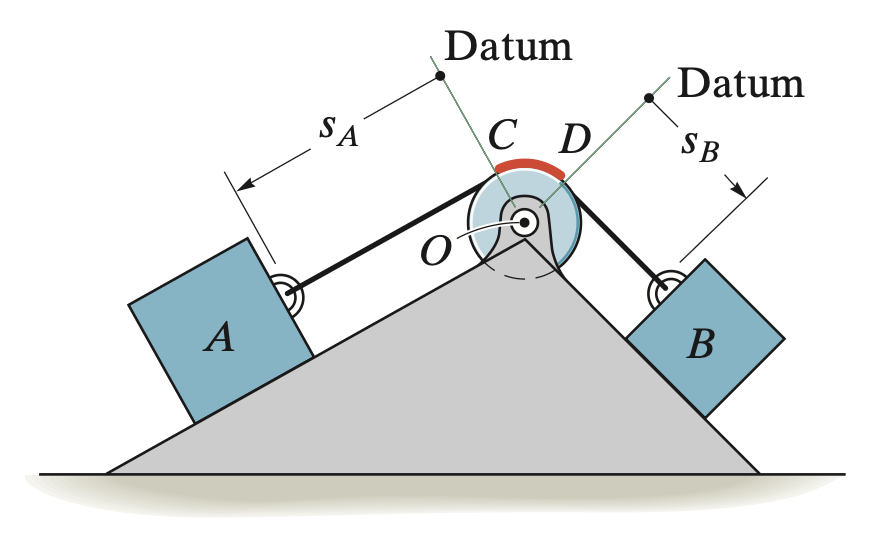
Many particle-motion systems involve objects whose motion is constrained by cables, pulleys, or connections to other moving objects. These are solved using absolute dependent motion. Other systems involve determining the motion of one particle as observed from another moving particle. These are solved using relative motion.
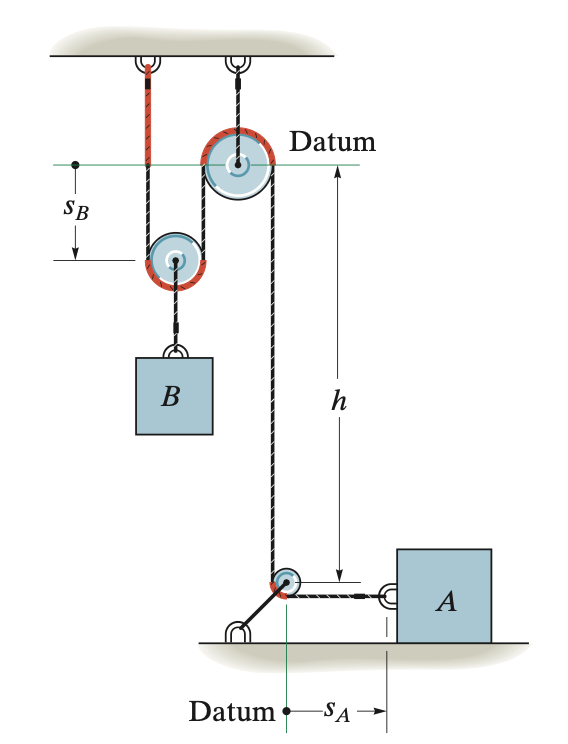
Absolute Dependent Motion
For an inextensible cable, .
We can write the total cable length as a function of particle positions:
When we differentiate, , so
From the example to the right, the total length of the cable (measured from the datum) is . Differentiating, . Therefore, blocks A and B move in opposite directions and the magnitude of B’s velocity is half of that of A.
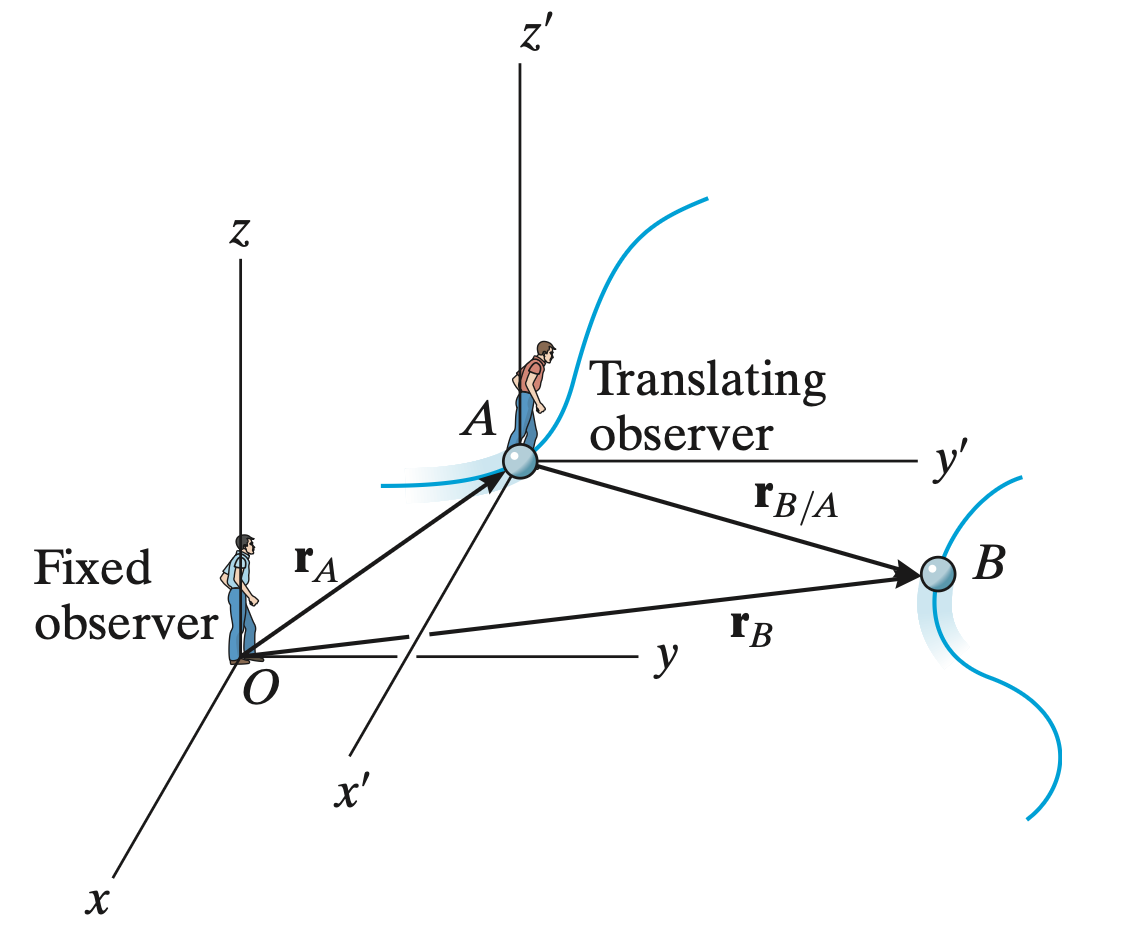
Relative Motion
B relative to A:
A relative to B:
Breaking vectors into components:
and .
Substituting into relative motion equation,
The magnitude of is the square root of the sum of the components squared.
Example 1:
Find the speed of block A when B is pulled down at 4 m/s. 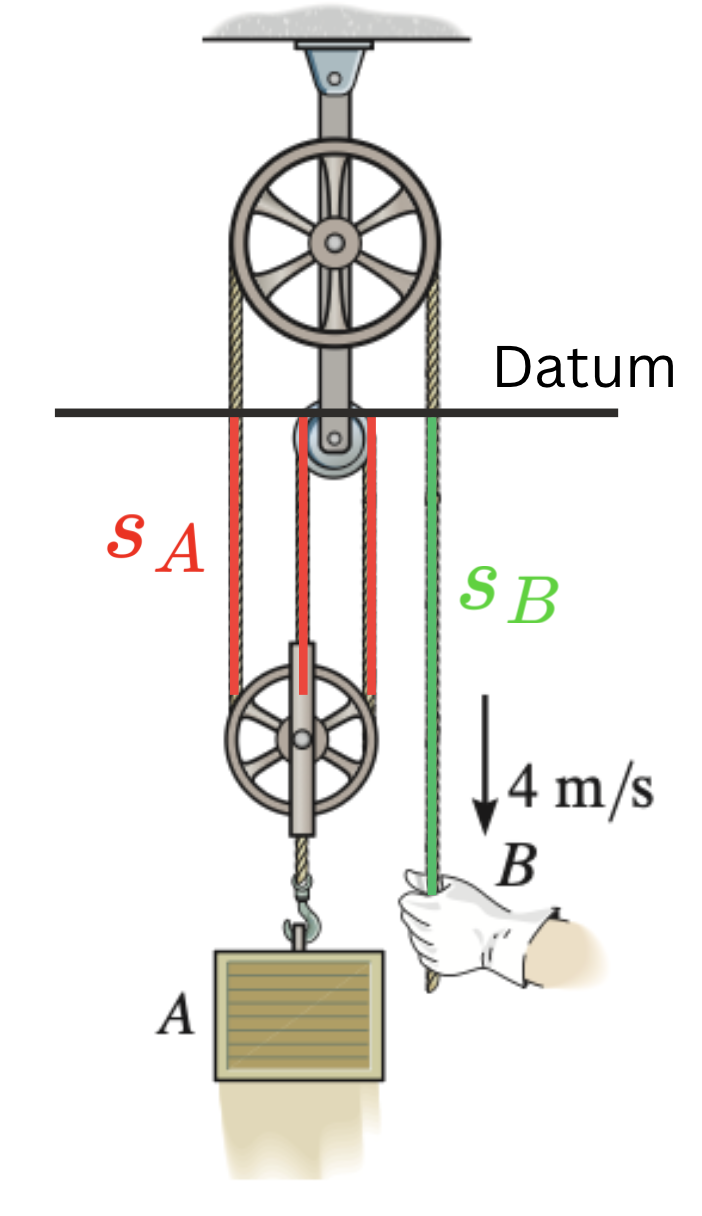
1) Write the total cable length as a function of positions:
2) Differentiate, knowing that :
3) Substitute in , solve for :
Example 2:
Find the velocity of boat A with respect to B and how long after leaving the shore that the boats are 600 m apart.
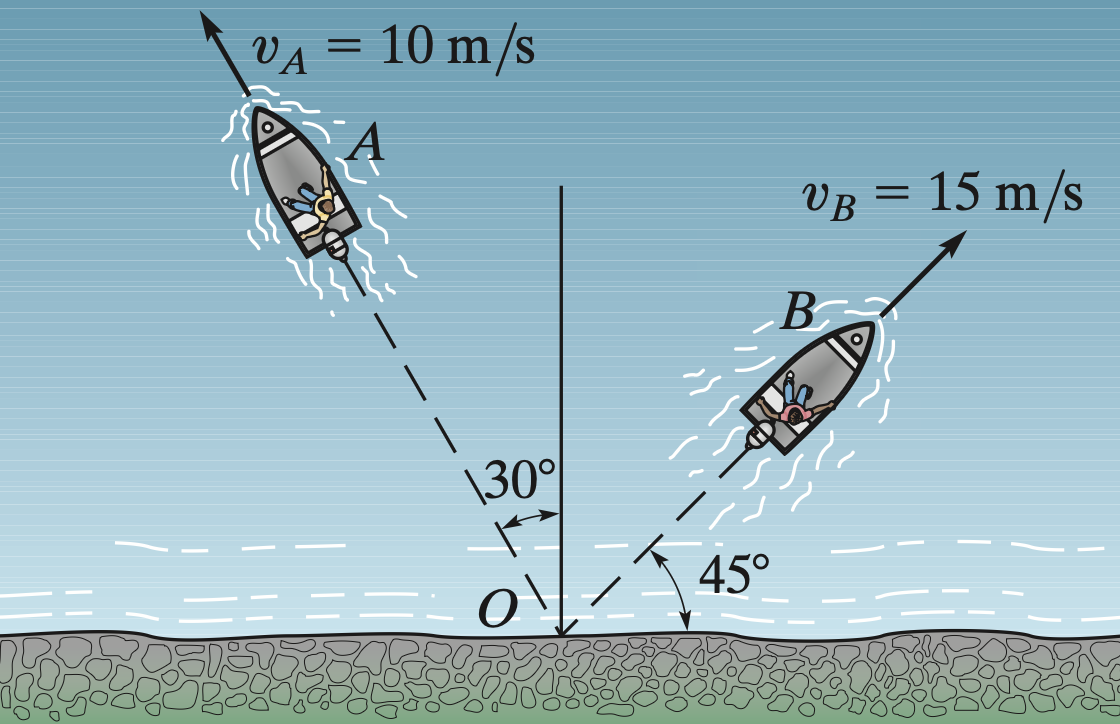
1) Write each boat’s velocity into components:
2) Relative motion of A with respect to B:
Magnitude of
3) Time until they are 600 m apart: