
Main Findings of Numerical Models for Hybrid PCM-Heat Sinks and Pool Boiling
Team: Mahdi Ghorbani, Dr. Hailei Wang, Dr. Nicholas Roberts
Introduction
- Passive: Integrates PCMs with heat sinks using numerical and analytical methods.
- Optimize PCM heat sink designs for safe temperatures.
- Active: Explores HFE-7000 for thermal management, with pool boiling modeling.
![Figure 1 – The schematic figure of the wireless charging system [1, 2, 3]](/images/people/departments/mae/research-labs/energy-technology-research-and-innovation/student-research-posters/2024/main-findings-of-numerical-models-for-hybrid-pcm-heat-sinks-and-pool-boiling/figure-1.png)
Figure 1 – The schematic figure of the wireless charging system [1, 2, 3]
Methods
Hybrid PCMs-Heat Sink
ANSYS Fluent (Enthalpy-Porosity)
PCM
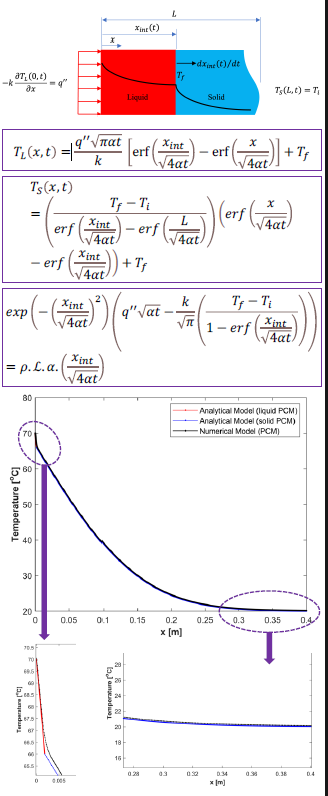
Analytical Model (Similarity Method)
ANSYS Fluent (Enthalpy-Porosity)
Pool Boiling of HFE-7000 on Ferrite
ANSYS Fluent (Volume of Fluid)
![Figure 2 – The heat sink configurations in numerical model and the thermophysical properties of PCMs [4]](/images/people/departments/mae/research-labs/energy-technology-research-and-innovation/student-research-posters/2024/main-findings-of-numerical-models-for-hybrid-pcm-heat-sinks-and-pool-boiling/figure-2.png)
Figure 2 – The heat sink configurations in numerical model and the thermophysical properties of PCMs [4]
![Figure 3 – The set point temperature for hybrid PCMs-Heat Sinks [4]](/images/people/departments/mae/research-labs/energy-technology-research-and-innovation/student-research-posters/2024/main-findings-of-numerical-models-for-hybrid-pcm-heat-sinks-and-pool-boiling/figure-3.png)
Figure 3 – The set point temperature for hybrid PCMs-Heat Sinks [4]
![Figure 4 – The surface temperature comparison or various hybrid PCMs integrated with different heat sinks [4]](/images/people/departments/mae/research-labs/energy-technology-research-and-innovation/student-research-posters/2024/main-findings-of-numerical-models-for-hybrid-pcm-heat-sinks-and-pool-boiling/figure-4.png)
Figure 4 – The surface temperature comparison or various hybrid PCMs integrated with different heat sinks [4]
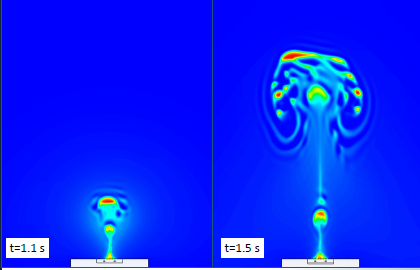
Figure 5 – The volume fraction of vapor in pool boiling of HFE-7000 on copper with the applied heat flux of 110 kW/m2
![Figure 6 – The comparison of experimental results [5] with numerical model in ANSYS Fluent](/images/people/departments/mae/research-labs/energy-technology-research-and-innovation/student-research-posters/2024/main-findings-of-numerical-models-for-hybrid-pcm-heat-sinks-and-pool-boiling/figure-6.png)
Figure 6 – The comparison of experimental results [5] with numerical model in ANSYS Fluent
Results (Analytical) [4]
Conclusion
- Hybrid PCM with heat sink proposed for secondary pad.
- More research required on PCM solidification process.
- HFE-7000 initial assessment promising on copper, potential for ferrite surface.
References
1.DOI: 10.1115/HT2023-107128
2.DOI: 10.1016/j.applthermaleng.2021.116710
3.DOI: 10.1109/APEC43599.2022.9773484.
4.DOI: 10.1016/j.icheatmasstransfer.2024.107460
5.DOI: 10.1016/j.tsep.2019.100428