
Numerical Study of Thermal Management Systems Using Phase Change Materials integrated with heat sink for Wireless Super-Fast Charging Stations of EVs
Team: Mahdi Ghorbani1; Hailei Wang, PhD1; Nicholas Roberts, PhD1
Abstract
In this study, the thermal management of wireless superchargers for electric vehicles has been investigated using a finned base heat sink integrated with Phase Change Material (PCM) to address the challenge of dissipating heat from high-power wireless chargers. The feasibility of using paraffin wax, RT70, as the desired PCM, has been numerically studied, and the effect of using different types of PCMs with varying thermal conductivity on the efficiency of the thermal management system has been explored.
In this study, the surface temperature of power electronic components for different configurations of finned base heat sink integrated with different types of PCMs is compared. The goal is to improve the efficiency and reliability of the system while controlling the junction temperature of the power electronics.
Project Description
The thermal management of electronic components using phase change materials (PCM) and heat sinks has been studied by several scholars. Giulia Righetti et al. [1] experimentally investigated the use of a PCM-based thermal management system with an aluminum 3D pyramidal periodic structure heat sink and found that adding a fan drastically increased heat dissipation and reduced maximum temperature. M. Mozafari et al. [2] focused on the performance of passive thermal management of electronic devices using heat sinks embedded with single or multiple PCMs and found that n-Eicosane provided the promptest melting process, whereas RT44 revealed lowest peak temperatures.
In this study, PCM integrated with rectangular finned base heat sinks have been investigated to find the best option for the thermal management system of power electronics under high heat flux, i.e., 25 kW/m2 in which the surface temperature of electronic component will remain below its junction temperature till the end of charging time.
Methods and Materials
The commercial software ANSYS Fluent 2021 has been used for the simulation of the thermal management system for the wireless super-fast charger. Conjugate heat transfer was used to simulate this system by solving continuity, momentum, and energy equations. Some simplifications have been applied to model the rectangular finned based heat sink integrated with composite PCM thermal management system in this study as follows:
- In the initial condition, the finned based heat sink and composite PCM are assumed to be at ambient temperature of 293 K (20 ºC).
- At the walls of the fins and heat sink base, no slip and impermeable conditions are applied.
- The radiation heat transfer is assumed to be negligible and is not considered in the model.
- Any heat loss at the contact surface of the electronic component and heat sink is assumed to be negligible and the only boundary condition which is applied was the heat flux from the electronic component to the bottom wall of the heat sinks.
- The thermophysical properties of the fins and heat sinks are considered to remain constant in all simulations.
- The contact thermal resistance of the heat sink with power electronic component is not considered and assumed to be negligible.
- The model for liquid PCM is assumed to be laminar, incompressible, and unsteady.
Boundary and Initial conditions
The transient study of the melting process for such a system is extremely timeconsuming and expensive. Therefore, it is selected to proceed with two-dimensional simulation only. The model has been developed in 2D and symmetry boundary condition has been applied to model small portion of the charging system.
It is assumed that the power electronic component will be attached to the bottom of the finned based heat sink and, therefore, the heat flux is applied on the bottom surface of the domain. The constant heat flux of 25 kW/m2 is applied to the bottom surface to simulate the power electronic component heat dissipation. The free convection with air is applied to the top wall of the domain to keep the model precise enough compared to the real model. The computation domains with boundary conditions are illustrated in Figure 1.
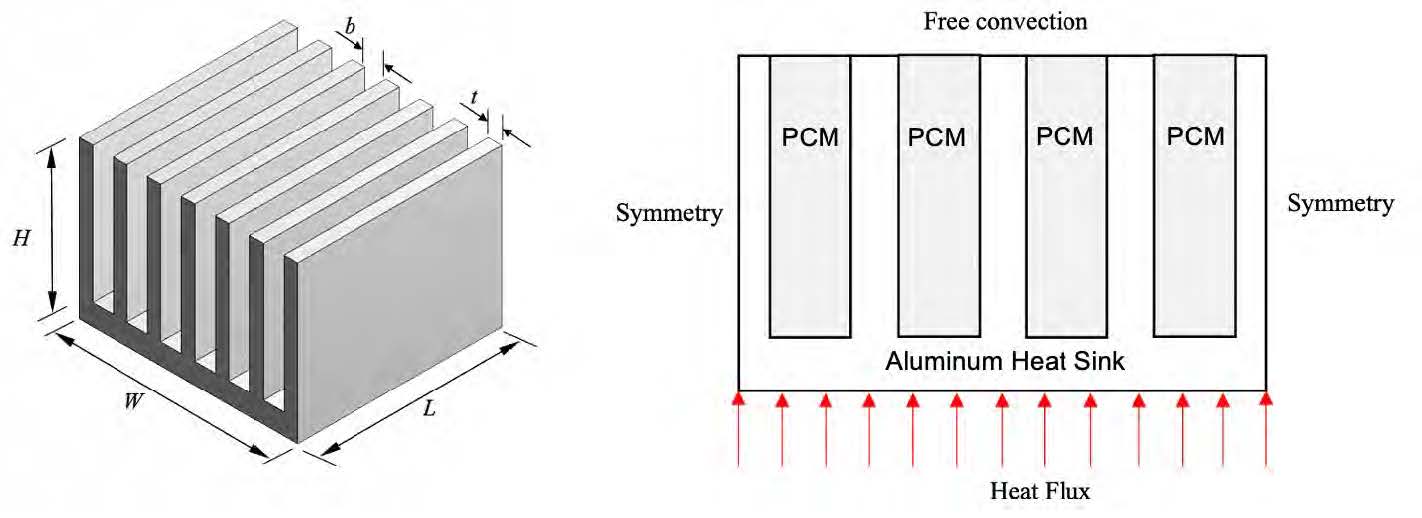
Figure 1 – The boundary condition in the simulation and schematic configuration of the heat sink in 3D
Comparison with Analytical Solution (Exact Solution)
The temperature distribution during the phase change process has been obtained using exact solution for semi-infinite 1D domain with constant temperature at two ends. ]Due to the transient phenomena of the phase transition process, the location of the interface between liquid and solid regions will be based on the time. The location of the interface has been found by using energy equation at the interface. The domain has been shown in Figure 2.
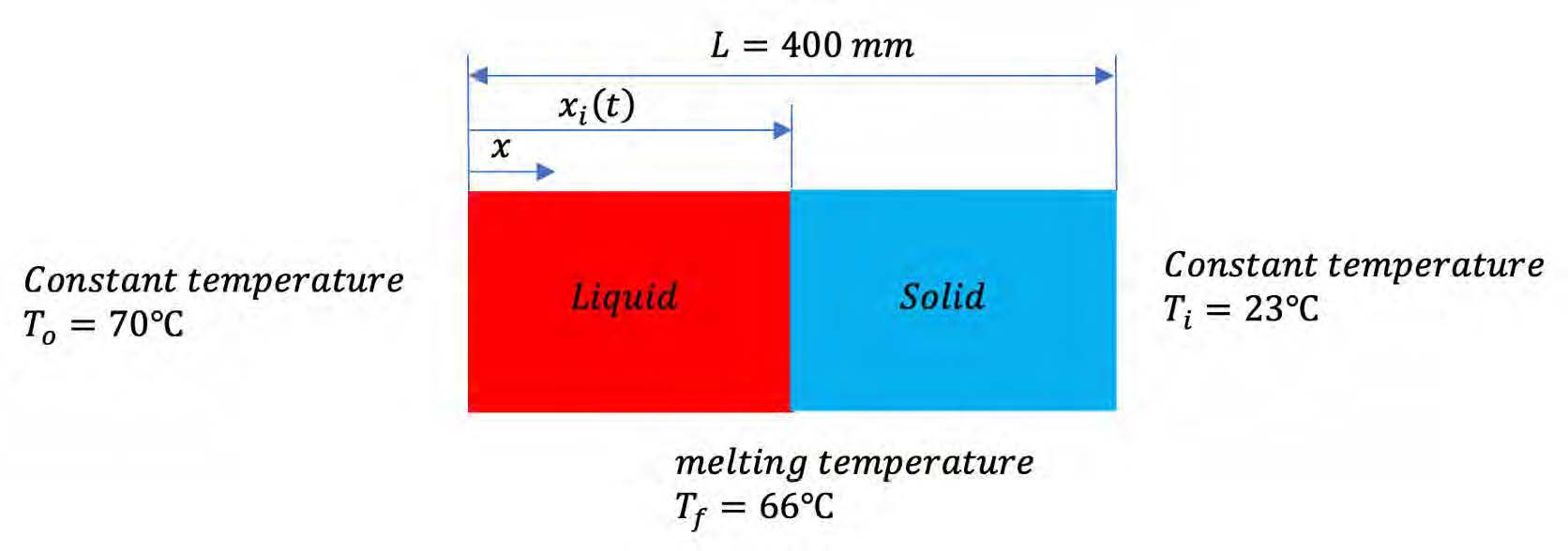
Figure 2 – The domain for exact solution
By solving the heat equations and applying the boundary condition, the temperature distribution will be calculated. The results of the exact solution has been plotted and compared with the results of the simulation in ANSYS Fluent in Figure 3.
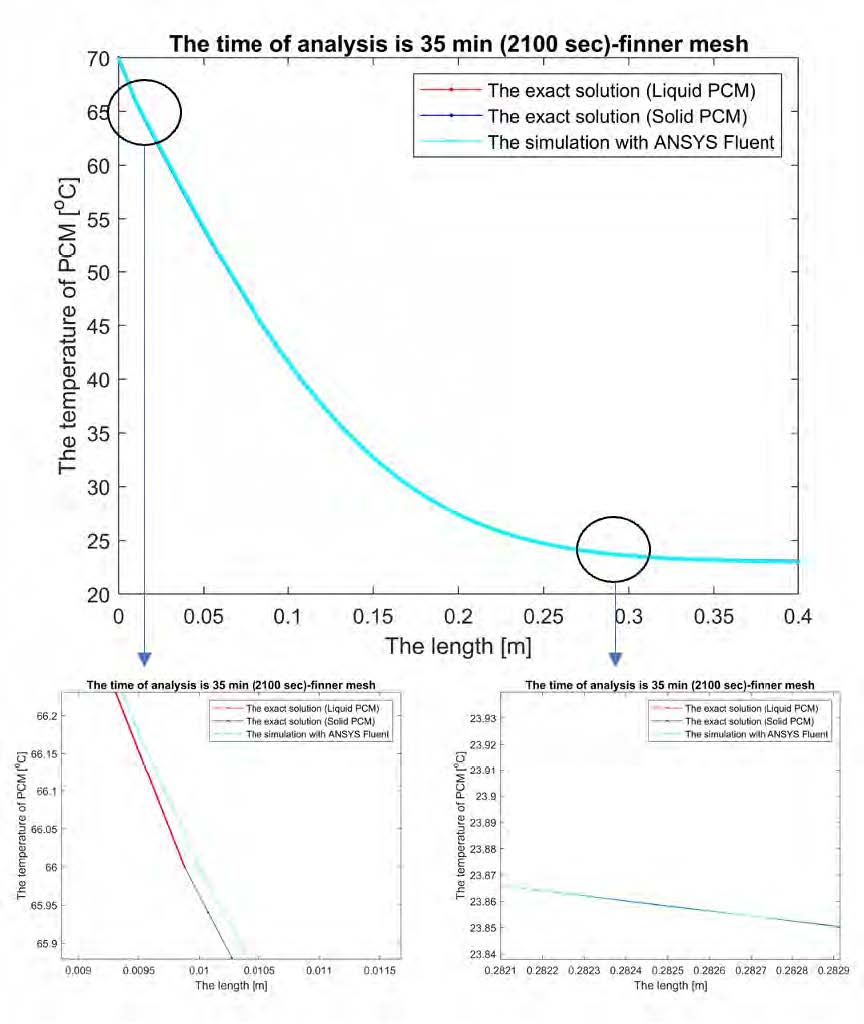
Figure 3 – The comparison between results of the exact solution with ANSYS Fluent for the temperature profile
Based on the comparison which has been performed there is a reasonable match between the results of exact solution for phase change in semi-infinite 1D domain and simulation in ANSYS Fluent 21.
Results
The surface temperature of the bottom of heat sink for the charging time of 10 min with heat flux of 25 kW/m2 has been illustrated in Figure 4.
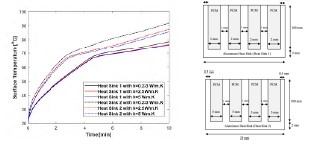
Figure 4 – The effect of different thermal conductivity on the surface temperature of power electronics
To further investigate the effect of using heat sink integrated with PCM, the longer duration of charging (35 minutes) has been studied to understand the efficiency of the thermal management system. The results has been shown in Figure 5.
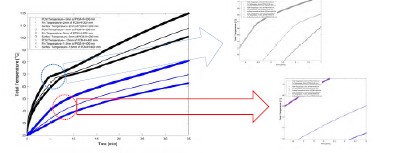
Figure 5 – The surface temperature of heat sink for different configurations of heat sink
As a different approach, to charge the same amount of energy, the heat flux is divided by two and the charging time is doubled to be able to maintain the surface temperature of power electronic below the junction temperature. The results has been illustrated in Figure 6.
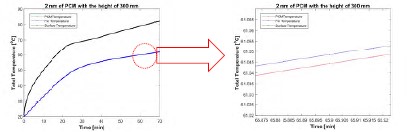
Figure 6 – The surface temperature of power electronic in lower heat flux and longer charging time
Discussion
Results showed that by increasing the charging time, the surface temperature of power electronic can be maintained in a lower temperature. However, this might not be enough considering the demand for super-fast charging station.
Conclusion
Based on the results of simulations, the following conclusions can be drawn:
- Although, using finned base heat sink can improve the overall thermal resistance of the thermal management system, any enhancement in the thermal conductivity of PCM can improve the efficiency of the thermal management system further.
- By increasing the charging time, passive thermal management system can be a good candidate for charging stations of Evs.
Reference
- 1. G. Righetti, C. Zilio, L. Doretti, G. A. Longo, and S. Mancin, “On the design of Phase Change Materials based thermal management systems for electronics cooling,” Applied Thermal Engineering, vol. 196, p. 117276, Sep. 2021, doi: 10.1016/j.applthermaleng.2021.117276.
- 2. M. Mozafari, A. Lee, and J. Mohammadpour, “Thermal management of single and multiple PCMs based heat sinks for electronics cooling,” Thermal Science and Engineering Progress, vol. 23, p. 100919, Jun. 2021, doi: 10.1016/j.tsep.2021.100919.