
Investigation of Ion Rejection in Polycrystalline Ice via Molecular Dynamics Simulations
Team: Adam Rasmussen, Mahbuba Jannat, Dr. Hailei Wang
Introduction
Water covers most of the Earth’s surface. However, the vast majority of the water is saltwater. Of the available freshwater, much of it is locked in glaciers (see the figure below1). In order to increase the availability of freshwater, many places rely on desalination systems to obtain freshwater from saltwater
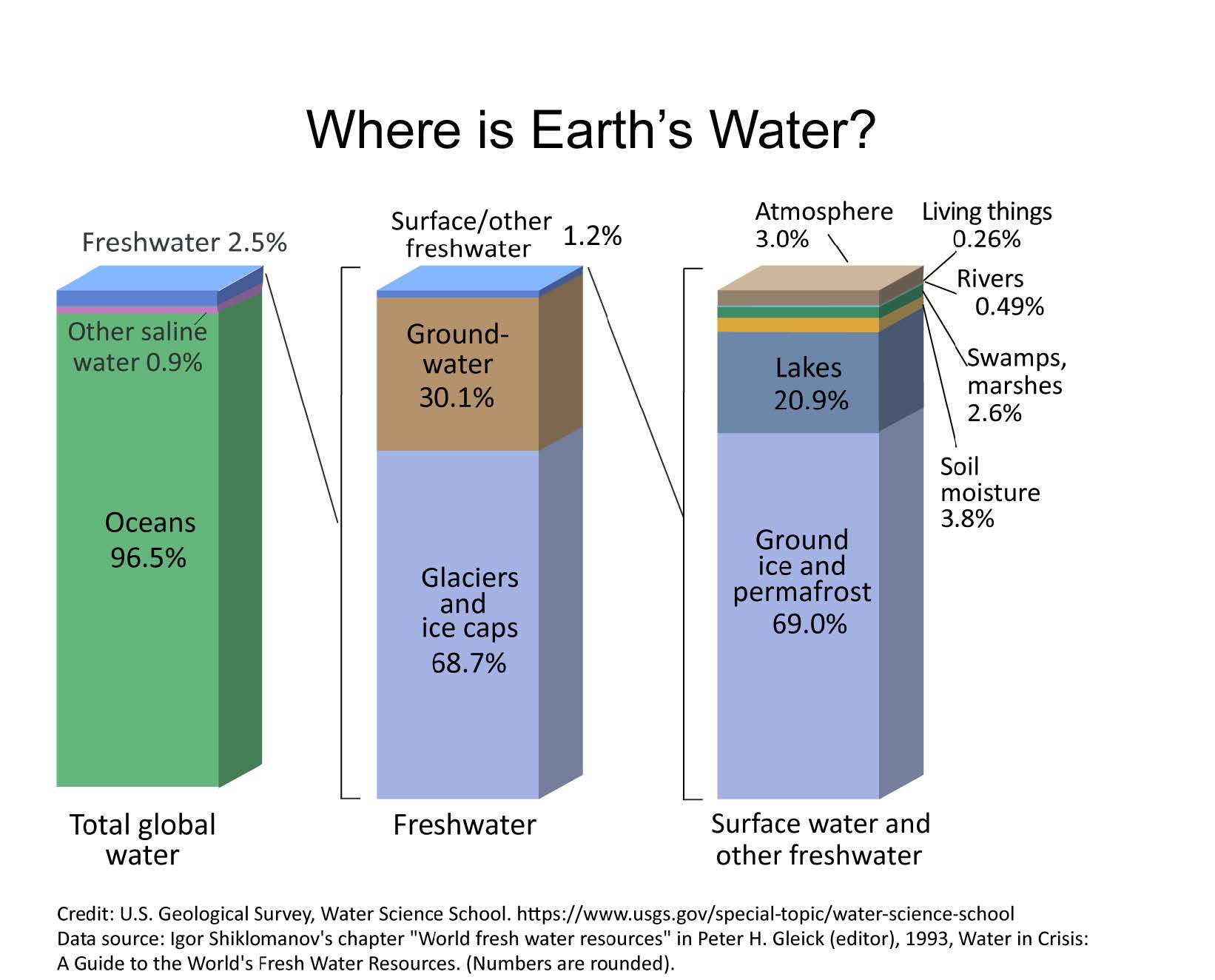
As the number of regions experiencing droughts increases, research of new desalination techniques also increases to find better desalination techniques. Freeze Desalination (FD) systems are relatively new processes and research on these systems has increased in recent years. However, the understanding of the molecular mechanisms remains unclear. Ion rejection is the phenomenon that drives FD systems, but its molecular mechanisms remain unclear. The goal of this research is to use Molecular Dynamics (MD) simulations to analyze the impact of grain boundaries on the motion of salts in freezing solutions.
Grain boundaries act as highways for particulates through polycrystalline material. Current research assumes a perfect ice crystal. As all real material is polycrystalline, the results of this research should expand the current understanding of the factors that influence the ion rejection phenomenon and, subsequently, FD systems.
Methodology –Simulation Set Up
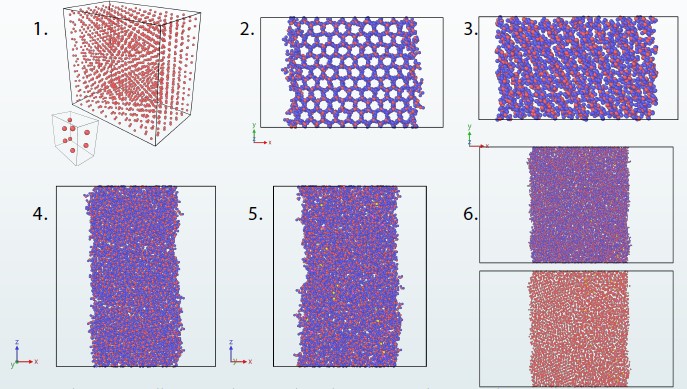
- The initial oxygen lattice generated using the orthorhombic unit cell of 8 atoms
- Initial Ice Lattice after equilibration. The ice is generated using a Monte Carlo algorithm from Buch et al.
- The ice is rotated CW and CWW 17.025°about the <-1 1 0 0 > direction for an angle of 34.05°between grains.
- The different grains are then stacked with 2 clockwise-rotated grains enclosing the counter-clockwise-rotated grain to allow for periodic boundary conditions.
- A saltwater system is generated with 42 NaCl pairs to achieve a concentration of ~0.6 M NaCl as in seawater.
- The saltwater and grain boundary systems are brought together to finish the setup and allow for testing.
Expected Results
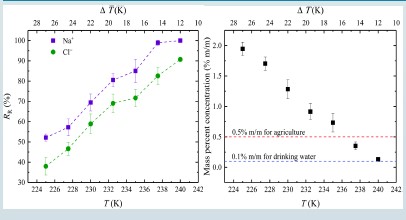
After the simulations are complete, the data will be compared against the literature. It is widely held that Na ions reject from the ice at a greater rate than Cl ions (see left image from Luo et al.)2.
Furthermore, it is also seen that salt rejection rates increase with temperature up until the freezing point of the solution. The right image from Luo et al. shows this rejection rate increase as at greater temperatures the ice has less solute and is closer to being freshwater
Data Analysis
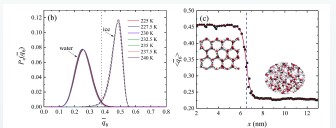
Using the averaged bond order parameter that can be calculated by the MD software, the ice front movement can be analyzed because a bond order of 0.38 or greater indicates the presence of ice as shown by Luo et al. in the following images.2
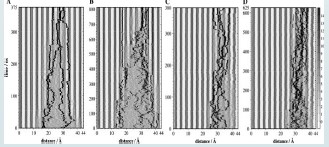
The earliest research on ion rejection by Vrbka and Jungwirth shows the rejection of ions in the following image where the striped region is the ice and the black lines show ion movement.3The below image shows the gradual rejection of salts over time, but, as with Luo et al., Vrbka and Jungwirth assumed a perfect set of ice.2,3Thus, the ions from the grain boundary simulations will mapped in a similar manner to compare this simulation against Vrbka and Jungwirth’s
Acknowledgements
Thanks Luo et al. for sharing their LAMMPS code as a framework for these simulations
References
- Where is Earth’s Water? | U.S. Geological Survey, (n.d.). https://www.usgs.gov/special-topics/water-science-school/science/where-earths-water (accessed April 3, 2023).
- S. Luo, Y. Jin, R. Tao, H. Li, C. Li, J. Wang, Z. Li, Molecular understanding of ion rejection in the freezing of aqueous solutions, Phys. Chem. Chem. Phys. 23 (2021) 13292–13299. https://doi.org/10.1039/D1CP01733K.
- L. Vrbka, P. Jungwirth, Molecular dynamics simulations of freezing of water and salt solutions, J. Mol. Liq. 134 (2007) 64–70. https://doi.org/10.1016/j.molliq.2006.12.011.