
Designing the Power Cycle in the Natrium System for Dynamic Modeling
Team: Aiden Meek, Seth Dana, Jacob Bryan, Manjur Basnet, and Hailei Wang
Sponsor: NEUP | Nuclear Energy University Programs U.S. Departement of Energy
Introduction
Global warming from greenhouse gas emissions is a growing concern around the world. According to the EPA, electricity production and transportation account for 25% and 29% of greenhouse gas emissions respectively [1]. These activities produce CO2 during the process of burning fossil fuels. Eliminating the need to burn fossil fuels for electricity generation would immediately reduce CO2 emissions.
Nuclear power has been on the forefront of electricity generation research for several years due to its potential as a carbon free source of heat for electricity. Electricity demand has been evolving since renewable energy has entered the power generation scene. The inconsistent nature of wind and solar power creates a fluctuating energy market to be met by power providers.
Nuclear power has traditionally been used as a baseload power source. Operation of a variable power nuclear plant is very expensive compared to base load power operation [2]. The Natrium reactor design from TerraPowerand GE Hitachi is a nu-clear plant design that can meet flexible energy demands. Natrium couples a sodium fast reactor with a molten salt-based thermal energy storage (TES) system
![Figure 1. Rendering of the Natrium system. [3]](/images/people/departments/mae/research-labs/energy-technology-research-and-innovation/student-research-posters/2023/designing/figure-1.jpg)
Figure 1. Rendering of the Natrium system. [3]
The TES system operates the nuclear (thermal) portion of Natrium at a constant output, while allowing the Rankine cycle (power) to ramp up and down to follow energy demand and prices. This project is coupled with a dynamic model that simulates the physics in the Rankine cycle. The dynamic model needs to be given information about the state points between components, so this model provides those while also optimizing the system for thermal efficiency.
Organic working fluids (replacing the water in the steam cycle) have been shown to potentially provide an increase in performance for lower temperature (300 C) Rankine cycles. This project also looks at how different working fluids perform in the system.
Methodology
The following figure shows the thermal cycle setup for a regenerative Rankine cycle, and a reheat Rankine cycle. These models were made in Python and optimized using Scipy’sDifferential Evolution optimizer. The optimizer chooses the outlet temperature of the high-pressure working fluid after each regenerator. The model then uses assumptions and thermodynamic relationships [4] to calculate the rest of the state points. The pinch points in each regenerator is also checked to ensure compliance with the second law of thermodynamics.
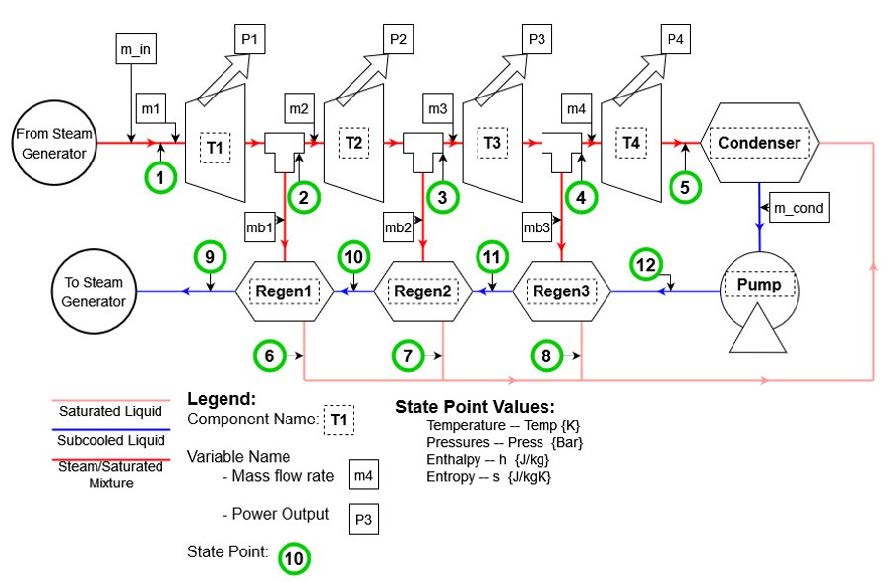
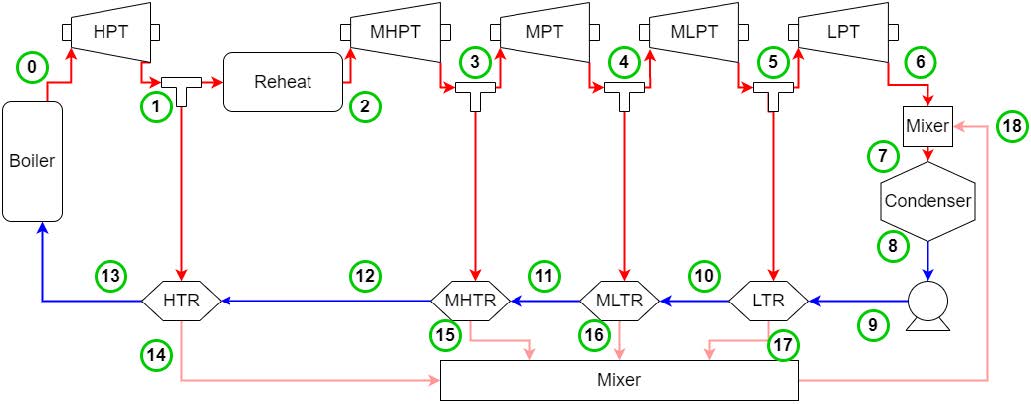
Figure 2 System Diagram of the Regen (top) and Reheat (bottom) Rankine cycles
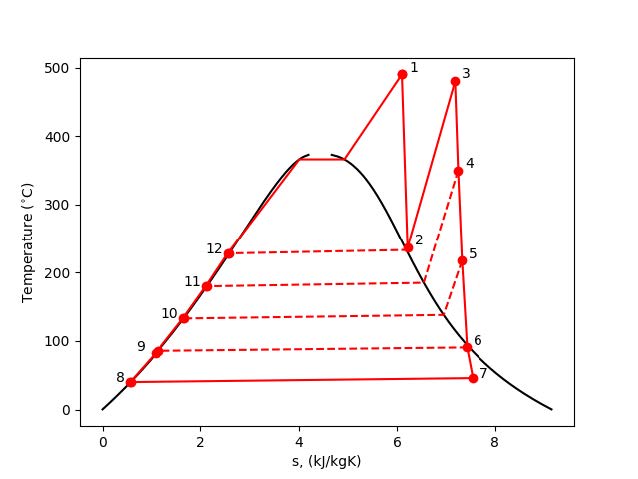
Figure 3 T-s diagram of a Nearly Optimum Reheat Rankine Cycle
Results
The models then ran a sweep over temperatures going into the steam generator and calculated the efficiency. The regeneration only model had trouble with different working fluids, so it was only run using water. The results show that water is the best working fluid for this cycle, with a maximum efficiency of 0.42 when the water is heated to 225 C in the regenerators. The T-s diagram of the optimum reheat cycle is shown in figure 3.
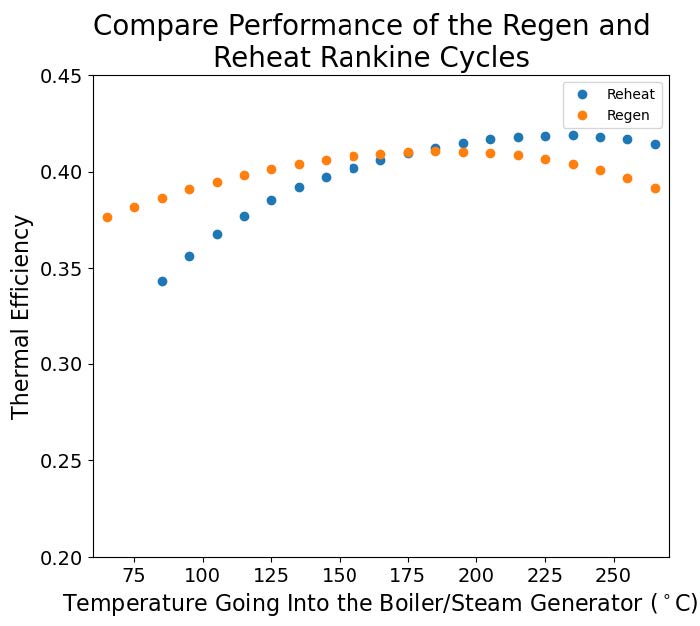
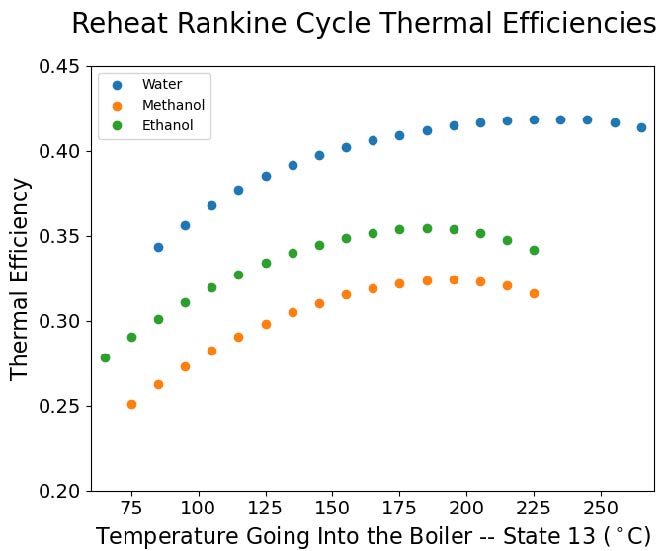
This cycle has an exergy efficiency of 66% using a heat source temperature of 520 C (temperature of the hot salt used by Natrium), and a heat sink temperature of 30 C, a typical wet bulb temperature for a summer day. The components with the greatest exergy destruction will be evaluated in future work.
The main state points of interest are shown in Table 1. These are the primary state points of interest in simple Rankine cycles. The water out of
| Temperature (C) | Pressure (Bar) | |
|---|---|---|
| Boiler Outlet (State 0) | 490 | 200 |
| LPT Outlet (State 6) | 45.8 | 0.1 |
| Condenser Outlet (State 8) | 40 | 0.1 |
| Pump Outlet (State 9) | 51.9 | 200 |
| Boiler Inlet (State 13) | 225 | 200 |
Conclusion
The Natrium Design team has said their Rankine cycle will have an efficiency between 40-42%, so this design project has found a good set of state points to use in the system. This information will be used in a dynamic model of the Natrium reactor to simulate plant operation. Simulating the plant operation will help in the economic analysis of this new reactor.
Reference
[1] , 2022. “Sources of greenhouse gas emissions”. United States Environmental Protection Agency. https://www.epa.gov.
[2] Li, Y., Cao, J., and et al., 2014. “Load shifting of nuclear power plants using cryogenic energy storage technology”. Applied Energy, 113, January, pp. 1710–1716.
[3] Natrium Power, “Carbon Free Power for the Clean Energy Transition” natriumpower.com
[4] Cengel, Y. A., and Boles, M. A., 2016. Thermodynamics: An Engineering Approach. McGraw Hill Education.
Acknowledgements
This project is funded by the NEUP