
Shasta Cloud - Automated Building Mapping
Team: Ben Anderson, Daniel Garner, Jaron Harbison, Dax Nielson and Bradin Rohde
Problem Description
The current process for building mapping and network installation is inefficient, characterized by high costs, heavy labor requirements, and a slow 6-to-8-week turnaround. To address this, we aim to reduce survey times to just one week by implementing a fast, user-friendly, and costeffective system. This solution would allow lowskilled workers to accurately map layouts and materials, ultimately streamlining RF modeling and network deployment.
Performance Review
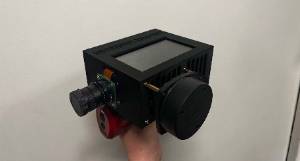
To test the design of our room scanner, we took frequent scans of rooms to verify the rooms were recorded and constructed correctly. We also tested the attenuation measurement setup by measuring signal loss between various materials independent of scans. To verify our programs, we generated self made rooms and used collected data to verify program accuracies.
Our design drastically improves the current process by reducing the survey drastically. Initially the survey takes 6-8 week, but with the performance of our design flow, the process would take less than a week. Along with this design flow doing well, the device also excels in its ability to capture accurate room data. This includes 5 inches of deviation from true room size, within 2 dB of path loss for material attenuation, and a total duration process of less than 15 hours. Overall, the device is well built. While the device is not to the hoped standard, this idea is more than effective. We believe we have provided a device with exceptional potential.
(A table to the right contains target, threshold, and performance values for our design)

| Requirement/Constraint/Goal | Target | Threshold | Actual Performance |
|---|---|---|---|
| Accuracy of 3D model | 4 in. (10 cm) | 12 in. (30 cm) | ±5 in. |
| Accuracy of Attenuation Measurements from Signal Generator/Spectrum Analyzer | 4 dB | 8 dB | ±2 dB |
| Duration of Total Process | 4 Days | 10 days | <15 hours (from limited testing) |
Design Description
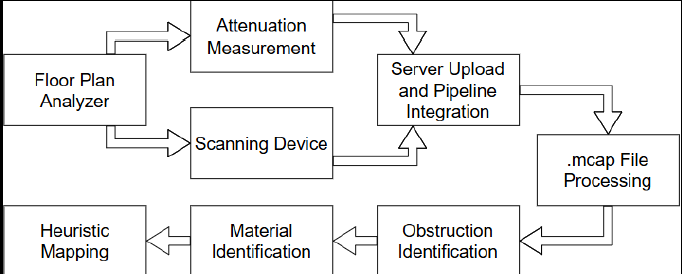
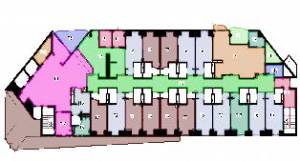
To solve this problem, we implemented the following design. The flowchart to the left provides a visual aid for this process. We first analyze a given floor plan to label unique rooms in minimizing survey time. After this, we deploy our building mapping and attenuation measurement devices to record these rooms, including images, 3D scans, and signal loss. From there, the device uses a server to upload data to the cloud. The data is then formatted to provide fast processing for the remaining programs. The last programs involve providing texture to wall features and identifying wall material based on the images taken. Finally, with each unique room scanned, the original floor plan is then reconstructed to provide a 3D building scan containing information on wall material attenuation.
Conclusion
As seen from how well our design met the requirements, constraints, and goals, we have delivered a device with exceptional potential. Our requirements, constraints, and goals were achieved at least within the threshold, with our duration of total process meeting our predicted performance.
Lessons we learned include the importance of good design practices, the intentional/unintentional ways that the parts interact with each other, the importance of off the shelf instruments, and the value of effective communication and group work. These lessons are crucial as we further our occupations in design and implementation.
Because the initial refinement phase was truncated, we recommend upgrading to professional-grade LiDAR hardware and further training the machine learning models to enhance data accuracy while maintaining cost-effectiveness. Additionally, we propose a "priority-scanning" feature to save time by automatically skipping low-traffic areas.
Thank you
We would like to thank Shasta Cloud for the opportunity to work with them to develop and implement this design. Without their generous contributions, this project would not have been possible. Thank you!