
Revamped Propane Tank
Team: Janzy Clark, Tyler Hatch, Dustyn Miller and Blake Schow
Project Description
The standard 20-lb propane tank has remained largely unchanged for over 75 years. We set out to modernize this everyday product by developing a smart handle assembly that retrofits onto existing tanks. Our design uses a magnetic float gauge and LCD display to show remaining propane levels. The handle improves ergonomics through increased grip surface and softer, rounded contact points, while a plastic footing adds drop protection and reduces noise when the tank is set down.


Propane Measurement & Electronics
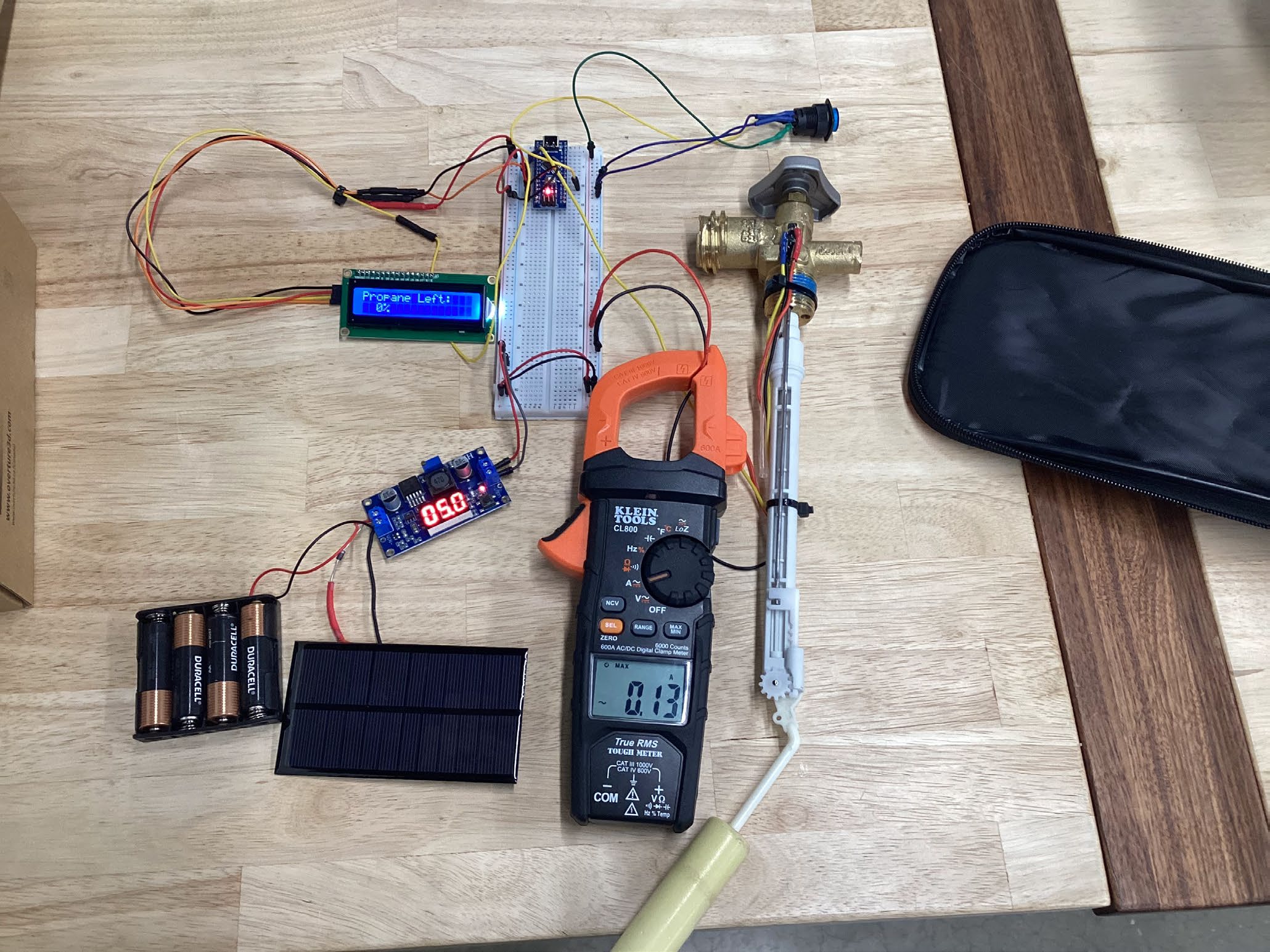
An SS49E linear hall effect sensor reads the position of a magnetic float inside the valve to determine propane fill level. An Arduino Nano processes the sensor data and displays the propane percentage on an LCD screen. The system is powered by a solar-battery hybrid (6V solar panel and 4×AA battery pack) regulated to 5V through an LM2596 buck converter. A button activates the display for 30 seconds per check to conserve power.

Handle Assembly
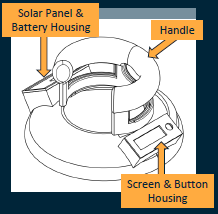
A 3D-printed handle assembly retrofits over the existing metal tank handle, providing increased grip surface area and softer, rounded contact points for improved ergonomics. The handle assembly also houses all electronics, the LCD display, and the solar panel.
Drop Protection Ring
A flexible TPU footing sits beneath the tank base, absorbing impact energy during drops and preventing direct steel-to-ground contact. This also reduces noise when the tank is set down and adds stability.

| Requirement/ Constraint/ Goal | Target | Threshold | Predicted Performance | Actual Performance |
|---|---|---|---|---|
| Similar weight to traditional propane tank | 18 lbs | Max 24 lbs | 25 lbs | 19.05 lbs |
| Similar diameter to traditional propane tank | 13 in. | Max 15 in. | 12.9 in. | 12 in. |
| Similar height to traditional propane tank | 18 in. | Max 20 in. | 18.58 in. | 18.27 in. |
| Propane gauge accuracy | ±5% of the actual amount | Max ±7% | ±6.52% ±5% | ±5% |
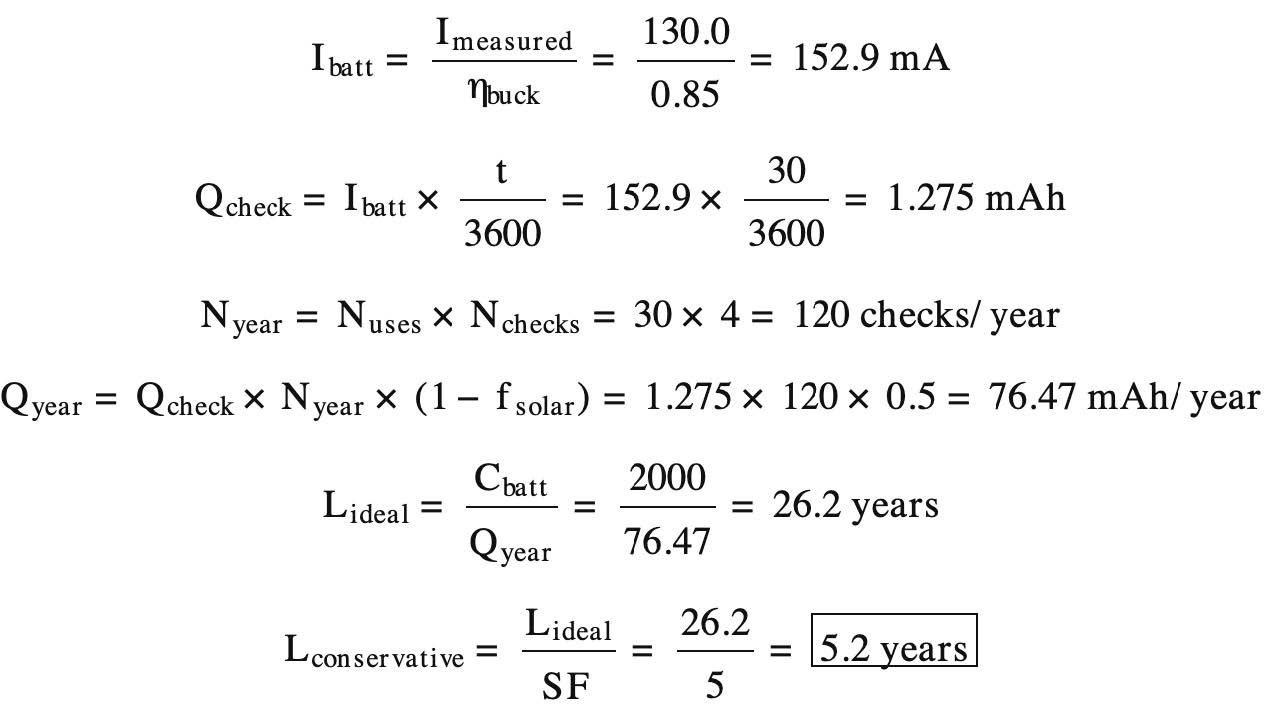
| Gauge display battery life | 5 years | 2 years | 12 years | 5.2 years |
| Drop force resistance | Withstand a 3-ft drop without structural failure or plastic yielding | Minor deformation acceptable; no cracking or collapse allowed | No damage | No damage |
Analysis & Testing
Design requirements were verified through physical measurements (weight, height, diameter), a drop test onto concrete, measuring the sensor's accuracy at its empty and full points, and energy consumption calculations using measured current draw. All results met or exceeded threshold values.
Conclusion
Our team met all constraints and goals, demonstrating that the standard propane tank can be meaningfully improved at low cost. Key areas for future development include miniaturizing the electronics with a custom PCB, using UV/weather-resistant materials for the handle, adding burn time estimation and a battery life indicator, and improving weatherproofing of the electronics housing. Through this project, our team gained hands-on experience with the design and prototyping process, having to pivot on our ideas multiple times. This taught us the value of real-world testing and prototyping, proving that theory and assumptions don't always hold up in practice.