
NGC - Torch Test Ablation Stand Improvements
Team: Bryson Dafoe, Ethan Layne, Jaz Merritt, Bradley Morris and Sarah Nelson
Project Description
The purpose of this project is to develop an improved ablation torch-testing stand for the purpose of gathering more accurate and repeatable quantitative data for material testing.
The heritage test fixture was designed around ablation testing methods in the 1980s. Our new design adjusts the stand's capability for modern testing methods.
The important factors for this project are improving usability, safety, and versatility with an end product that is more accurate in its results, and more robust for long-term use.
Design Description
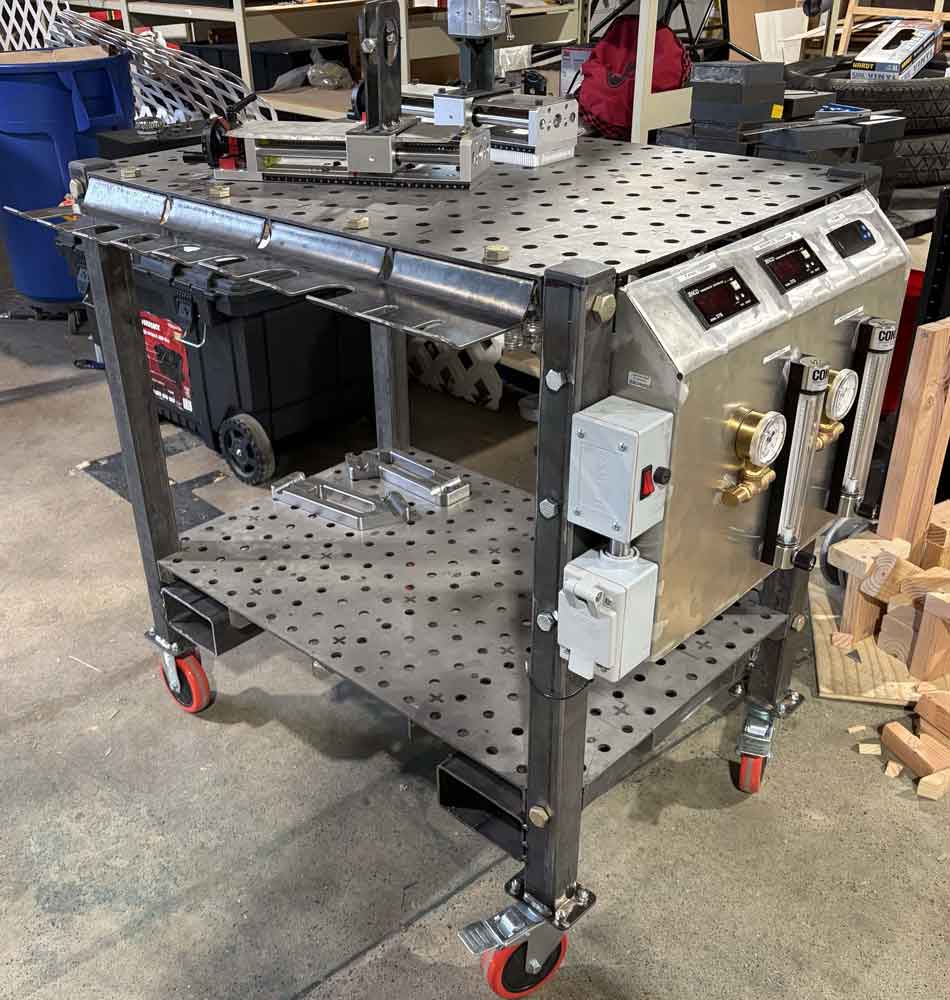
The design consists of four subsystems: table, sample holder, torch holder, instrumentation panel.
The table includes welding tabletops for easy mounting, sample holder rack with tools, water reservoir, forklift slots, and a fire extinguisher.
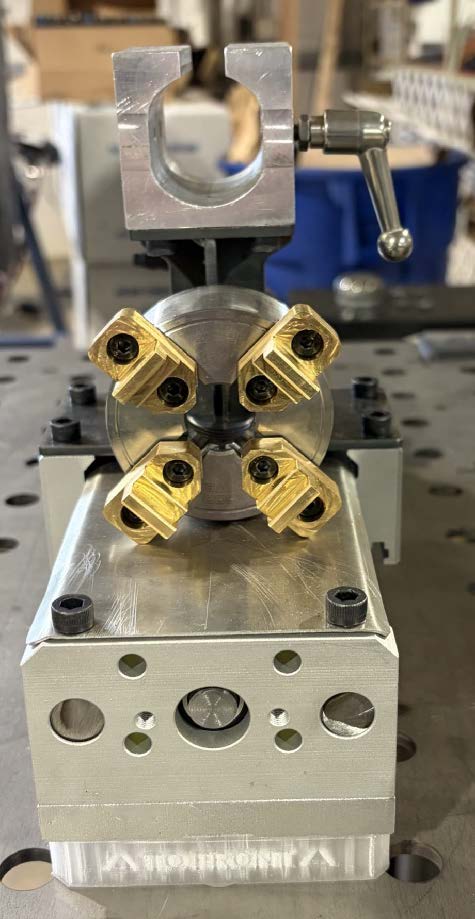
The sample holder subsystem uses a custom tailstock and multiple mini lathe chucks for rapid sampling of 2-in. samples with machined brass jaws.
The torch holder has spacing for propane and oxy-acetylene torch nozzles with movement between the calorimeter and sample.
The instrumentation panel is equipped with flow meters and pressure gauges to measure gas flow supplied to the torch and determine plume characteristics.


Design Requirements
| Requirement | Target | Threshold | Actual |
|---|---|---|---|
| Set-Up Time | 10 min | 20 min | 1 min |
| Max. Component Weight | N/A | 40 lb | 10 lb |
| Oxy-Acetylene Torch Flux | 300 BTU/s*ft² | 50 BTU/s*ft² | 50-300 BTU/s*ft² |
Most important project design requirements and their required values with the actual values from the improved system.
Performance Review
Analysis was done on all parts of the design to ensure it met design requirements. These tests included finite element and thermal analyses of the tabletop, torch, tailstock, and chuck. There was no concern for deformation or thermal effects on any components.
Loading analysis was done on the torch mount to ensure it could support operator weight, on the table to prove it would not tip over when fully assembled, and on the system to ensure a forklift would be able to move the final design.

Conclusions
Our team's design exceeded all our design requirement, goals, and constraint thresholds. The project was delivered on time and under budget.
The lessons learned in this project focused on breaking larger tasks into small deadlines, importance of strong idea generation in the design phase, and team-client communication.
Recommended future work to further improve the finished design includes automating data acquisition, implementing a water-cooling system, or upgrading with additional sensors and instrumentation.
Special Thanks to Northrop Grumman