
Explosive Donut: 3D-Printed Rocket Igniter
Team: Cameron Zirker, Logan Mecham, Brandon Coltrin, Matthew Walker, and Bryson Shaw
Sponsor: Northrop Grumman
Introduction / Requirement
Northrop Grumman is seeking new ways to manufacture igniters easier and faster for their Orion spacecraft. We were tasked to create a 3D printed igniter to meet the following goals:
- Withstand 2250psi of hydrostatic pressure
- Minimize part count with varied wall thickness
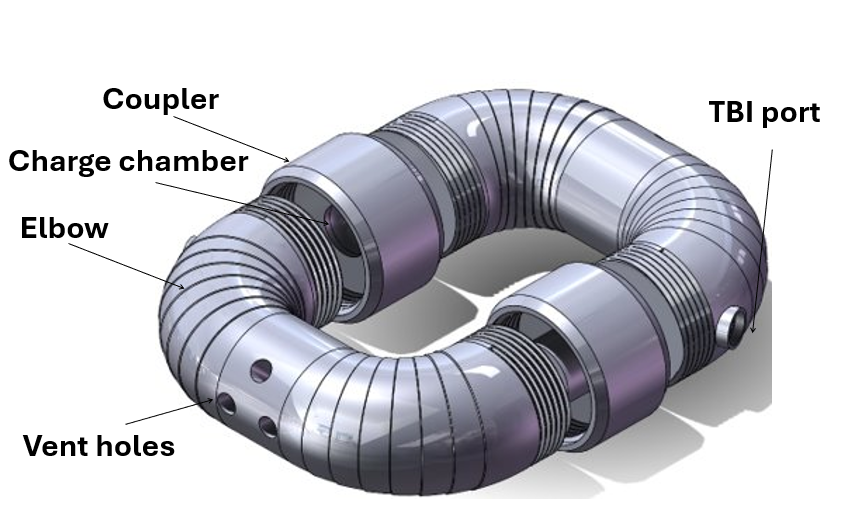
- Fit charge pellets with a charge chamber and hollow interior, vent holes, an internal port, and a TBI port
- Follow a toroidal shape to fit the Orion stage 3 combustion chamber geometry
Material Testing
- Tensile and shear testing show that polycarbonate (PC) is the best filament candidate
- PC has the highest strength along and against the print direction


Finite Element Analysis (FEA)
FEA testing reveals that the inner port, vent holes, and elbows are areas of high stress and may be where the part fails at high pressure


Solid Model
Hydrostatic Testing
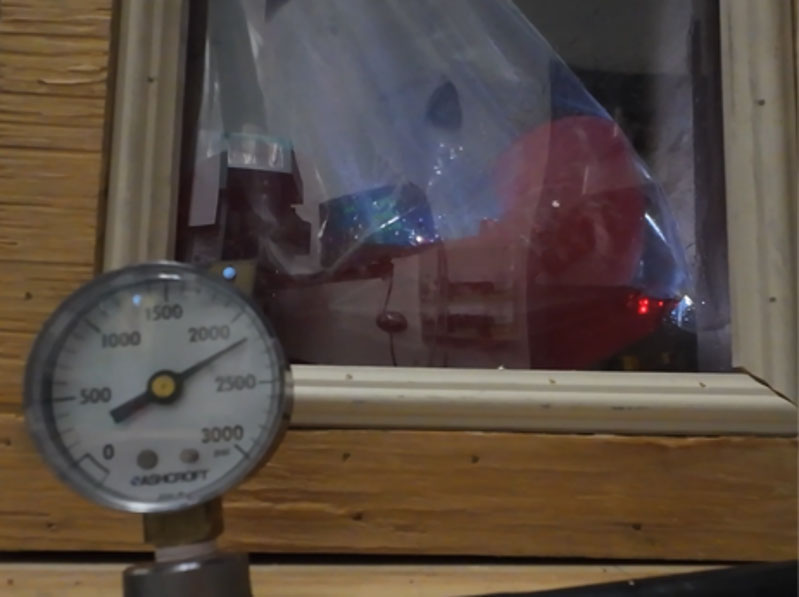
Hydrostatic testing revealed that the PC elbow did not crack at 2200psi, but the pump we were testing with did Other elbows that burst broke along layer lines at the elbow or outside on the bend


Conclusion
- Our design reaches 2200psi at minimum, and meets all of the size requirements
- In the future, the testing can be completed without pump failure and the wall thickness can be optimized
- As a team, we learned collaboration, test engineering practices, finite element analysis, and project management