
Deburring Automation/Process Improvement
Team: Kaleb Crowford, Hyrum Kunz, and Heidi Moulton
Sponsor: Campbell Scientific
Project Description:
Campbell Scientific manufactures weathermonitoring instruments. They make instrumenthousings by stamping piecesout of aluminum and steel sheet metal.This process leavesburrs (jagged edgesand excess material) which then must be removed.The deburring processis a bottleneck in their workflow. The goal ofthis project is to implement a new processwith increased output and decreasedoperator interaction.
Requirements & Constraints
Design decisions were made based on the requirements and constraints in the table below.
| System | Requirement/Constraint | Units | Target | Actual |
|---|---|---|---|---|
| Overall Deburring Process | Parts per Hour Output | Parts/Hour | 99.7 - 153.3 | 116 |
| Maximum Part Size | Diagonal (in) | 14-17 | 14 | |
| Cost | $1,000 | 200-300 | 150 | |
| Freq. of Maintenance | Num/Year | 2-12 | 2 | |
| Required Number of Operators | Num | 1 - 3 | 1 | |
| Washer | Parts per Hour Output | Parts/Hour | 99.7 - 153.3 | 800 |
| Parts are Cleaned | Not tracked | YES | ||
| Dryer | Parts per Hour Output | Parts/Hour | 99.7 - 153.3 | 800 |
| Parts are Dried | Not tracked | YES |
Performance Review
To ensure our project met the constraints, we performed several analyses and tests. Results are shown circled in blue.
Using production hours, average part output, and speed of the new equipment, we simulated the new output to be 51% higher than with the old system.
A large factor of output is the washing and drying of parts. By testing various pressures, distance to parts, and angles, we determined the best orientation for the sprayers and air knives.
Deburr Bowl

Washer (1), Dryer (2), and Enclosure

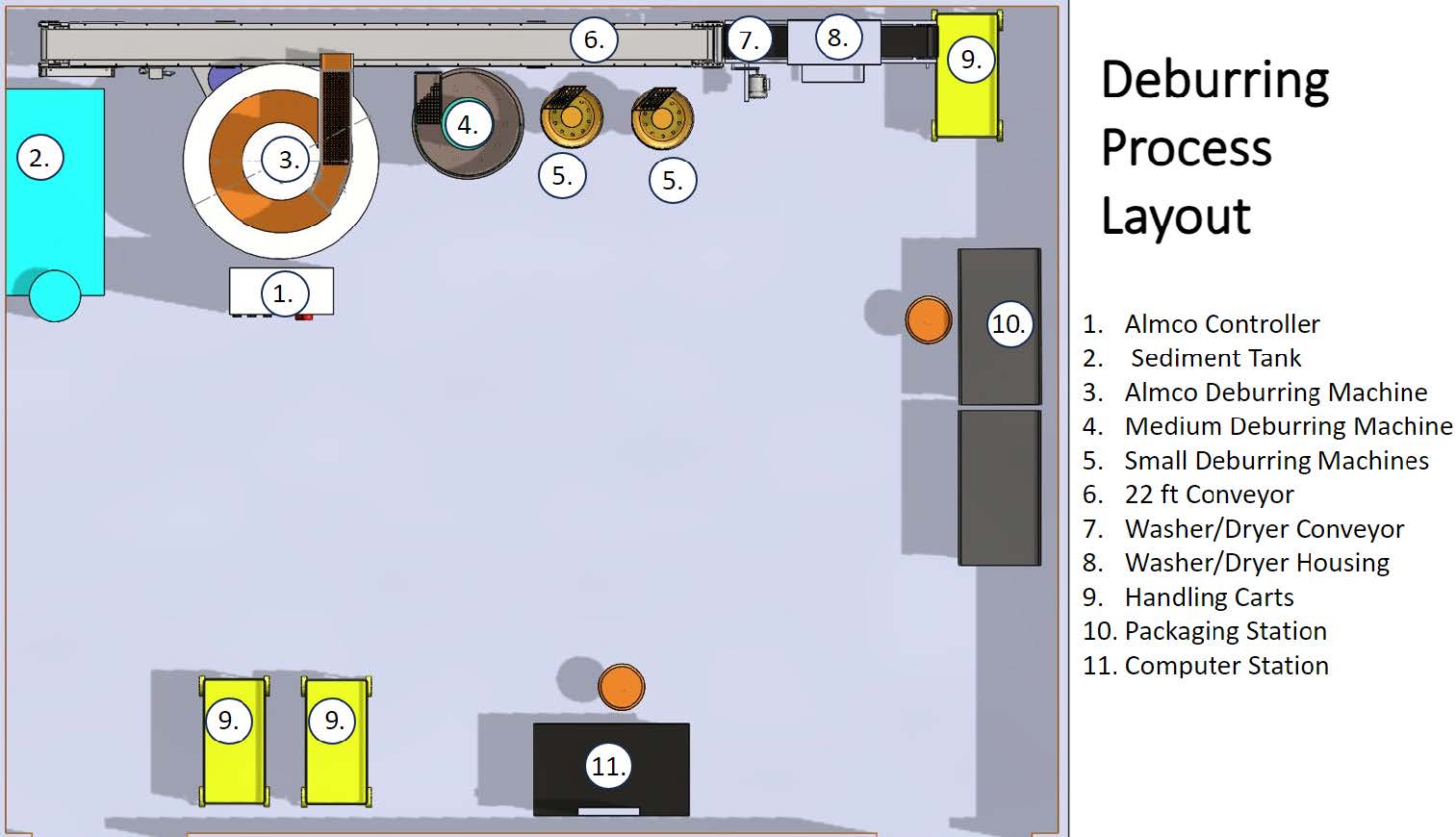
Design Overview
Our proposed design incorporates a faster deburring bowl that sifts the parts from the media,aconveyor system that transports parts, anda washer and dryer to automatically clean and dry the parts. These elements vastly reduce handling time.
Conclusion
Our redesign was successful in surpassing or meeting the target in maintenance, number of operators, and cost. However, we only met the threshold on output and minimum part size. The redesign will result in a significant profit for the company; paying itself off in 2.1 years, and netting $75k every year following.
Throughout the process, our team learned that setting goals and creating a timeline is vital to ensuring the project has a real pathway forward.
Recommended future-work includes: automating start-and-stop of washer and dryer, incorporating more deburring bowls, expanding enclosure to include more washers and dryers.