
2024 Baja SAE
Team: Hunter Andersen, Couy Crane, Jesse Hobson, Jason Hutchinson, Braedon Lukens, Jake Murdock, Peter Nelson, Noah Nordfelt, Anika Slade, Tristan Spencer, Trenton Thornley, and Alex Yancey
Sponsor: USU SAE
Project Description
The purpose of this project is to design a competitive off-roading buggy to compete in the Baja SAE California 2024 competition. Success in competition is determined by a combined score in the static and dynamic events.
Static Events:
- Business Presentation
- Design Presentation
- Cost Report
Dynamic Events:
- Acceleration
- Hill Climb
- Maneuverability
- Suspension & Traction
- Endurance
The design objectives can be summarized into five different categories: improve acceleration, reduce weight, improve handling, improve durability, and maintain suspension and traction.
Design Goals and Requirements
| Requirement | Design Target / Goal |
|---|---|
| Curb Weight | 476 lbs |
| Lower Motor Height | 4” |
| Ground Clearance | 8”-10” |
| Suspension Travel | 9” |
| Steering Wheel Rotations (lock to lock) | 180 Deg. |
| Outside Turn Radius | 75” |
| Top Speed | 25 mph |
| Acceleration Time (150ft) | 4.2 sec |
| Vehicle Life Target (miles/hours) | 15 Hrs. |
Major Systems Design
Steering: The inclusion of a steering quickener with a 2:1 ratio ensures a swift response to driver input while maintaining precise control. This system also employs the use of a rack and pinion to translate the steering wheel turning to turn the tires.
Suspension: The front suspension uses a double wishbone suspension while the rear uses a hybrid-wishbone design. This design is optimal for the obstacles the buggy faces while competing such as rocks and boulder, logs, trenches, and jumps.
Brakes: The brake system uses PS1 Willwoodbrake calipers which can hold up to 490 N of braking force.
Drivetrain: The team decided to produce a custom reduction box and drivetrain assembly that was designed and manufactured in house. The reduction box utilized a two-stage reduction, with an extension after the first stage that drove the front wheels of the buggy. The second stage drove a solid axle that replaced a differential.
Frame: The primary frame design goals this year were to maintain the weight of the frame, increase frame reliability, increase access to the CVT, increase build/weld precision, and lower center of gravity/form drag. This was achieved by increasing tube thickness and altering frame geometry

Frame (front right)

Drivetrain (rear left)

Frame (rear right)

Drivetrain (rear right)
FEA & Performance Review


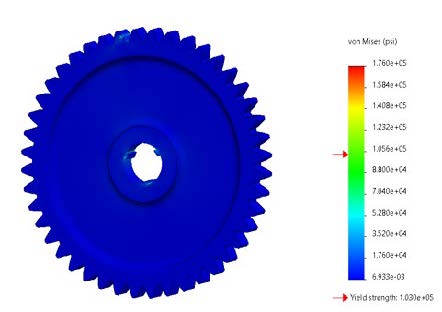


Vehicle Weight: The frame saw an increase in weight of 8 pounds. The CVT saw a reduction in weight of 5 pounds. The gearbox saw a reduction in weight of 29 pounds. The assumption made of the weight of the driver was that there would be a minimum of a 25-pound reduction. The final physically measured weight loss totaled to be just over 110 pounds which is a significant decrease.
Rolling Resistance: The results of this analysis showed that based on the expected reduction in weight of 51 pounds, an expected force to push of 54 pounds of force was calculated for this year’s buggy.
Acceleration to 150 ft: The predicted time this year’s buggy will take to accelerate to 150 ft (derived mathematically) is approximately 5.158s. This lies within the desired range of 5.60-4.2 s. Actual acceleration as recorded during the 2024 Baja California acceleration event was 4.36 s.
Turning Radius: With a mathematically derived turning radius of 84 in, the turning radius was sufficient for this year’s buggy to perform better than last year’s turning radius. It allowed us to be much more competitive in the maneuverability events as well as helped with general vehicle performance.
Suspension Functionality: This year’s suspension design worked very well and as expected. There was some damage on the suspension that occurred during the suspension and traction that should be addressed in future iterations like heimjoint size and arm placement. Other than these few things the suspension worked very well and gave the buggy the travel and adjustability that it needed to do well throughout the entire competition.
Time Lost to Repairs: Since the thread locker is confirmed to be an acceptable securing method for bolts, it is assumed that 10 minutes will be spent on resecuring bolts. A total of 20 minutes is estimated to be spent overall on these general repairs. Actual repairs during Baja events were slightly longer given the severity of our heimjoint failures.
Time to Remove Major Components: The previous year’s buggy had rear frame members impeding removal of the secondary CVT. This year frame members were optimized to provide sufficient room for CVT repairs. Furthermore, a single button release CVT cover was created for quick access to the CVT. Access to the CVT can now be achieved in approximately one minute.
Conclusion
| Requirement | Design Target / Goal | Result |
|---|---|---|
| Curb Weight | 476 lbs | 417 lbs. |
| Lower Motor Height | 4” | 3.75” |
| Ground Clearance | 8”-10” | 8-10” |
| Suspension Travel | 9” | 11” |
| Steering Wheel Rotations (lock to lock) | 180 Deg. | 190 degree |
| Outside Turn Radius | 75” | 79.4” |
| Top Speed | 25 mph | 27 mph |
| Acceleration Time (150ft) | 4.2 sec | 4.36 sec |
| Vehicle Life Target (miles/hours) | 15 Hrs. | SF >1.2 |
Lessons Learned
Steering: The original steering design created a significant angle between the steering rack and pinion and the main steering column. When the team was in competition, they discovered that it was significantly harder for the driver to turn the steering wheel when the U-joint reached a certain angle. The team had to modify the steering column to be at a larger angle to give the joint more clearance and allow the driver to turn the wheel significantly easier than before.
Suspension: The rear suspension was manufactured with smaller heim joints than the front. During the competition, there was significantly more damage done to the rear joints than the front. Looking forward, it would be beneficial to use the larger joints all around.
Brakes: One of the lessons learned in brakes this year was within the linkage between the master cylinders and the pedal. The original design incorporated a heim joint that allowed the team to bias the brakes. When the team began manufacturing the linkage, they discovered the joint would allow the linkage to buckle, which wouldn’t provide maximum braking force to the cylinders.
Drivetrain: The team committed to using Gaged Clutches for the buggy. The benefit of this was the opportunity to tune the clutch to the buggy. The company did not show up to competition, so the team was unable to tune the buggy to the drivetrain which led to significant losses in certain dynamic events.
Frame: The biggest lesson that the team learned this year was the importance of building a frame jig. By doing so, the tolerances were significantly reduced, and manufacturing was improved significantly. If the team wishes to be successful and produce a buggy frame that passes technical inspection the first time through, they need to use a frame jig during manufacturing.
Recommended Future Work
The biggest recommendations for next year’s team is to use the frame jig and keep the same frame and drivetrain design. The frame was able to pass technical inspection the first time through and was more ergonomic and dynamic. The drivetrain needs to be kept and somewhat improved to allow for reverse or other additions. The clutches should remain the same but there should be significant research into the tuning and improvements of the clutches to take full advantage of the use of that specific clutch. It would be highly beneficial to keep many of the subsystems the same, and to improve some of the existing systems. By doing this, there can be more focus on improving a system that is lacking, without having to reinvent the entire buggy repeatedly.