
Wheels on Exoskeletons
Increasing range of exoskeletons for individuals with paraplegia
Team: Emron Bardsley, Reva Grandstaff, Shannon Hafen, Dan O'Crowley
Sponsor: Utah Assistive Technology Program
Project Description
Design a future mobility device that incorporates standing while traveling, entering a vehicle without entry modifications to the vehicle, and be able to walk/step when needed (curbs, stairs, etc).
The user (individual with paraplegia) should be able to accomplish all the daily activities while in the device.
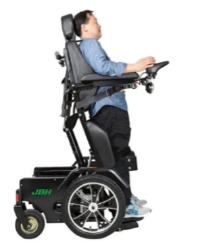 |
 |
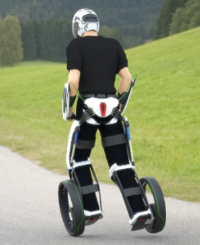 |
|
| Standing health benefits | Checked | Checked | Checked |
| Not limited to flat surfaces | Checked | Checked | |
| Easy to transport | Checked | Checked | |
| Fast transportation | Checked | Checked | |
| Battery life sufficient for a day | Checked | Checked |
Design Description

Our design has a frame to represent the exoskeleton that would allow the user to walk. The wheels were taken from a Segway device and have self-balancing and driving capabilities. The actuators allow the wheels (and user) to move up and down to transition between stepping and rolling. All the electronic controls are housed in the upper waist tray which provides a display and button controls. The joystick used for turning is a handheld part connected by wire to the tray as well.
Performance Review
| Constraints | Target | Threshold | Predicted Performance | Actual Performance |
|---|---|---|---|---|
| Device weight (kg) | 32 | 45 | 40 | 30.4 |
| Time to transition in and out of vehicle (s) | 60 | 120 | 35 | Driver Side: In-2:05, Out-30 Passenger Side: In-0:53, Out-0:19 |
| Travel in standing position | Yes | No | Yes | Yes |
| Walk up and down stairs | Yes | No | Yes | Yes |
| Move around hands free | Yes | No | No | No |
| Time to transition between step and roll (s) | 5 | 20 | 5 Both Wheels 16 One Wheel |
6 Both Wheels |
Conclusion
- SUCCESS! Our project can walk, self-balance, drive, take stairs, and get into a van.
- BUT… Our project doesn’t quite fit into front seats of a car, and shakes due to miscalibration and flex in the frame. Transition to the wheels still requires assistance.
- How well did our design meet the requirements and constraints?
- We exceeded some targets (goals) and met most of our thresholds (minimum requirements)
- Many of the difficulties with the project would not exist if the wheels were attached to a full, powered exoskeleton, as envisioned
- Lessons learned: Longer planning stages are beneficial, building it helps you see the next step, heat forming plastic is hard
- Recommended future work:
- Build a better (potentially Bluetooth) control stick
- Build better support plates and straps to secure the wearer
- Select different lift motors to make getting into cars easier
- New control electronics, hopefully partner with Segway for to calibrate to our physical specs.
- Give the feet more heel length
- Look for partners in companies that have already working exoskeletons