
Spaceport America Cup 2023
Team: Zachary Foster, Tyler Gardner, Jorge Hernandez Ramiro, Xavier Kipping, Sam Murdock, Xander Summers, Jonathon Thomsen
Sponsor: Utah Space Grant Consortium and MAE
Project Description
USU entered this year’s Spaceport America Cup with a team of Seven Mechanical Engineering Seniors supported by a team from the Electrical and Computer Engineering Department to design and build a payload.
The competition is to design and build a rocket capable of launching an 8.8 lb payload to an altitude of 10,000 ft.
The competition will take place in White Sands, New Mexico on June 19th - 24th.

Flight Summary
Design Description
The team designed two major components of the rocket: the airframe, and its altitude control system.
The airframe of the rocket was designed to use a M2400T motor and reach an altitude of 12,000 feet.
The Altitude Control System (ACS) will use real-time sensor data to deploy the rocket’s airbrakes to increase the rocket’s drag and target an apogee of 10,000 feet.

ACS Solidworks Assembly
Performance Review
Airframe A descent rate analysis on the rocket shows the rocket descends at an acceptable rate. OpenRocket and RasAero simulations ensure high stability despite using airbrakes.
Altitude Control System (ACS) A structural analysis on the airbrake flaps shows they can handle the aerodynamic forces of flight.
Along with the structural analysis, a study was ran to ensure the stepper motor will provide enough torque to open the airbrake flaps without destroying hardware.
GPS Recovery System The GPS Recovery system was tested on another high-powered rocket to ensure packets could be received and GPS altitude recovered for the Spaceport America Competition
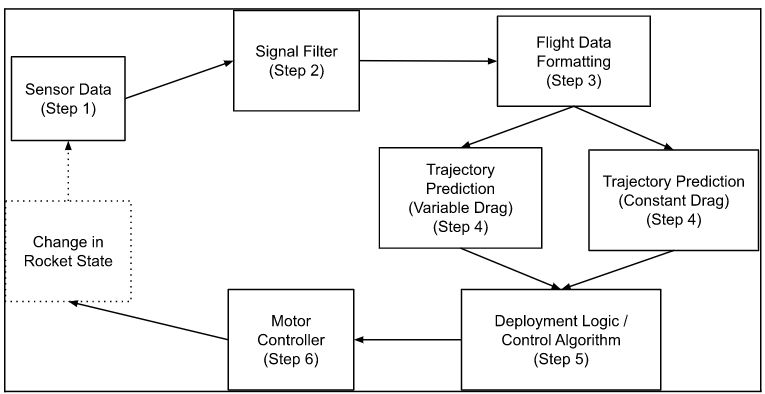
ACS Control Loop
Conclusion
- The payload fits the size requirement. The airframe without ACS assistance is predicted to approach 12,000 ft, and the rocket design has been approved by safety officials.
- The team has learned a lot about constructing high-power rocket airframes, electronic guidance and control systems, testing interfaces, and designing components to increase reliability of performance.
- The team recommends future teams to reuse the designed airframe, but to develop different solutions to the ACS system such as: multiple power screws or “teeth” that are pushed radially outward. The team also recommends consulting experts for aspects that are without the team’s specialty to prevent excessive use of funds.

Solidworks Aerodynamic Performance Model

Ansys Fluent CFD Mach and Density Visualization

Final Assembly