
Passive Spacecraft Thermal Switch
Team: Nathan Hoch, Ammon Holesinsky, Jordan Kunz, Rhett Parry, Nathan Thompson
Sponsor: Thermal Management Technologies
Project Description
The purpose of this project is to create a device that cools the electrical components of spacecraft by transferring heat to a radiator
Requirements
- Must transfer 10 W of heat
- Passive actuation (no electrical input)
Constraints
- ≤ 0.5 kg of mass
- ≤ 2.75 inch diameter
- ≤ 1.8 inch height
- ≥ 2000 K/W open thermal resistance
- ≤ 1 K/W closed thermal resistance
Design Description
The device opens and closes a thermal path by using a phase changing material for actuation. The device is in the open state when the temperature of the system is low, and no heat transfer is needed. As the temperature of the system increases, the device actuates to enter the closed state where heat transfer begins to take place.
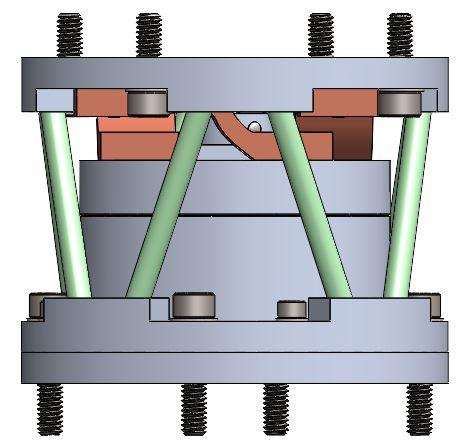
Side view

Isometric View

Fully Assembled Prototype
Performance Review
Design Performance
| Target | Designed | Tested | |
|---|---|---|---|
| Mass | ≤ 0.5 kg | 0.432 kg | 0.351 kg |
| Diameter | ≤ 2.75” | 2.75” | 2.75” |
| Height | ≤ 1.8” | 2.1” | 2.1” |
| Closed Thermal Resistance | ≤ 1 𝐾/𝑊 | 0.964 𝐾/𝑊 | 1.01 𝐾/𝑊 |
| Open Thermal Resistance | ≥ 2000 𝐾/𝑊 | 2056 𝐾/𝑊 | 54.6 𝐾/𝑊 |
Analysis showed that open thermal resistance was too low when the overall height of the device was 1.8”. Increasing the designed height to 2.1” allowed for the needed increase in open thermal resistance.


Conclusion
Testing of the prototype demonstrated that project goals were met for heat transfer, actuation, height, diameter, mass, and closed thermal resistance but not for open thermal resistance.
Lessons Learned: More sources for thermal material properties needed to be utilized to obtain more accurate thermal resistance calculations.
Recommended Future Work : The structure of the device needs to be redesigned to achieve the desired thermal resistance in the open state.