
Aggie Clean Beans -Cocoa Bean Sorter

Project Description
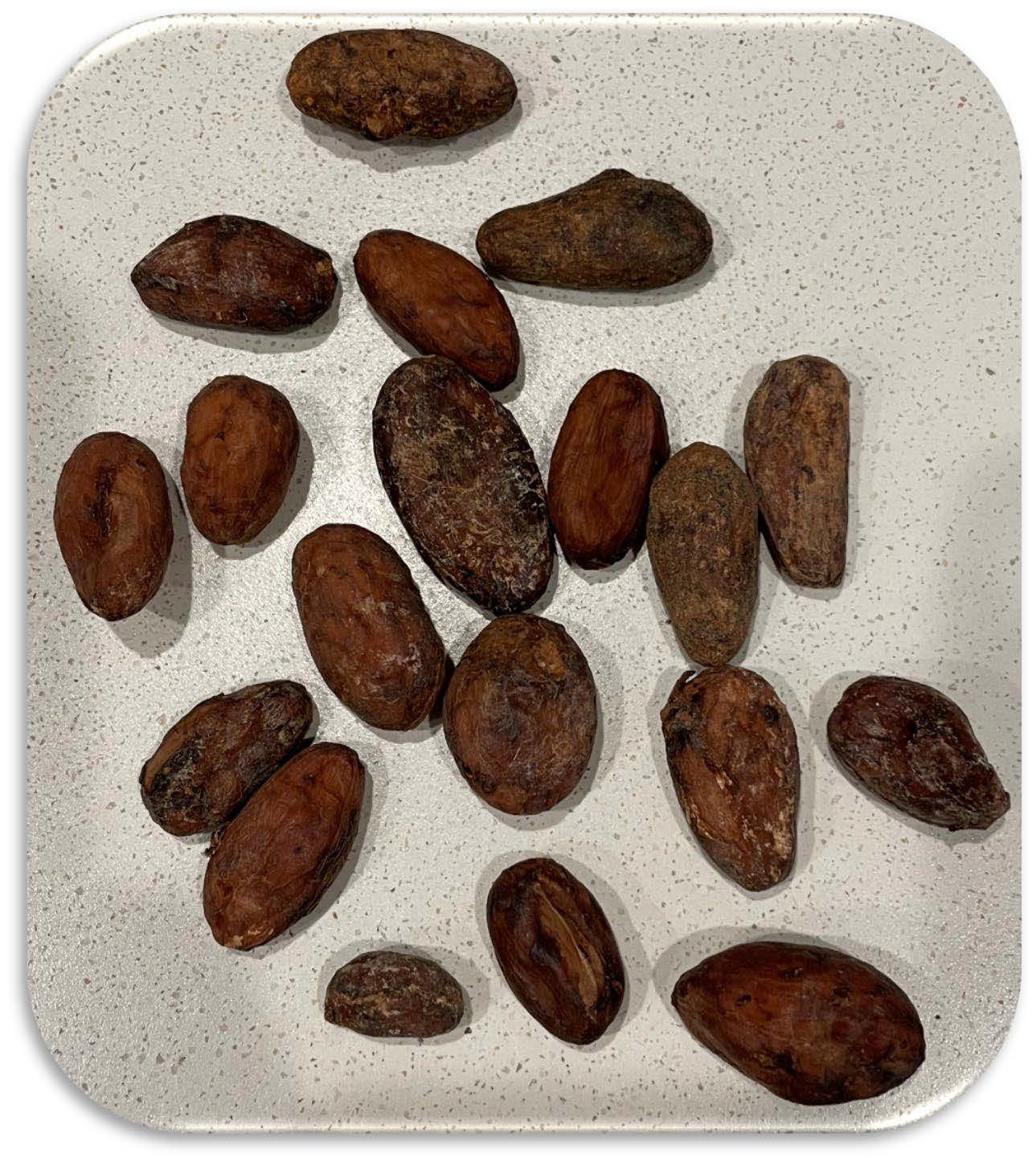
- Our Challenge: Aggie Chocolate Factory (ACF) employees currently spend approximately ten hours of labor every week sorting beans
- Our Goal: Save manual labor time with an automated sorter
- Sort at least 12-15 kg of beans per hour
- Sort out the waste, imperfect, and perfect beans into corresponding buckets
- Absolutely no foreign material remaining with beans
- Should last 10-20 years; being used 2-3 hours/day and 5 days/week
- Save more money in a year than it costs to build
- Able to be operated by high-school graduates of average build
- For easy replacement and calibration, use off the shelf motors and parts
- Material in contact with the beans must be food grade, as well as no liquid exposure to the beans
- To avoid disturbing residents, the machine must not make excessive noise

Design Description


Performance Review


- Forced air tube to remove low density material
- Air tube sorts out material as designed, such as the string and shells shown.
- Nested rolling drums to filter out both oversize and undersize material
- Drum holes are specifically sized for good cocoa beans to pass through the first drum and be retained in the second, outer drum.
- In-air optical classification and sorting speed
- Machine vision cameras take pictures of the front and rear of each bean. These are used by the convolutional neural network to classify the bean into one of three categories: primary, secondary, and waste.
- The expected sorting rate is 4 beans per second per optical sorter. The design calls for 2 optical sorting units initially, but these optical sorting units can be added on modularly.
- Secondary beans and waste material are ejected by a solenoid activated flap as they fall. The solenoid activates in 33 milliseconds after classification.
Conclusion
- The team was unable to complete the full build of the project. Due to the modular design of the product the whole machine needed to be built to receive functional results. The results out of the hopper, air tube, and rotating drums were all promising, and it is believed the optical sorter will perform at the desired rate once the build is completed.
- The team learned the project was far beyond the scope of their knowledge. They should have taken a more conservative approach from the start of their project . The team realized they also needed to do further research on availability of machines at the Metal Factory and their capabilities.
- The team recommended completing the design with the last two modules of the design, the singulator and the optical sorter. Finishing the optical sort includes the rest of its programming and taking the training photos.

Daniel Bardwell, Ryan Hulet, Heidi Pace, Sierra Brookshire, Emily Santana
Special thanks to the Aggie Chocolate Factory for their sponsorship and the guidance of Dr. Silvana Martini and Mr. Steven Bernet.