
Sustainable Energy
Biofuels
Development of sustainable biofuels is an important aspect of a concerted adoption of renewable fuels. Integration of photonics and plasmonics with biology in biofuel systems provides a number of key research opportunities. Prof Roper’s group is evaluating photonic interactions that enhance cultivation and growth of algae for production of biofuel alcohols. The group is also developing photon/plasmon enhanced methods to improve economics of cultivation, harvest, and recovery of biofuel replacements for petroleum-based fuels.

Prof. Roper recently completed coauthorship of the 3rd edition of Separation Process Principles, with Bob Seader and Ernest Henley. Prof Roper introduced chapters into the text that provide important biochemical and chemical background as well as basic principles and advanced techniques to assist engineers in developing bio-based analytical, preparation, and process methods to integrate into development and manufacture of both pharmaceuticals and biofuels.
Solar Photovoltaics
Plasmon and photon interactions provide order of magnitude improvements in electron-hole pair generation and photocurrent in conventional and prototype solar photovoltaics. But historically, these gains have been limited by thermalization and confined to limited regions of the solar spectrum. Prof. Roper’s group is developing accurate and computationally efficient models for plasmon-photon and thermoplasmonic interactions in solar photovoltaics. Using these models guides development of nanoarchitectures that provide significant broadband enhancement in solar photovoltaic efficiency.
Model results are used to fabricate enhanced solar photovoltaic prototypes using unique, economic combinations of top-down (EBL, CVD) and bottom-up (NSL, NIL) approaches. In these protoypes, photonic, plasmonic, and thermal effects are balanced to optimize electron-hole pair generation and photocurrent.
Fuel Cells
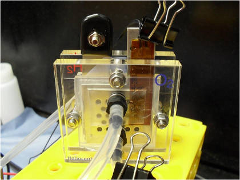
Flooding of recombined water occurs in the cathode of PEMFCs resulting in the necessity of excessive platinum (Pt) catalyst and reduced catalytic efficiency. Thermal sensitivity of the fuel cell membrane does not allow bulk heating of the cell as a means of combating flooding. However, we anticipate that flooding can be mitigated and the cell efficiency increased by the addition of targeted heating at the catalyst surface via phonon decay of photon-excited plasmons interaction in gold (Au) nanoparticle (NP) arrays imbedded within the cathode.
Prof. Roper’s group is currently characterizing the ability of plasmon heating in solid-state Au NP arrays generated by an Argon ion laser to evaporate fluid from the array surface. We have expanded an energy balance to predict both the fluid evaporation rate and the effects of evaporative cooling on the local temperature profile of surfaces adjacent to the array. We then compare the predicted thermal profiles with those obtained experimentally using two different fluids. We also have a PEMFC system in which we are measuring the effects of targeted heating of the cathode.