
Hardware Nintendo Entertainment System (NES) Emulator
Team: Easton McBeth
Project
Software emulators can only simulate the behavior of a game console. A hardware emulator can perfectly recreate it. This system is a cycle-accurate emulation of the original NES hardware
- Custom CPU and Picture Processing Unit (PPU)
- VGA game output with no stuttering
- Python menu allowing simple game switching
- Custom connectors for original NES controllers
System
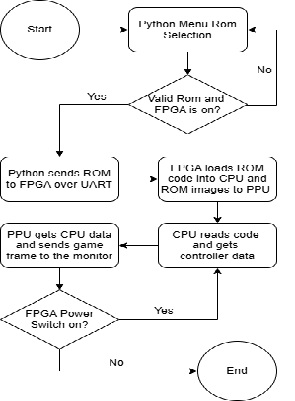
Software Diagram
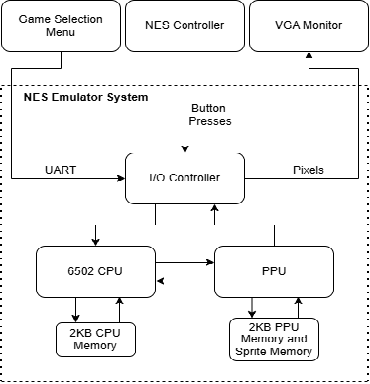
Hardware Diagram
Methods
Design and Hardware:
- Core Logic: Implemented in Verilog and synthesized onto a Basys3 FPGA
- Controller Interface: Original NES ports soldered to a PMOD connector to interface with the FPGA
- Video Output: A dual-port RAM buffers data between the PPU and VGA, also scaling the 256x224 resolution to a 512x448 VGA output
Data Processing:
- ROM Loading: A custom Python script parses game ROM headers and transmits the configuration and data to the FPGA using UART
- System Execution: The 6502 CPU executes program code and passes background and sprite data to the PPU for pixel rendering
Conclusion
Results:
- Successfully plays NES games using mappers 0 through 3, with accurate video rendering to VGA and original controller input
What I Learned:
- Designing complex and parallel hardware systems
- Implementing UART to transfer large data files to an FPGA
- Reverse-engineering and interfacing with old hardware standards
Future Improvements:
- Add support for games with persistent save data
- Implement the Audio Processing Unit (APU) to add sound support
- Add logic for more complex memory mappers to support more games