
E-Ink Cards
Team: Ethan Moser and Austin Smith
Project
- Traditional card games come with a hidden cost: space. A family trip means packing Uno, a standard 52-card deck, Exploding Kittens, Phase 10 — each in its own box, eating up room in your bag before you've packed a single shirt.
- We set out to solve this with a single elegant idea: a deck of cards whose faces can change. Our deck stores game faces digitally — with a tap, you switch between a standard playing card set, a Uno deck, or any specialty game you've downloaded. One deck box. Every game you love. Nothing left behind.
System
Methods
- E-Ink display — power only when it changes E-Ink panels only consume power at the moment of an update. Once a new card face is written, the image persists indefinitely with zero standby power draw — no connection, no battery required to stay visible.
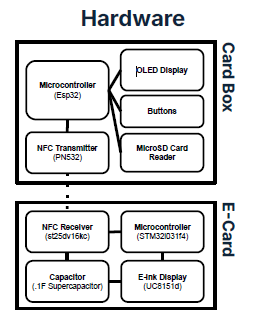
- NFC — wireless power and data in one Each card contains a built-in NFC antenna. The deck box acts as an NFC transmitter, inductively coupling with each card to simultaneously transfer the new card face data and supply the energy needed to execute the display update. No batteries in the cards, no contacts, no charging.
- Together: a passive, batteryless system E-Ink's zero standby draw means the cards never need to stay "on," and NFC's combined power-and-data delivery means the cards never need their own battery. The box energizes on demand; the cards store their face passively.
Conclusion
Over the course of this project, our team made significant strides in bringing the concept of dynamic, face-changing E-Ink playing cards to life. We successfully designed and manufactured a custom flexible PCB tailored specifically for our cards, demonstrating a strong command of hardware design and fabrication.
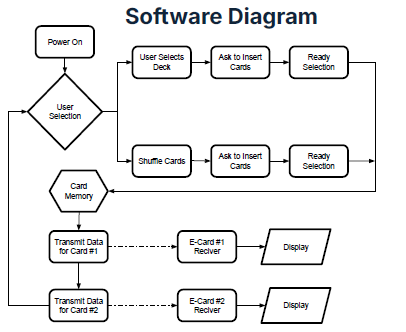
Our deck box prototype proved to be a standout achievement — we were able to program it to transmit an NFC signal to a card module and implement digital card shuffling functionality, laying a solid foundation for the full system.
While we were able to demonstrate wireless data transfer between the deck box and a card, fully programming the cards to render and update the E-Ink display remained just out of reach within the semester's timeline.
The groundwork we have established, however, is substantial: a manufactured and populated custom PCB, a functioning NFC-capable deck box, and a validated data transfer pipeline collectively represent meaningful progress toward every one of our original objectives. With additional development time, completing the display refresh pipeline and achieving full image transmission across a complete deck is a highly attainable next step, and this prototype stands as a strong proof of concept for the innovation at the heart of our project.