
High-Repetition Laser Interlock
Team: Timothy Goodale and Sammy Kiguthi
Project
Laser Research
There is ongoing research using lasers in academia and industry, including:
- Laser Fusion
- Silicon Fabrication
- Gravitational Waves (LIGO)
- X-Ray generation
Problem
Research into lasers is often slowed down by problems with the experimental setup.
- Laser systems contain hundreds of expensive optics
- Critical optics may become damaged, damage propagates to other optics
- Lasers with a high rep-rate can cause immense damage in milliseconds
Our Interlock system identifies damage, then shuts down the laser system within the period of a laser pulse.
System

Methods
Sampling
Laser is sampled by CMOS camera.
- Camera exposure triggered by laser timing
- Beam intensity controlled by wedge and filter

Analysis
Analysis is performed by GPU, 1/0 using the PC.
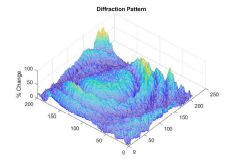
- Compare each pixel of two frames, if difference is above a threshold, flag the pixel
- If enough pixels are flagged, shut down laser

Control
Microcontroller controls diodes based on input from the Cryo Unit and Analysis.
Conclusion
Functionality
The Interlock system identifies damage and shuts down the laser with the following:
- Damage occurs on the order of a laser pulse
- Number of Pixels flagged from noise is less than pixels flagged from damage
Future Work
Damage may occur over the span of minutes. Improvements could include:
- Machine learning or histogram to identify damage
- FPGA implementation to remove user start-up, compact system
