
Wi-Fi Intrusion Detection System (WBIDS)
Team: Bridger Altice, James Hyland
Sponsor: LT Security
Project and Solution
Limitations of Modern Intrusion Detection Systems:
- Line-of-sight detection required (Ex: cameras)
- Limited data feedback
- Difficult installation
- Expensive
The WBIDS Solution:
- Does not require line-of-sight
- Tracks position and velocity
- Easy setup (Wi-Fi is already in most buildings)
- Low-cost
System Diagrams
Hardware
Overall System

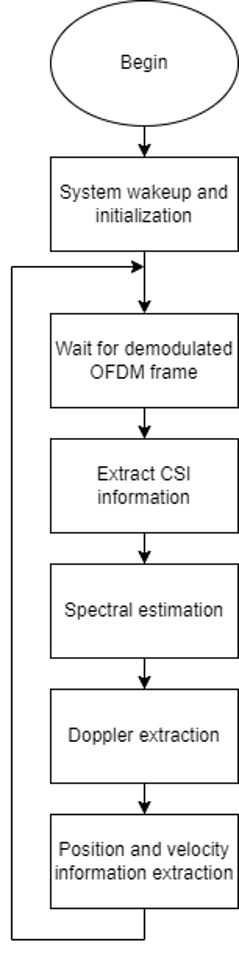
Software
OFDM Demodulate

CSI Extraction and Processing
Methods
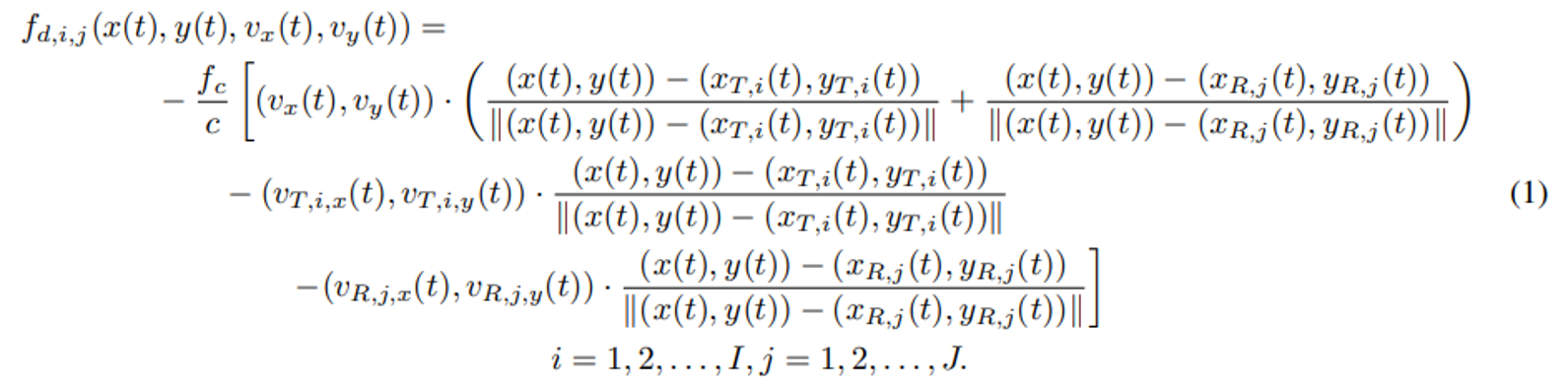
Doppler Shift
- When an object in motion reflects a signal back to a receiver, this causes a doppler shift in the received signal
- By reverse-engineering the doppler (fd) equation below, the position (x,y) and velocity (vx,vy) of the object relative to the receive antennas can be calculated
- This equation requires inputs from 4 receive antennas
Why Wi-Fi?
- Found in most buildings
- Signal travels through walls
- OFDM allows for better object tracking due to 52 data subcarriers/signals vs. only 1
52 Subcarriers Spectra

Conclusion
Results
- The doppler frequency shift created by a moving target is detectable
- Doppler information can be tracked and used to estimate target velocity
- By working on this project, we learned the basics of communication systems, how Wi-Fi modulates data using OFDM, and how to implement various algorithms used for tracking and matching data
For The Future
Spectrum With Matched Filters

Given more time to work on the project, we would improve the system's ability to track position, increase the signal-to-noise ratio, and implement the system in real time.
Improving the signal-to-noise ratio would remove the need for the target to be carrying a reflector, and could be implemented by reducing the length of wires, increasing transmit power, or reducing interference from other transmitters.