
How Green Infrastructure Can Fix Woodland Hills Stormwater Flooding
Team: Hunter Taylor, Carson Goodrich, Joey Knight, Zach Hatfield
Sponsor: Jones and DeMille Engineering
Proposal Summary
The City of Woodland Hills is a small town at the base of Loafer Mountain at the southern end of Utah County. This city sits on an alluvial fan with grades generally up to 15% within the developed areas. With roads and other developments at some locations, water runoff is channelized and has caused problems such as erosion, road drainage, and property damage in Woodland Hills. The challenge is to find a way to reduce or mitigate the risk of the water flow. This includes minimizing the flows that result from the steep roadways and associated drains, culverts, and slopes.
Alternatives
- Conventional Storm Drain System - This alternative includes placing curb, gutter, and reinforced concrete pipe along streets.
- Bioswales/Bioretention - Vegetation would be planted to reduce erosion and slow the velocity of water alongside roadways.
- Pervious Asphalt - Can allow water to go through the replaced asphalt.
- Rock Swales with Check Dams - Rock swales are shallow ditches with rocks that would run along roadsides. Check dams are small piles of rock that will be placed across the drainage swale.
- R-Tank Water Retention - These are water retention tanks that are placed in excavated ditches and covered with soil, vegetation, or rocks.
- Do Nothing - Was important to consider.
Design & Decision Matrix
These alternatives were developed by receiving input from the client and from Dr. R. Ryan Dupont, Ph.D. The alternatives are evaluated based on the established criteria: Client Preference, Maintenance, Cost, Environmental Impact, and Meets the 80th percentile storm.
Client Preference & Environmental Impact
The client wants a solution that would be aesthetically pleasing and implements an environmentally friendly solution. Overall, when comparing each of the alternatives, bioswales performed well because they added a pleasing aesthetic and were environmentally friendly. The conventional storm drain system performed the worst because it created an urban feel to the environment and is not a type of green infrastructure.
80th Percentile Storm
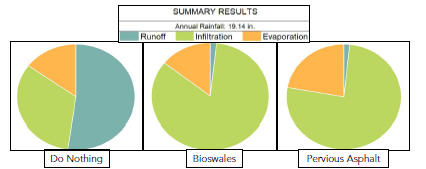
Each alternative must be able to retain the 80th percentile storm (0.5in). Do nothing alternative was the only design that was not able to retain the 80th percentile storm. Using the EPA stormwater calculator the following pie charts were created
Maintenance
The general maintenance of each alternative is considered so the amount of continual upkeep is minimized for the client. R-Tanks performed well in this category because with proper design and construction there would minimal to no maintenance required.
Cost

The client is interested in finding a solution that has a reasonable cost of construction. The graphic to the right compares the cost of each alternative. The alternative chosen was a combination of bioswales and rock swales/check dams. The total cost for both of these alternatives was $2,052,254.17. Once the final design was complete a more accurate cost estimate was completed. The total cost for the final design was $2,602,271.00
Selected Alternative: Bioswales with Check Dams
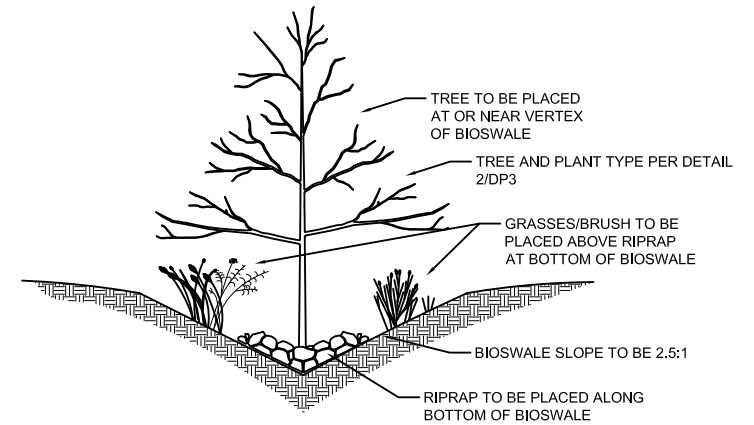
The alternative selected is the combination of a bioswale and a check dam. The check dams retain and slow the flow of the water while the bioswales allow for the water uptake via transpiration and to infiltrate into the ground by the plant’s roots creating preferential flow paths for the water to infiltrate easier. Overall, this combined method will decrease the velocity while increasing the infiltration rate of the stormwater runoff.
This alternative was selected because it was the best in terms of the chosen decision criteria: storm performance, construction cost, maintenance cost, environmental impact, and client preference.

Now the selected bioswale alternative just needs to be adequately designed to meet the necessary requirements. According to the requirements outlined by the Utah Department of Environmental Quality (DEQ), Woodland Hills must incorporate a stormwater design that retains the 80th percentile storm.
Final Design
The bioswales designed include many native plants, riprap to reduce erosion, and small check dams to slow the flow and increase infiltration rates.These check dams are designed to retain the 80th percentile storm and reduce the velocities to less than 2 ft/s throughout even the steepest regions of Woodland Hills.
Acknowledgements
On behalf of JZHC Engineering, we are very grateful and would like to thank the following individuals for all the time, effort and mentoring given for this project:
- Austin Ball, Professor, S.E., P.E.
- Dr. R. Ryan Dupont, Faculty, PhD
- Milan Malkovich, Woodland Hills Resident Architect
- Ted Mickelson, External P.E.
- Mark K. Sovine, Woodland Hills Public Works Director