
Educational Hydraulic Model
Team: Matthew Farley, Emilie Hill, Kristina Roller, Daniel Torgersen
Sponsor: Carollo Engineers
Summary
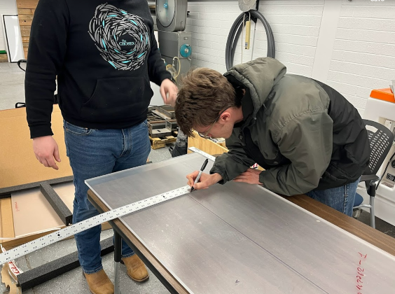
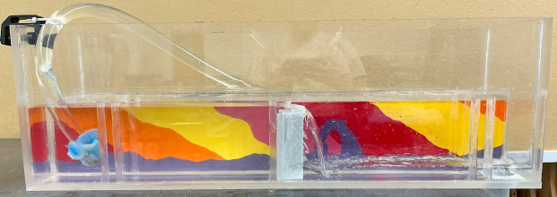
The Utah State Engineering Ambassadors tasked our team to develop a tool to showcase hydraulics in civil engineering. This tool will travel with the Ambassadors to a wide variety of event with hope of sparking interest in engineering.
The team:
- Evaluated alternatives based on the client’s criteria
- Created plans for the recommended alternative
- Prototyped and constructed a full scale hydraulic model
- Delivered the model and instructional booklet to the client
Alternatives
- New model
- Design and build a completely new, customizable model
- Modify existing model
- Fix issues with an existing abandoned model
- Educational videos
- Film lesson plans using existing flumes in the USU hydraulic lab
- Do nothing


Assessment
Priority criteria from the client:
- Engaging for a middle school target audience
- Transportable within an average sedan
- Easy to operate in a wide range of venues
- Allows for future presentations to be added
Alternative Decision Matrix
| New Model | Modify Existing | Videos | Do Nothing | |||||||
|---|---|---|---|---|---|---|---|---|---|---|
| Decision Factors | Factor Weight | Raw | Weighted | Raw | Weighted | Raw | Weighted | Raw | Weighted | |
| 1 | Engaging | 25% | 4 | 1 | 3 | 0.75 | 1 | 0.25 | 2 | 0.5 |
| 2 | Transportability | 20% | 3 | 0.6 | 2 | 0.4 | 4 | 0.8 | 1 | 0.2 |
| 3 | Usability | 15% | 3 | 0.45 | 2 | 0.3 | 4 | 0.6 | 1 | 0.15 |
| 4 | Maintenance & Operation | 10% | 3 | 0.3 | 2 | 0.2 | 4 | 0.4 | 1 | 0.1 |
| 5 | Longevity | 10% | 4 | 0.4 | 3 | 0.3 | 2 | 0.2 | 1 | 0.1 |
| 6 | Overall cost | 10% | 1 | 0.1 | 3 | 0.3 | 2 | 0.2 | 4 | 0.4 |
| 7 | Customizability | 5% | 4 | 0.2 | 3 | 0.15 | 1 | 0.05 | 2 | 0.1 |
| 8 | Sustainability | 5% | 1 | 0.05 | 3 | 0.15 | 2 | 0.15 | 4 | 0.2 | Total Score: | 3.1 | 2.55 | 2.65 | 1.75 |
Preferred Alternative
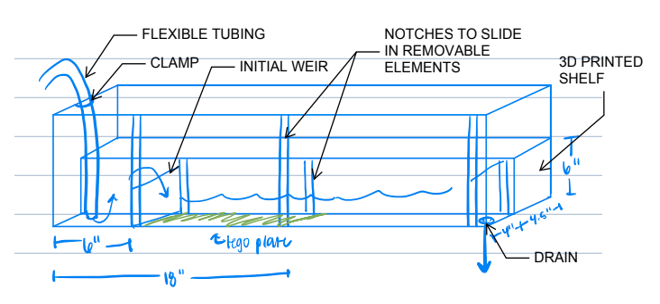
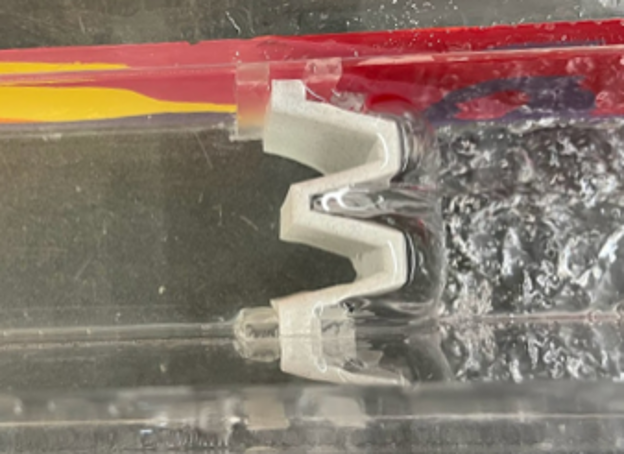
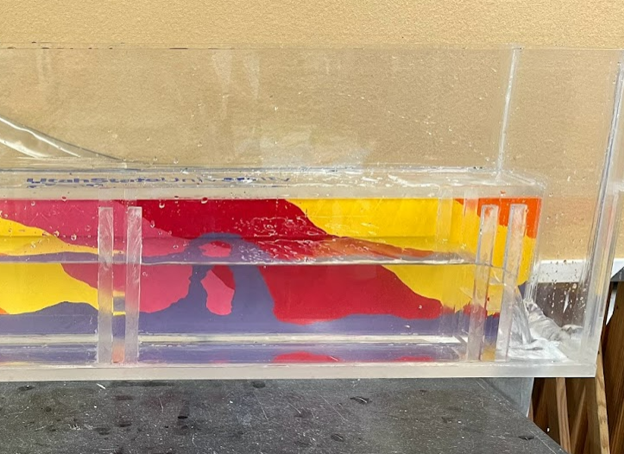
Based on the result of our decision matrix, the preferred alternative was to construct a new hydraulic model. The specificati ons of the model are a 36” x 9” x 12” tank with a 4” channel. The tank is constructed out of acrylic for visibility and the various hydraulic elements are eith er 3D printed or made from acrylic. Three groove sites are positioned along the channel allowing for elements to be interchangeable. The water flows through a pu mp sitting at the bottom of a bucket, through flexible tubing leading into the model. After passing through the channel, the water drains back into the buc ket . The model is currently capable of demonstrating the presentations described in the following section.


Presentations


Conclusion
The model was made to adapt and change for different presentations. The interchangeable parts allow the client to create new presentations and add new elements.
Additional Presentations Ideas:
- Use a sponge to look at infiltration and flow through soil
- Add a culvert attachment
- Add more weir types (PK, broad crested, OG, etc.)
- Add fish pebbles to demonstrate sediment transport
- Add houses and trees to the shelf to better represent flooding
- Make small boats to send through the model
- Do a presentation on hydrostatic pressure
Conclusion
Our team is very grateful for the opportunity to create this model. A special thanks to all the following for making this project possible!
- Client: Kristina Glaittli and the USU Engineering Ambassadors, Utah State University
- Faculty Advisor: Dr. Colin Phillips, Utah State University
- External PE: Brad Buswell, P.E., Carollo Engineers Professor Austin Ball, P.E., Utah State University Ken Jewkes, Utah State University