
Blacksmith Fork Canyon Earthen Dam
Team: Dalton Gaither, Max Johnson, Catherine Kime, Camren Todd
Sponsor: Cache Water District, Jacobs Engineering, Utah State University
Abstract
Cache Valley currently has water rights to 10,000 acre-ft of water and does not have water storage structures in place. MCDC Engineering took on the challenge to find a feasible option for the CWD.

Curtis Creek and Dry Curis Creek in Blacksmith Fork Canyon
When designing the project, MCDC considered three different alternatives. The first alternative was using a concrete dam, the second alternative was a concrete dam with a rubber dam on top, and the third alternative was an earthen dam.
Using a Pugh Decision Matrix, MCDC found the earthen dam, using on site materials, to be the best option for the CWD. This option minimized cost and operational concerns due to it’s relatively low environmental impact.
Earth Dam Plan View
Along with designing the earthen dam structure, MCDC also designed elements of the outlet works and an auxiliary spillway. The outlet works were designed to pass the daily annual flow and a 100 year flood. The auxiliary spillway was designed to pass the probable maximum flood.

Outlook and spillway design modeled via AutoCad
Design Criteria
The Cache Water District requested a dam to hold 5,000 acre-ft of water. MCDC Engineering worked to design an earthen dam at a location that would minimize the total amount of materials required.

Earth Dam located at Curtis Creek
Final Design
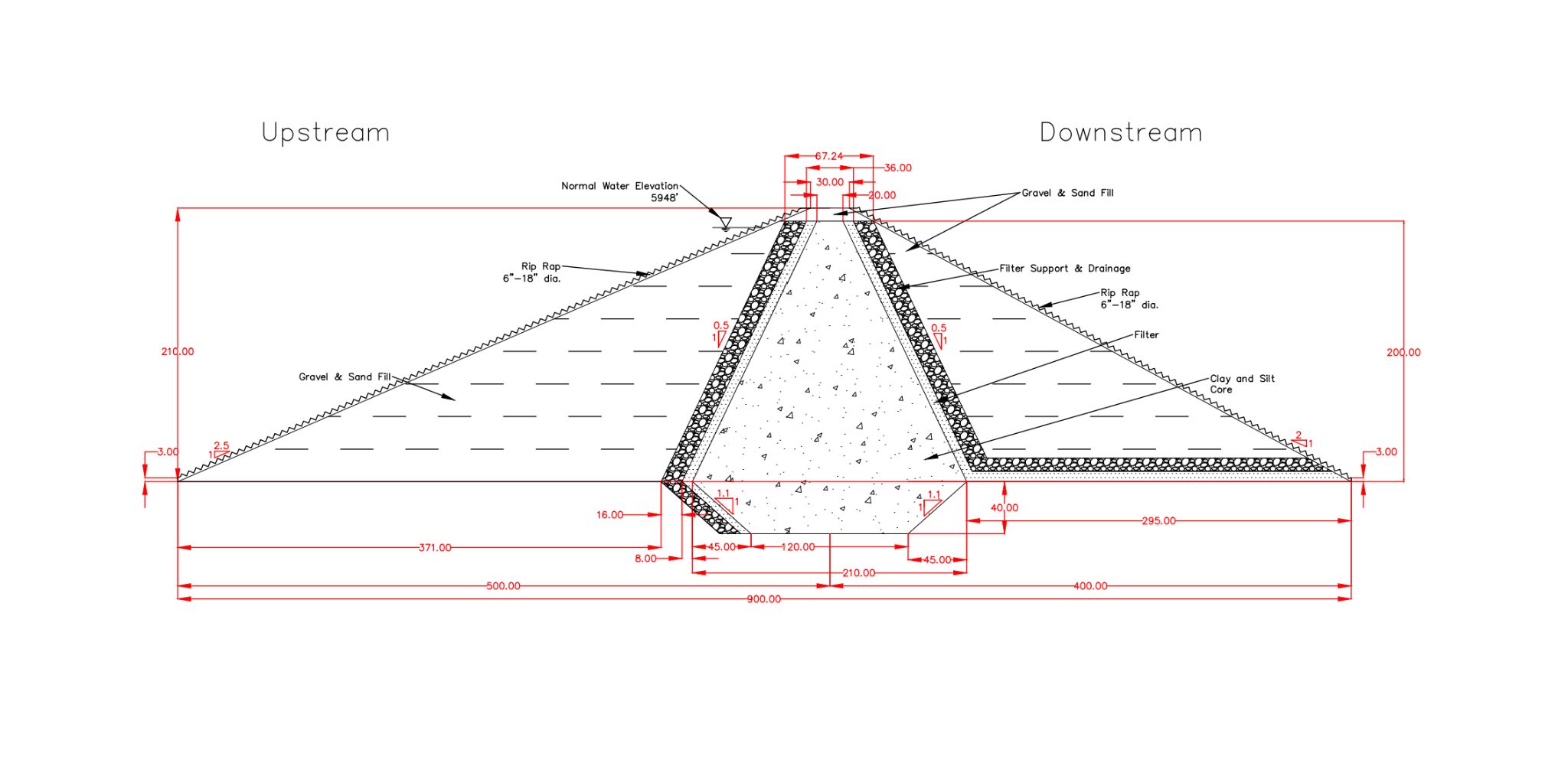
MCDC Engineering has designed an earthen dam that will store 5,000 acre-feet of water. The dimensions for the dam are 210 ft tall, 815 ft wide at the top and tapers to 350 ft wide at the bottom.

Slope stability of the Earth Dam using Slide
The dam will be made with a clay and silt core. Surrounding the core is a filter to help transport water safely through the structure. Next is the filter support and drainage that helps keep the filter from being washed out. The shell, or sand and gravel fill, will be the outer layer of the earthen dam providing strength and core protection.
The surrounding land of Blacksmith Fork Canyon will be used as materials for the dam. Other materials that cannot be found near the site will be brought in from a borrow source.
Conclusion
MCDC performed a preliminary feasibility study to determine the possibility of creating a dam up Blacksmith Fork Canyon at the intersection of Curtis Creek and Dry Curtis Creek. It is left to the client to determine if 5,000 acre-ft of water storage for Cache Valley justifies the cost of 8 million dollars.
Acknowledgements: Instructor - Professor Ball P.E. , External Mentor - Jeff Miner P.E. , Faculty Advisor - Wade Barfuss P.E.