Life of a Latinx Leader Series Provides Inspiration, Tools to Thrive in Academia
The "Life of a Latinx Leader" series features Dr. Alfonso Torres-Rua, an associate professor in Civil & Environmental Engineering.
Water
Associate Professor

Alfonso Torres-Rua is an Associate Professor in the Department of Civil and Environmental Engineering at Utah State University and Lead of the AggieAir Drone Program. His research focuses on advancing water resources management through the integration of unmanned aerial systems (UAS), satellite remote sensing, environmental modeling, and artificial intelligence.
His work develops innovative methods to monitor evapotranspiration, crop water use, plant stress, irrigation performance, and ecosystem conditions across agricultural, urban, and natural landscapes. Through collaborations in the United States, Europe, Latin America, and the Middle East, he has contributed to the development and application of remote sensing technologies for water-limited environments.
Dr. Torres-Rua's research combines physical understanding of water processes with data-driven approaches to improve decision-making for agriculture, water resources, and environmental management. His long-term vision is to enable autonomous environmental sensing systems that support resilient water management, sustainable food production, and climate adaptation in arid and semi-arid regions.
Remote Sensing, Precision Agriculture, Agricultural Water Management
My research addresses the challenge of understanding and managing water across agricultural, urban, and natural systems in a changing climate. I develop and apply drone-based, ground-based, and satellite remote sensing technologies to quantify water use, evapotranspiration, plant stress, irrigation performance, and ecosystem functioning.
A central focus of my work is the integration of environmental sensing, machine learning, computer vision, and physical process models to generate actionable information for resource managers, producers, and decision-makers. I am particularly interested in combining physics-based and data-driven approaches to improve the accuracy, scalability, and operational use of environmental monitoring systems.
Current research activities include autonomous environmental sensing, evapotranspiration estimation, precision irrigation, agricultural water management, artificial intelligence applications in remote sensing, digital agriculture, climate resilience, and water sustainability. Through these efforts, I seek to advance the development of intelligent systems that support efficient water use and resilient landscapes in arid and semi-arid regions.
Outstanding Graduate Mentor of the Year, 2022
Civil and Environmental Engineering Department
HydroLearn Educational Development Training, 2021
National Science Foundation
CEE Department Undergraduate Research Mentor of the Year, 2020
Utah State University
Visiting Professor- Agricultural Engineering, 2019
La Molina National Agrarian University
Faculty Development Symposium Scholarship, 2019
National Science Foundation
Nominee to the EPA FY 2020 membership for the Agricultural Sciences Committee , 2019
Environmental Protection Agency
Top 2017-2018 Downloaded Article, 2019
Irrigation and Drainage Journal - Wiley
UWRL Outstanding Faculty Spotlight, 2019
Utah State University
Faculty Development Symposium Scholarship, 2018
National Science Foundation
An asterisk (*) at the end of a publication indicates that it has not been peer-reviewed.
An asterisk (*) at the end of a publication indicates that it has not been peer-reviewed.
An asterisk (*) at the end of a publication indicates that it has not been peer-reviewed.
An asterisk (*) at the end of a publication indicates that it has not been peer-reviewed.
An asterisk (*) at the end of a publication indicates that it has not been peer-reviewed.
An asterisk (*) at the end of a publication indicates that it has not been peer-reviewed.
The "Life of a Latinx Leader" series features Dr. Alfonso Torres-Rua, an associate professor in Civil & Environmental Engineering.
Randy Martin, an associate research professor of environmental engineering, is one of many Utah State University faculty members who contributed to the recently completed 2021 Report to the Governor on Utah’s Land, Water, and Air.
A new grant will allow researchers to determine how water markets can be used to make water management systems more resilient. The interdisciplinary team include (left to right) Matt Yost, Niel Allen, Sarah Null, David Rosenberg, and Alfonso Torres-Rua.
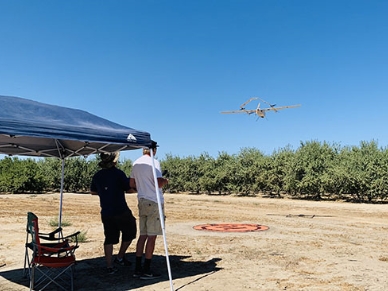
Utah State University researchers are working to make almond production more sustainable by gathering information with drones to improve water management for almond groves and increase almond yield.
AggieAir is part of several new projects funded by the Almond Board of California and the California Department of Food and Agriculture to use a variety of tools including drones, hyperspectral imagery, eddy covariance systems, and, of course, field-based...
A multidisciplinary team of researchers at Utah State University and Michigan State University have been awarded $1.97 million over 4 years from the United States Department of Agriculture to study more efficient ways of managing tart cherry sales.