
Bioremediation & Resource Biorecovery
The treatment of metals/metalloids containing effluents using biological processes is promising from the perspective of converting toxic species into non-toxic forms that could be recovered for industrial applications. Our group studies fungal transformations of toxic species of selenium, a common metalloid, into elemental selenium nanoparticles. These elemental forms are less toxic and more stable than the dissolved species, thus allowing the removal of the metalloid from effluents and potentially recovering unique valuable composites.
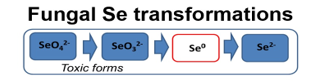
Fungal Se tranformations
SeO42- Arrow towards SeO32-
Toxic forms
Arrow towards Se0 Arrow towards Se2-

Selenium (Se) pollution
Se-containing wastewater
Agriculture drainage water
Leachates from contaminated soil
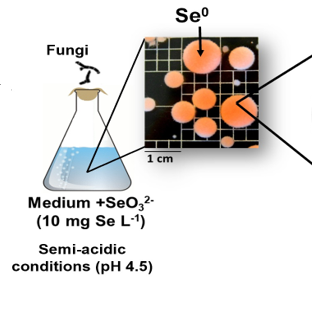
Medium +SeO32-
(10 mg se L-1)
Semi-acidic conditions (pH 4.5)
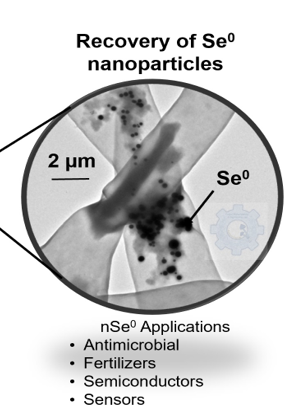
Recovery of Se0 nanoparticles
nSe0 Applications
- Antimicrobial
- Fertilizers
- Semiconductors
- Sensors
Medium +SeO32-
(10 mg se L-1)
Semi-acidic conditions (pH 4.5)
Recovery of Se0 nanoparticles
nSe0 Applications
- Antimicrobial
- Fertilizers
- Semiconductors
- Sensors