
Denitrification of Ion Exchange Brines using an Electro-Biochemical Reactor
Team: Jackson Burton, Eric Matthews, Dalline Fairbourn, Zachary Davis
Sponsor: Wes-Tech-Inc.
Abstract
The aim of the project is to investigate the feasibility of the EBR in the denitrification of Ion Exchange brines, a byproduct of ion-exchange water purification. This is being accomplished through a market analysis, bench-scale test, computer model, and genetic analysis.
Background
Ion Exchange (IX) has been proven to efficiently clean groundwater from nitrates and other unwanted contaminants. Unfortunately, it produces a concentrated IX brine that is difficult to dispose of. IX brines are often disposed of with unreliable and unsustainable methods such as evaporation ponds, wastewater treatment plants, or by simply dumping them in the ocean [1].
The Electro-Biochemical Reactor (EBR) presents a cost-effective solution for treatment of IX brines. An EBR uses an electric current instead of organic matter to provide microbes with necessary electrons. These microbes reduce nitrate and nitrite to gaseous nitrogen through a process called denitrification. Thus, the hazardous IX brines can be safely and economically disposed of.
Methods
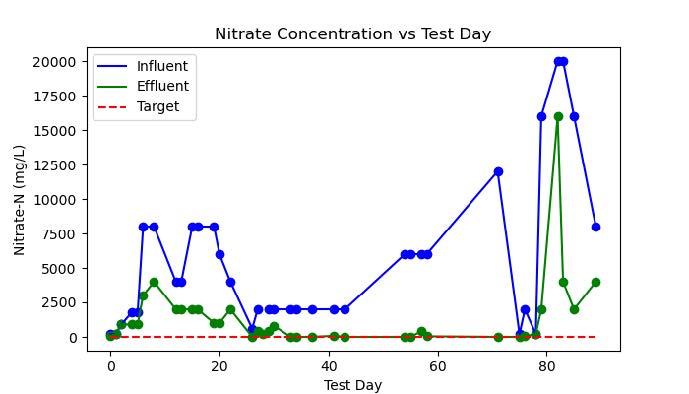
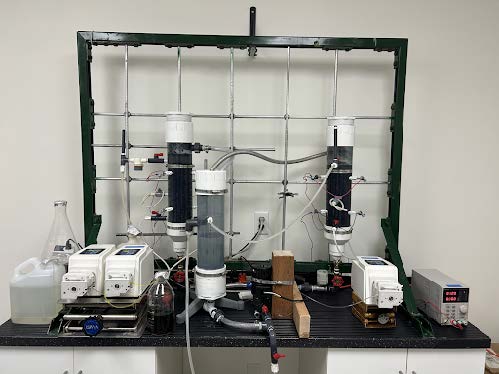
A two-stage benchtop EBR was operated with IX brine samples from California and Kansas. Samples were taken daily at five points
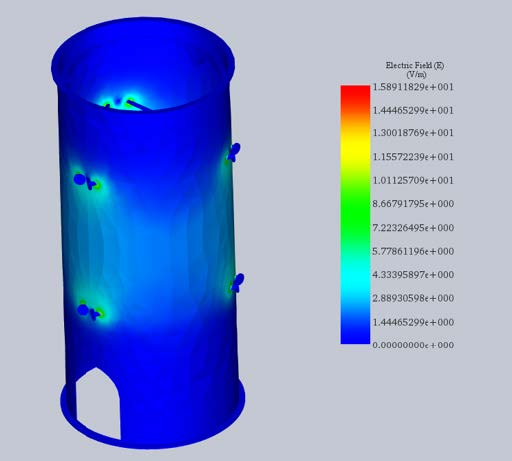
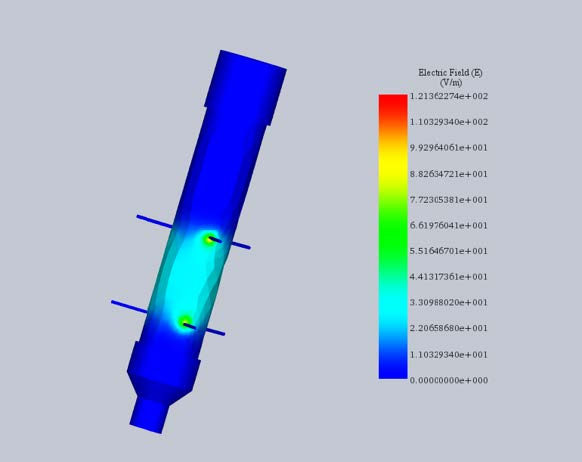
Bench and an industrial scale models of the EBR were generated using EMWorks Electromagnetic Simulation software
A market analysis was conducted to determine demand and necessary cost range of an IX brine solution.
The microbes were identified using Genewiz metagenomic 16S population analysis.
Results
Bench-scale EBR
Market Analysis
- There are an estimated 1,155 communities in need of nitrate removal solutions in the United States [2]
- Estimated market for IX brine treatment is 231.9 million USD/year
Scale models of EBR
Genetic Analysis
- DNA extraction was delayed due to sampling challenges, but results are currently being processed.
Conclusion
This study demonstrates the feasibility of the electro-biochemical reactor in the denitrification of IX brines. This has the potential to become a cheaper and environmentally safe method of disposing of IX brines.
Future testing will analyze the stress capacity of the microbes with different conditions and IX brine compositions.
References
- Ola Opara. EBR Denitrification of IX Brines. 2022.
- America’s Nitrate Habit Is Costly and Dangerous | Environmental Working Group [Internet]. 2018 [cited 2023 Mar 26]. Available from: https://www.ewg.org/research/nitratecost
- Panagopoulos A, Haralambous K-J, Loizidou M. Desalination brine disposal methods and treatment technologies - A review. Science of The Total Environment. 2019;693:133545.